


Environmental advocates yesterday called for action to reverse alleged breakdown of the algal reef near the third liquefied natural gas (LNG) terminal at Guantang Industrial Port (觀塘工業港), saying it was likely caused by the construction of the terminal over the past few years.
The terminal, known as the Guantang LNG Plant in Taoyuan’s Guanyin District (觀音), is run by CPC Corp, Taiwan after the company obtained development rights in 2017 through acquisition of Tungting Liquefied Gas Industrial Co, the original developer.
Construction began in November 2019 after the then-Environmental Protection Administration’s environmental impact assessment committee approved the project and proposed measures against potential environmental impact.
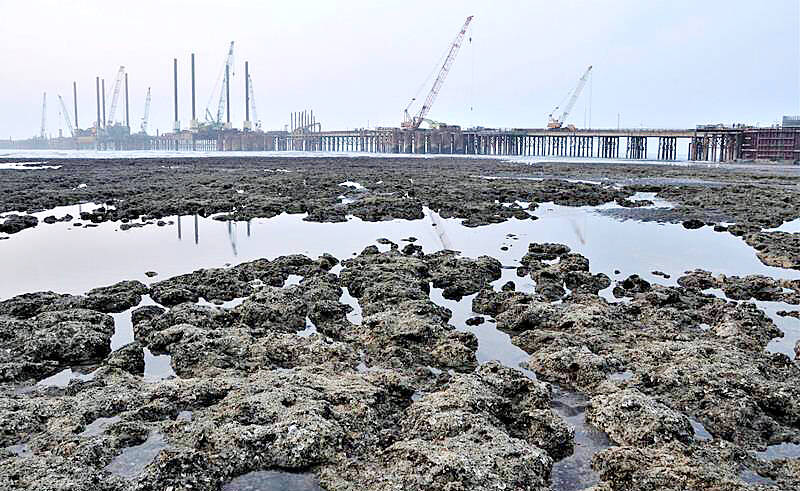
Photo: Taipei Times
The terminal came online in May last year.
Environmentalist Pan Chong-cheng (潘忠政), who initiated a referendum in 2020 aiming to relocate the terminal, yesterday told a news conference that algal reefs in the district are the largest remaining habitat for Polycyathus isabela a Taiwanese endemic coral species classified as critically endangered.
The algal reef ecosystem along the coast of the district was divided into G1, G2 and G3 zones when the construction project was delineated, with G1 zone being the nearest to the construction site.
He showed underwater photos taken by environmental groups of the crustose coralline algae — which cement the reef, aiding reef-building corals — in G1 zone decreasing from 84 percent coverage in April 2019 to about 10 percent in April 2023.
Caissons used in the project disrupted the ooze layer, burying the algal reefs in G2 zone in ooze, while the newly built port diverted sea currents, leading to sand accumulating along the coast, Pan said.
This is why pieces of dead algal reef proliferated after construction began in 2019, he said, adding that the accumulated sand and ooze near the reefs has become inhabited by non-reef-building algae.
Pan asked CPC to conduct an investigation with environmentalists during low tide on Wednesday morning next week to find out whether the observation results were true.
He urged government authorities to establish a response unit to reverse the algal reef decline.
CPC representative Huang Chih-chien (黃志堅) said sand accumulation fluctuated mainly with seasonal climate effects such as typhoons and the northeast monsoon every December.
Regarding ooze stirred up by caisson construction, Huang said they were placed indirectly on the seabed with a layer of pads and a layer of stones in between.
The project used more than 300 caissons, a number “disproportionate” to the vastness of the ocean, he said, adding that improperly discharged industrial sludge could be a cause of the siltation.
The shrinking coverage of crustose coralline algae could be caused by rising sea temperatures and increased seawater turbidity along the west coast of Taiwan, rather than solely by the siltation, Huang said, citing research by National Taiwan Ocean University.
CPC would cooperate in conducting on-site investigations along with representatives from environmental groups to examine algal reef conditions, as well as provide research data for review, he said.
University vice president and aquaculture professor Nan Fan-hua (冉繁華) said research showed that coral growth does change with sea temperatures and seawater turbidity.
Reef-building coralline algae are declining while the non-reef-building types are increasing not only around the construction site, but in other areas of the sea, he said, adding that damage caused by siltation to algae reefs at the tissue level could be restored after the ooze and sand is removed.
The university has achieved fruitful outcomes in the restoration of Polycyathus isabela, Nan said.

REASONS FOR TRAVEL: An assistant professor said that proposed amendments to penalize drivers if they used drugs overseas would not deter people from traveling People who operate a motor vehicle under the influence of marijuana would have their driver’s license revoked, even if they used the substance while overseas, the Ministry of Transportation and Communications said yesterday, citing proposed amendments to the Road Traffic Management and Penalty Act (道路交通管理處罰條例). The amendments would also authorize the government to revoke the licenses of people determined to have used Category 1 or Category 2 narcotics, even if they were not operating a vehicle while under the influence of drugs, as well as ban them from taking the license test for three years, the ministry said. People aged 18 or

GLOBALGIVING: ‘ Caving to external pressure is not acceptable for an organization that has cultivated justice reform and human rights for 30 years,’ one NGO said A slew of non-government organizations (NGOs) have withdrawn from the GlobalGiving fundraising platform after it announced it would use “Chinese Taipei” instead of “Taiwan” from next month. The Taiwan Good Rice Association wrote on Facebook on Friday that it was informed on April 28 via a teleconference call of the change, which was made because the platform wanted to operate in China. Taiwan Good Rice is to terminate all cooperative relationships with GlobalGiving in response to the platform’s “unilateral and non-negotiable” decision to remove references to Taiwan, the NGO said. “Taiwan is in the official name of Taiwan Good Rice Association and the

HEAVY WEATHER: Typhoon Jangmi is due to crash straight into the Ryukyus as airlines look to shift flights to larger aircraft or cancel flights to Okinawa entirely Taiwan’s international air carriers announced flight adjustments over the weekend as Typhoon Jangmi is forecast to hit the Ryukyu Islands today and tomorrow. The Central Weather Administration (CWA) upgraded Jangmi from a tropical storm to a typhoon at 8am yesterday, with the eye located 580km south of Naha city. It was moving north at 19kph. Today, China Airlines’ CI-120, CI-121, CI-122 and CI-123 flights between Taoyuan and Naha, Okinawa, have been canceled as well as CI-132 and CI-133 between Kaohsiung and Naha. EVA Air’s BR-112, BR-113, BR-186 and BR-185 flights between Taoyuan and Naha are also canceled. Low-cost carrier Tigerair Taiwan canceled IT-230,
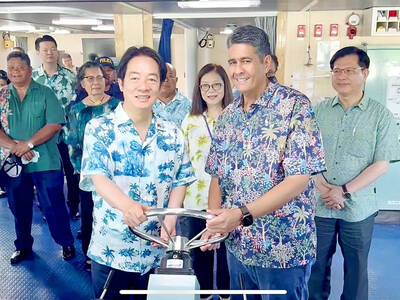
MULTIPRONGED APPROACH: China has sought to pressure Palau across a number of fronts, but the island nation has staunchly resisted overtures to ditch Taiwan Palau has been firm in backing Taiwan despite Chinese pressure that uses tourism economics, cyberattacks and criminal infiltration as tools to threaten the Pacific ally into renouncing its recognition of Taiwan as a sovereign state. The Presidential Office yesterday announced that Vice President Hsiao Bi-khim (蕭美琴) would visit Palau from Saturday to Wednesday next week at the invitation of Palauan President Surangel Whipps Jr. Whipps in April said in an interview that China had outspokenly asked Palau to “denounce Taiwan.” “And we have said: ‘We have no enemies, but nobody tells us who our friends are,’” he said. Whipps has told reporters multiple times


 RSS
RSS