


The Highway Bureau and New Taipei City are hosting events between April 25 and May 9 allowing people to experience the Danjiang Bridge (淡江大橋) before it officially opens on May 12.
The construction of the 920m-long asymmetric single-tower cable-stayed bridge, the longest of its type in the world, is scheduled to be completed in April.
Designed by the late Iraqi-British architect Zaha Hadid, the bridge was chosen by CNN as one of the “11 architecture projects set to shape the world” last year.
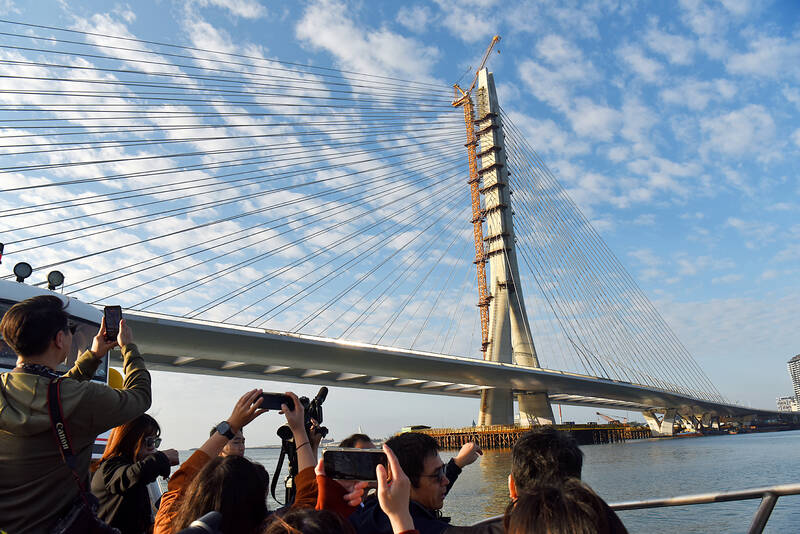
Photo: Wu Liang-yi, Taipei Times
Once open, the bridge would cut the travel distance between Tamsui (淡水) and Bali (八里) districts in New Taipei City by about 15km, saving about 25 minutes of driving time.
It would ease congestion on Provincial Highway No. 2 by reducing traffic in Jhuwei (竹圍) by 17 percent and on the Guandu Bridge (關渡大橋) by 30 percent.
The bridge would function as an important link among Expressway No. 61, Provincial Highway 15 and Expressway No. 64, forming a comprehensive expressway network and serving as a major access route for the Danhai New Town (淡海新市鎮).
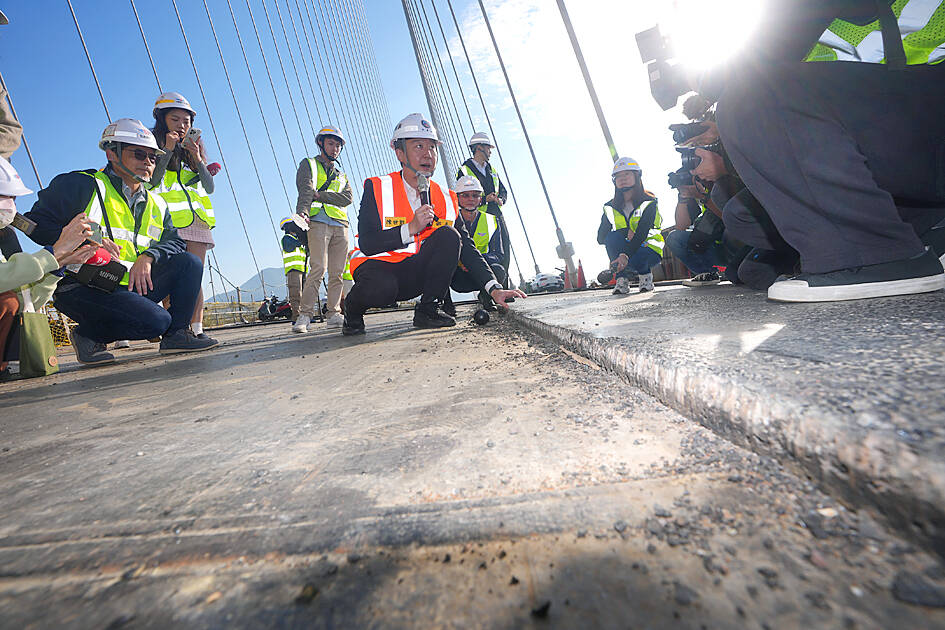
Photo: CNA
Aside from a road run on April 18 and cycling race on April 19, people are invited to walk over the bridge on April 25 and join a parade on April 26, the bureau said, adding that artistic groups in Tamsui would be performing at the parade.
The Highway Bureau is to hold an evening concert on May 2, featuring performances of a symphony orchestra and a Golden Melody Award-winning Hakka musician.
On May 3, organizers would place 100 deck chairs on the bridge for people to lie down. The bridge would be open for public picnics that day.
An inauguration ceremony would be held on the night of May 9, where engineers and workers involved in the construction of the bridge would be invited to attend.
The Tamsui-based Cloud Gate Dance Theatre — whose performances inspired the design of the bridge — would present a brand new work titled Light Chain (光鏈) at the ceremony.
Organizers are hosting photography and painting contests for the bridge opening, accepting submissions until March 31.
Construction of the bridge hit another milestone this week with the completion of the pavement, Minister of Transportation and Communications Chen Shih-kai (陳世凱) told reporters while inspecting construction progress yesterday.
To ensure durability of the steel bridge, the construction team first applied GUSS asphalt concrete, which was created by blending petroleum asphalt and processed Trinidad lake asphalt, before applying regular asphalt, Chen said.
The GUSS asphalt concrete would prevent rain from seeping into the steel bed base and avoid corrosion-induced steel fatigue and damage, Chen said.
Installing lamp posts on the bridge is another challenging task, Chen said.
The height of 128 lamp posts varies from 10m to 27m, and the angle at which they are installed ranges from 20 to 70 degrees.
The construction crew can only install two long lamp posts per day using two large cranes, Chen said.
Cheng Ming-chung (鄭閔中), chief of the bureau’s northern region new construction branch office, said that the bridge was designed to last for 120 years with the combined use of weathering steel, a heavy-duty coating system and GUSS pavement.
The stay cables, which are the most outstanding feature of the bridge, serve as the core support structure, Cheng said.
Each cable is equipped with a damper and a fire-proof blanket, which prevent it from being damaged by earthquakes, strong winds and fire, Cheng said.
The bridge is equipped with seven hydraulic fuse restraints (HFR) on the main bridge tower, with each providing a damping force of 750 tonnes, he said.
The system is designed to remain undamaged during frequent earthquakes, and to sustain only minor damage during rare major earthquakes, which can be manually reset, thereby ensuring the structural stability and long-term safety of the main bridge, Cheng said.
The bridge is an authentic international project, he said.
“The bridge was designed by a British architect, steel cables were made in Austria, steel guardrails were manufactured in Italy, and HFRs and bridge expansion joints were produced in Switzerland. The curved formwork for the bridge tower was made by Peri Co, a German firm,” Cheng said.
The construction team has engineers from Japan, Germany, UK, the Philippines and Cambodia, Cheng added.
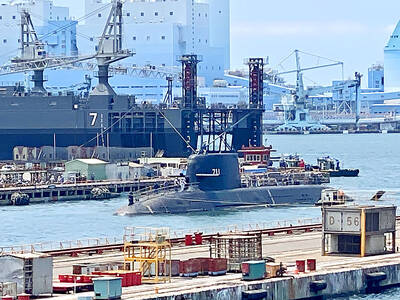
AGING: While Japan has 22 submarines, Taiwan only operates four, two of which were commissioned by the US in 1945 and 1946, and transferred to Taiwan in 1973 Taiwan would need at least 12 submarines to reach modern fleet capabilities, CSBC Corp, Taiwan chairman Chen Cheng-hung (陳政宏) said in an interview broadcast on Friday, citing a US assessment. CSBC is testing the nation’s first indigenous defense submarine, the Hai Kun (海鯤, Narwhal), which is scheduled to be delivered to the navy next month or in July. The Hai Kun has completed torpedo-firing tests and is scheduled to undergo overnight sea trials, Chen said on an SET TV military affairs program. Taiwan would require at least 12 submarines to establish a modern submarine force after assessing the nation’s operational environment and defense

Yangmingshan National Park authorities yesterday urged visitors to respect public spaces and obey the law after a couple was caught on a camera livestream having sex at the park’s Qingtiangang (擎天崗) earlier in the day. The Shilin Police Precinct in Taipei said it has identified a suspect and his vehicle registration number, and would summon him for questioning. The case would be handled in accordance with public indecency charges, it added. The couple entered the park at about 11pm on Thursday and began fooling around by 1am yesterday, the police said, adding that the two were unaware of the park’s all-day live
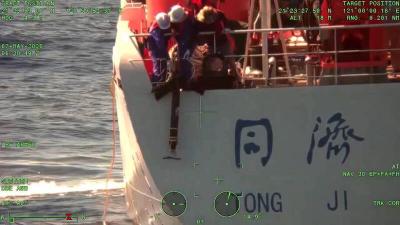
The coast guard today said that it had disrupted "illegal" operations by a Chinese research ship in waters close to the nation and driven it away, part of what Taipei sees a provocative pattern of China's stepped up maritime activities. The coast guard said that it on Thursday last week detected the Chinese ship Tongji (同濟號), which was commissioned only last year, 29 nautical miles (54km) southeast of the southern tip of Taiwan, although just outside restricted waters. The ship was observed lowering ropes into the water, suspected to be the deployment of scientific instruments for "illegal" survey operations, and the coast

A former soldier and an active-duty army officer were yesterday indicted for allegedly selling classified military training materials to a Chinese intelligence operative for a total of NT$79,440. The Taipei District Prosecutors’ Office indicted Chen Tai-yin (陳泰尹) and Lee Chun-ta (李俊達) for contravening the National Security Act (國家安全法) and the Anti-Corruption Act (貪污治罪條例). Chen left the military in September 2013 after serving alongside then-staff sergeant Lee, now an army lieutenant, at the 21st Artillery Command of the army’s Sixth Corps from 2011 to 2013, according to the indictment. Chen met a Chinese intelligence operative identified as “Wang” (王) through a friend in November


 RSS
RSS