


The Executive Yuan yesterday proposed a bill to raise the monthly subsidy for older farmers to NT$10,000 (US$317) from NT$8,110, requiring a budget increase of NT$12.9 billion.
The changes to articles 2, 4 and 7 of the Provisional Act Governing the Welfare Allowance for Elderly Farmers (老年農民福利津貼暫行條例) would loosen means-testing rules and increase the subsidy amount.
The bill would be submitted to the Legislative Yuan for review.
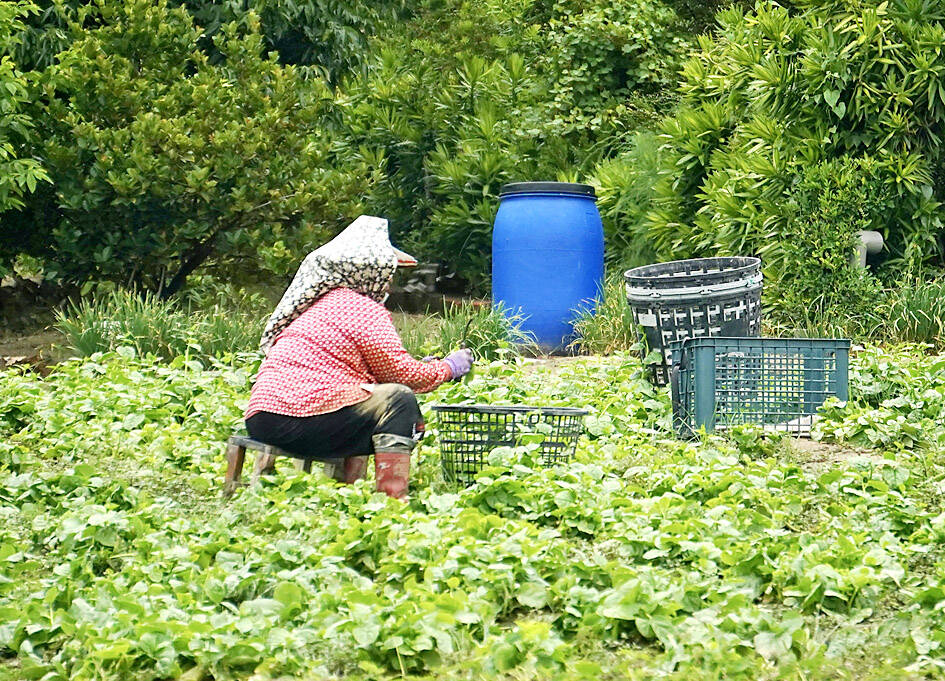
Photo: CNA
The ceiling for non-agricultural taxable income would be raised from NT$500,000 to NT$600,000, and the land and housing property value limit would rise from NT$5 million to NT$10.25 million, the draft says, citing changes in calculation, including agriculture-related gains and general income.
Eligibility thresholds of means-testing rules have remained unchanged for more than 13 years, despite rising prices and asset values, the Cabinet said.
The proposal also removes the upper limit on deductions for an applicant’s sole self-occupied residence to prevent exclusion due to housing needs.
Under the new mechanism, the amounts would be adjusted quadrennially, and the amount disbursed would be reviewed biennially, or when the consumer price index increases by 3 percent or more, to combat short-term commodity price inflation.
About 14,505 people are ineligible for farmers’ subsidies, the Executive Yuan said.
About 7,000 farmers are expected to benefit from the amendment and become eligible for the older farmer subsidy, bringing the total number of people eligible for the subsidies nationwide to 530,000, it said.
Executive Yuan spokesperson Michelle Lee (李慧芝) quoted Premier Cho Jung-tai (卓榮泰) as saying that the amendment affirms farmers’ contributions to the nation and that they deserve care in their old age.
The changes require a supplementary budget, which could only be pursued after the central government’s annual budget for this year is passed, Lee said, urging the Legislative Yuan to expedite its passage.
The amendment would also affect the general review of other welfare subsidies, Cho added.
All subsidies would adhere to the principles of guaranteeing people’s livelihoods, protecting the disadvantaged and maintaining the nation’s overall fiscal health, he said.
Deputy Minister of Agriculture Hu Chung-yi (胡忠一) said the NT$10,000 amount was decided based on concerns about negative population growth, particularly over the next four decades.
The senior farmer allowance program was launched in 1995.
Farmers aged 65 or older who have been enrolled in farmers’ insurance for at least 15 years are eligible for the monthly benefit, which was initially set at NT$3,000 and raised to NT$7,000 in 2011.
The allowance was last adjusted to NT$8,110 in 2024.

Considering that most countries issue more than five denominations of banknotes, the central bank has decided to redesign all five denominations, the bank said as it prepares for the first major overhaul of the banknotes in more than 24 years. Central bank Governor Yang Chin-lung (楊金龍) is expected to report to the Legislative Yuan today on the bank’s operations and the redesign’s progress. The bank in a report sent to the legislature ahead of today’s meeting said it had commissioned a survey on the public’s preferences. Survey results showed that NT$100 and NT$1,000 banknotes are the most commonly used, while NT$200 and NT$2,000

The Centers for Disease Control (CDC) yesterday reported the first case of a new COVID-19 subvariant — BA.3.2 — in a 10-year-old Singaporean girl who had a fever upon arrival in Taiwan and tested positive for the disease. The girl left Taiwan on March 20 and the case did not have a direct impact on the local community, it said. The WHO added the BA.3.2 strain to its list of Variants Under Monitoring in December last year, but this was the first imported case of the COVID-19 variant in Taiwan, CDC Deputy Director-General Lin Ming-cheng (林明誠) said. The girl arrived in Taiwan on

South Korea is planning to revise its controversial electronic arrival card, a step Taiwanese officials said prompted them to hold off on planned retaliatory measures, a South Korean media report said yesterday. A Yonhap News Agency report said that the South Korean Ministry of Foreign Affairs is planning to remove the “previous departure place” and “next destination” fields from its e-arrival card system. The plan, reached after interagency consultations, is under review and aims to simplify entry procedures and align the electronic form with the paper version, a South Korean ministry official said. The fields — which appeared only on the electronic form

The Ministry of Foreign Affairs (MOFA) is suspending retaliation measures against South Korea that were set to take effect tomorrow, after Seoul said it is updating its e-arrival system, MOFA said today. The measures were to be a new round of retaliation after Taiwan on March 1 changed South Korea's designation on government-issued alien resident certificates held by South Korean nationals to "South Korea” from the "Republic of Korea," the country’s official name. The move came after months of protests to Seoul over its listing of Taiwan as "China (Taiwan)" in dropdown menus on its new online immigration entry system. MOFA last week


 RSS
RSS