


Most of the NT$1.25 trillion (US$39.57 billion) special defense budget is for arms procurement from other countries, while NT$300 billion would go toward domestic defense production, Deputy Minister of National Defense Hsu Szu-chien (徐斯儉) said yesterday.
Hsu was responding to a comment by Taiwan People’s Party (TPP) Chairman Huang Kuo-chang (黃國昌) on Wednesday that only NT$300 billion of the budget is for arms procurement from the US.
Huang, who returned from a visit to the US on Wednesday, said he made the discovery after meeting unnamed officials in Washington.
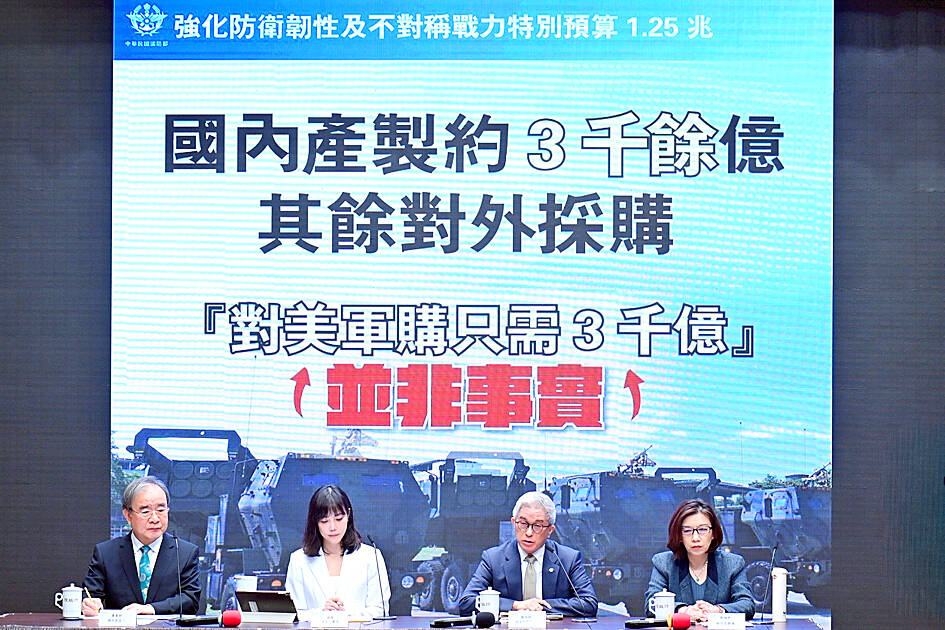
Photo: Chen Yu-fu, Taipei Times
The figure is closer to NT$900 billion, Hsu told the post-Cabinet meeting news conference, calling Huang’s claim “absolutely false.”
Hsu rejected accusations from Huang that the budget proposal lacked clarity and that it only earmarked small portions for weapon purchases.
As Taiwan is facing escalating threats, the military must have a higher budget to expedite the acquisition of needed weapon systems and to enhance combat readiness, Hsu said.
The proposal already contains known weapons procurements for US-made High Mobility Artillery Rocket Systems, M109A7 Paladin howitzers, Altius attack drones, Javelin anti-tank missiles, and tube-launched, optically tracked, wire-guided 2B guided missiles, he said.
The Ministry of National Defense would explain classified portions of the spending plan to lawmakers at a classified meeting on Monday, he added.
Hsu also refuted an insinuation by opposition parties that the special defense budget “gives a blank check” to the government, citing past instances in which special budget ceilings were first approved by the legislature before individual items were considered.
He was likely referring to special budgets proposed between February 2016 and February 2024, when the ruling Democratic Progressive Party (DPP) held a majority in the legislature.
The NT$300 billion earmarked for domestic defense production would create more than 90,000 jobs and boost industrial output by NT$400 billion, Cabinet spokeswoman Michelle Lee (李慧芝) said.
Meanwhile, the US Department of State yesterday said that Washington strongly supports Taiwan’s efforts to share in defense responsibilities, including by bolstering its defense and deterrence capabilities through reforms and increased defense spending.
The US also welcomed President William Lai’s (賴清德) plan to increase military expenditure to more than 3 percent of GDP this year and to 5 percent of GDP by 2030.
The American Institute in Taiwan (AIT) reiterated that it welcomes the NT$1.25 billion special defense budget, as AIT Director Raymond Greene wrote on social media on Nov. 26 last year.
“The United States supports Taiwan’s rapid acquisition of critical asymmetric capabilities needed to strengthen deterrence, consistent with the Taiwan Relations Act and decades of commitment across multiple US administrations,” Greene said in the post.
DPP Legislator Wang Ting-yu (王定宇) said that US officials rebutted the claims made by opposition parties and its backers, who are attempting to mislead the public about the special defense budget.
Huang has contrived to misrepresent the meetings he had with US officials in Washington, Wang said.
After returning from the US, Huang and his TPP delegation have again stated their opposition to reviewing the special defense budget by citing a “lack of clarity” on how the money would be spent, as they say a “relatively high proportion” would not be allotted to US arms purchases, he added.

FUKUOKA SITUATION: Japanese media reported that the pathogen is expected to be identified by the summer, while the CDC downplayed the idea that it was hMPV A “mysterious cold-like illness” reported in Japan’s Fukuoka Prefecture does not seem to be a new disease, but Japanese authorities have been asked about the situation, the Centers for Disease Control (CDC) said yesterday. The Fukuoka Prefectural Medical Association on Wednesday told a news conference that a “mystery cold” that has become a hot topic on social media is “highly likely to be caused by some kind of viral infection,” Japan’s KBC News reported. “Many people are experiencing symptoms starting with a sore throat, followed by a runny nose, phlegm and a severe cough,” KBC News reported, citing association officials. Health authorities are

Nvidia Corp CEO Jensen Huang (黃仁勳) arrived in Taiwan yesterday ahead of upcoming AI and technology events, saying he plans to meet with clients and Taiwan Semiconductor Manufacturing Co Chairman C.C. Wei (魏哲家) during his visit. After landing at Taipei Songshan Airport, Huang posed for photos with fans and handed out Yakult drinks to reporters and supporters waiting at the scene, saying he has “a lot to do” during the trip. Asked about reports that Nvidia’s planned headquarters site in Taipei’s Beitou Shilin Technology Park could break ground on May 27, Huang said that if the company holds an event, he would

The Ministry of Finance this afternoon announced the winning numbers for the March-April uniform invoice lottery. The winning number for the NT$10 million (US$318,060) special prize is 19531471, and the winning number for the NT$2 million grand prize is 85941329. Three numbers were drawn for the NT$200,000 first prize: 07225810, 20231230 and 83518781. Those with receipts matching the last seven digits of any of the first-prize numbers will win the NT$40,000 second prize, while those matching the last six digits will win the NT$10,000 third prize. Those whose receipts match the last five digits of the first-prize numbers can claim the NT$4,000 fourth prize,
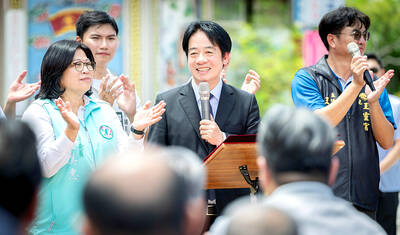
SIX SUBSIDIES: The monthly allowance for older farmers is to increase to NT$10,000, and NT$5,000 is to be given to homemakers under the national pension system, Lai said The government is to implement major welfare policies for disadvantaged groups, including raising the monthly allowance for older farmers to NT$10,000 and providing homemakers with NT$5,000 per month, President William Lai (賴清德) said yesterday. Lai made the remarks during a visit to Wangling Temple in Chiayi County, saying that the planned increases were being introduced amid economic growth and an increase in tax revenue. Touting a policy, in which the government plans to provide a monthly allowance of NT$5,000 for every child under the age of 18 in a bid to address Taiwan’s low birthrate, Lai said that if received for the


 RSS
RSS