


More US arms sales to Taiwan are in the pipeline, with four deals pending notification to the US Congress, Deputy Minister of National Defense Hsu Szu-chien (徐斯儉) said today, following the announcement of a US$11 billion package last month, the largest ever for the nation.
The US is Taiwan's most important international backer and arms supplier, despite a lack of formal diplomatic ties.
Speaking to reporters in Taipei after a weekly Cabinet meeting, Hsu said that four additional packages for Taiwan had yet to be formally notified to Congress, the usual process for approval of such sales.
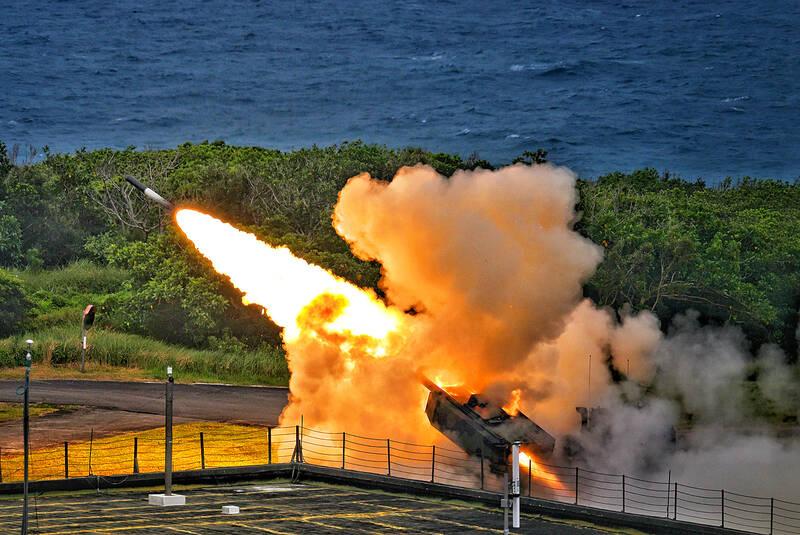
Photo: Chen Yi-kuan, Taipei Times
"Don't ask me what four these are, I cannot say, but there are still four cases yet to be notified to Congress," Hsu said, adding that he could not say more for legal reasons.
The US Department of State did not immediately respond to a request for comment outside Washington business hours.
The arms sales announced last month cover eight items, including Lockheed Martin High Mobility Artillery Rocket Systems and Altius loitering munition drones.
In November last year, President Willaim Lai (賴清德) unveiled a NT$1.25 trillion (US$39.59 billion) special defense budget from this year to 2033 to underscore Taiwan’s determination to defend itself in the face of the rising threat from China.
However, the Chinese Nationalist Party (KMT) and Taiwan People’s Party, which together hold a majority in the legislature, have not let the budget progress to the committee stage for review, saying that the spending details are vague and that they want more details.
Minister of National Defense Wellington Koo (顧立雄) would give lawmakers a confidential briefing on Monday next week, and the ministry is happy to share more details, Hsu said.
"It is not that we are unwilling to explain — give us an opportunity to explain, a legal opportunity," Hsu said. "This is not a black box."
The administration of US President Donald Trump has strongly backed Taiwan's plans to ramp up military spending, something it has been pushing its allies in Europe in particular to do.
Taiwan has to spend more given the threat, Hsu said.
"Everyone knows the threat we are facing is growing and growing," he added.
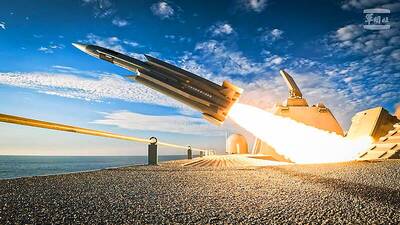
DETERRENCE: With 1,000 indigenous Hsiung Feng II and III missiles and 400 Harpoon missiles, the nation would boast the highest anti-ship missile density in the world With Taiwan wrapping up mass production of Hsiung Feng II and III missiles by December and an influx of Harpoon missiles from the US, Taiwan would have the highest density of anti-ship missiles in the world, a source said yesterday. Taiwan is to wrap up mass production of the indigenous anti-ship missiles by the end of year, as the Chungshan Institute of Science and Technology has been meeting production targets ahead of schedule, a defense official with knowledge of the matter said. Combined with the 400 Harpoon anti-ship missiles Taiwan expects to receive from the US by 2028, the nation would have
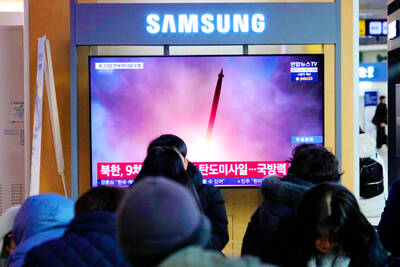
North Korea yesterday fired about 10 ballistic missiles to the sea toward Japan, the South Korean Joint Chiefs of Staff (JCS) said, days after Pyongyang warned of “terrible consequences” over ongoing South Korea-US military drills. Pyongyang recently dashed hopes of a diplomatic thaw with Seoul, Washington’s security ally, describing its latest peace efforts as a “clumsy, deceptive farce.” Seoul’s military detected “around 10 ballistic missiles launched from the Sunan area in North Korea toward the East Sea [Sea of Japan] at around 1:20pm,” JCS said in a statement, referring to South Korea’s name for the body of water. The missiles

‘UNWAVERING FRIENDSHIP’: A representative of a Japanese group that co-organized a memorial, said he hopes Japanese never forget Taiwan’s kindness President William Lai (賴清德) yesterday marked the 15th anniversary of the Tohoku earthquake and tsunami, urging continued cooperation between Taiwan and Japan on disaster prevention and humanitarian assistance. Lai wrote on social media that Taiwan and Japan have always helped each other in the aftermath of major disasters. The magnitude 9 earthquake struck northeastern Japan on March 11, 2011, triggering a massive tsunami that claimed more than 19,000 lives, according to data from Japanese authorities. Following the disaster, Taiwan donated more than US$240 million in aid, making it one of the largest contributors of financial assistance to Japan. In addition to cash donations and
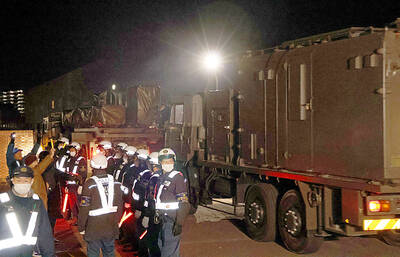
CLOSER TO CHINA: The upgraded Type-12 missile has a range of about 1,000km, compared with the original model’s range of 200km, and can reach mainland China Japan is preparing to deploy its first batch of domestically developed long-range missiles, with their launchers arriving at an army camp yesterday, as the country accelerates its offensive capability in response to rising challenges in the region. The upgraded Type-12 land-to-ship missiles are to be deployed at Camp Kengun in Japan’s southwestern prefecture of Kumamoto by the end of this month, completing the process of deployment, Japanese Chief Cabinet Secretary Minoru Kihara said without giving details. Army vehicles carrying the launchers and other equipment arrived past midnight in a highly secretive mission criticized by residents. Dozens of people stood outside of the


 RSS
RSS