


Parents’ groups yesterday urged that the debate over a proposed amendment to the Assisted Reproduction Act (人工生殖法) consider the need for greater disclosure to patients of potential health risks associated with assisted reproduction.
“Before any amendments are made, stakeholders should disclose impact assessment reports and clarify whether any related risks have been overlooked,” Action Alliance on Basic Education chairman Wang Han-yang (王瀚陽) said at a news conference in Taipei.
Wang said the three parents’ groups at the news conference were not against the proposed amendment, which would grant single women and married female couples access to assisted reproductive technology.
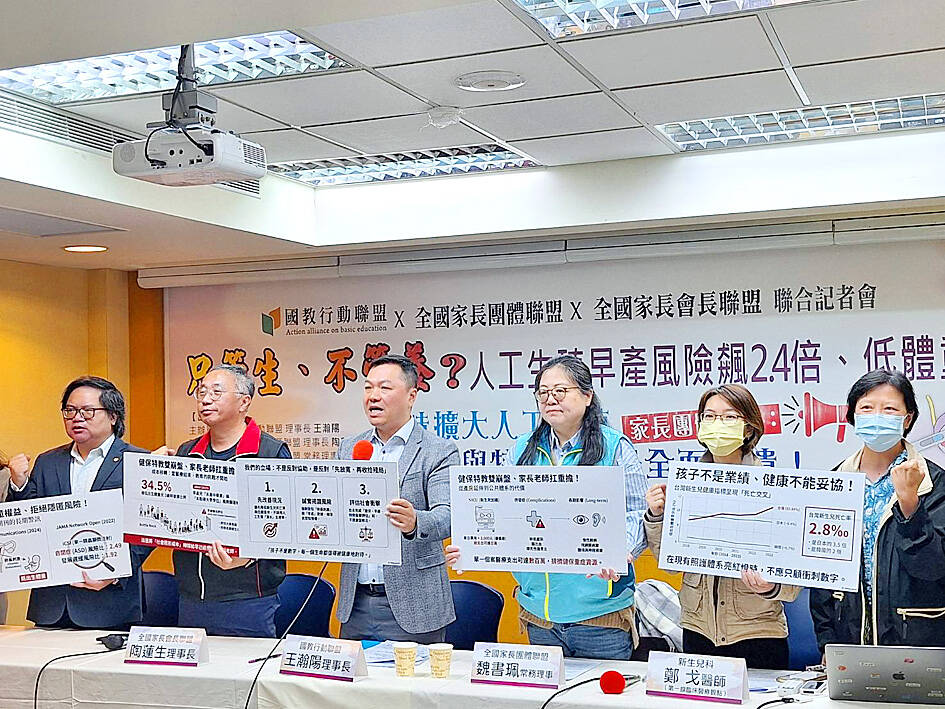
Photo: CNA
However, assisted reproductive technology-related health risks have not been fully addressed in public hearings or legislative deliberations related to the proposed amendment, he said.
Article 12 of the Assisted Reproduction Act currently stipulates that a medical institution must explain “any possible complications or hazards” of assisted reproduction to the recipient couple, without clearly spelling out what information must be disclosed.
Wang said that the “possible complications or hazards” cited in Article 12 mainly focus on risks to the woman during pregnancy rather than the potential health risks for the child.
Those child-related risks, including preterm and underweight births, should be clearly included in the informed consent form signed by both parties, and medical institutions should be required to ensure that applicants fully understand the information, he said.
He called for those specific disclosure requirements to be written into the law.
To push for such changes, Wang said parents’ groups reached out to lawmakers and the Ministry of Health and Welfare yesterday, and planned to hold meetings to press their case.
Among the risks is that babies conceived through assisted reproductive technology have a prematurity rate (defined as delivery before 37 weeks of pregnancy) of 26.4 percent, Health Promotion Administration 2023 data showed, Wang said.
The 26.4 percent rate was about 2.4 times the national average, he said.
Also, the low birth weight rate, defined as weighing less than 2.5kg at birth, was 25.7 percent among assisted reproductive technology births, about 2.3 times the national average, he added.
In a prerecorded video, neonatologist Cheng Yi (鄭弋) said preterm infants conceived through assisted reproduction tend to have poorer lung function because their lungs are not fully developed, and that the gap with full-term infants could persist into adulthood.
Low birth weight babies are 2.5 times more likely to develop diabetes later in life than those born at a normal weight, Cheng said.
“We can help them survive and grow up, but the problem is their health might still not be good,” Cheng added.
Wang said preterm birth and low birth weight are also “major risk factors” for developmental delays, and that children with these issues often need long-term medical rehabilitation and special education support.
He said that if the proposed amendment led to a surge in newborns at high risk of health complications, the already strained National Health Insurance system and special education services could be pushed to the brink.

A magnitude 6.1 earthquake struck off the coast of Yilan County at 8:39pm tonight, the Central Weather Administration (CWA) said, with no immediate reports of damage or injuries. The epicenter was 38.7km east-northeast of Yilan County Hall at a focal depth of 98.3km, the CWA’s Seismological Center said. The quake’s maximum intensity, which gauges the actual physical effect of a seismic event, was a level 4 on Taiwan’s 7-tier intensity scale, the center said. That intensity level was recorded in Yilan County’s Nanao Township (南澳), Hsinchu County’s Guansi Township (關西), Nantou County’s Hehuanshan (合歡山) and Hualien County’s Yanliao (鹽寮). An intensity of 3 was
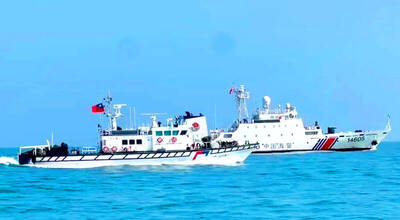
Instead of focusing solely on the threat of a full-scale military invasion, the US and its allies must prepare for a potential Chinese “quarantine” of Taiwan enforced through customs inspections, Stanford University Hoover fellow Eyck Freymann said in a Foreign Affairs article published on Wednesday. China could use various “gray zone” tactics in “reconfiguring the regional and ultimately the global economic order without a war,” said Freymann, who is also a nonresident research fellow at the US Naval War College. China might seize control of Taiwan’s links to the outside world by requiring all flights and ships entering or leaving Taiwan
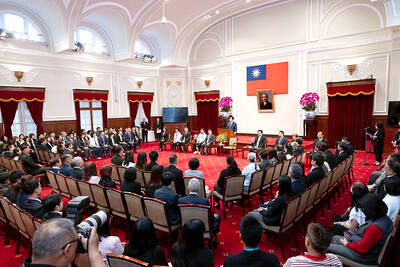
The next minimum wage hike is expected to exceed NT$30,000, President William Lai (賴清德) said yesterday during an award ceremony honoring “model workers,” including migrant workers, at the Presidential Office ahead of Workers’ Day today. Lai said he wished to thank the awardees on behalf of the nation and extend his most sincere respect for their hard work, on which Taiwan’s prosperity has been built. Lai specifically thanked 10 migrant workers selected for the award, saying that although they left their home countries to further their own goals, their efforts have benefited Taiwan as well. The nation’s industrial sector and small businesses lay
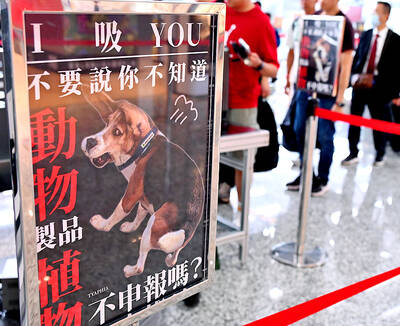
Quarantine awareness posters at Taiwan Taoyuan International Airport have gone viral for their use of wordplay. Issued by the airport branch of the Animal and Plant Health Inspection Agency, the posters feature sniffer dogs making a range of facial expressions, paired with advisory messages built around homophones. “We update the messages for holidays and campaign needs, periodically refreshing materials to attract people’s attention,” quarantine officials said. “The aim is to use the dogs’ appeal to draw focus to quarantine regulations.” A Japanese traveler visiting Taiwan has posted a photo on X of a poster showing a quarantine dog with a


 RSS
RSS