


The Legislative Yuan yesterday passed draft amendments to the customs import tariff that would make malt and hops duty-free to lower costs and boost the competitiveness of the domestic beer industry.
Under the revisions, the 7.5 percent tariff on roasted and unroasted malt would be eliminated. Tariffs on hops — whether ground, unground or pelletized, as well as hop extracts — would also be cut to zero from 7.5 to 15 percent.
The legislature’s Finance Committee jointly reviewed the amendments last month after they were proposed by Chinese Nationalist Party (KMT) Legislator Lin Szu-ming (林思銘) and several lawmakers from across party lines.
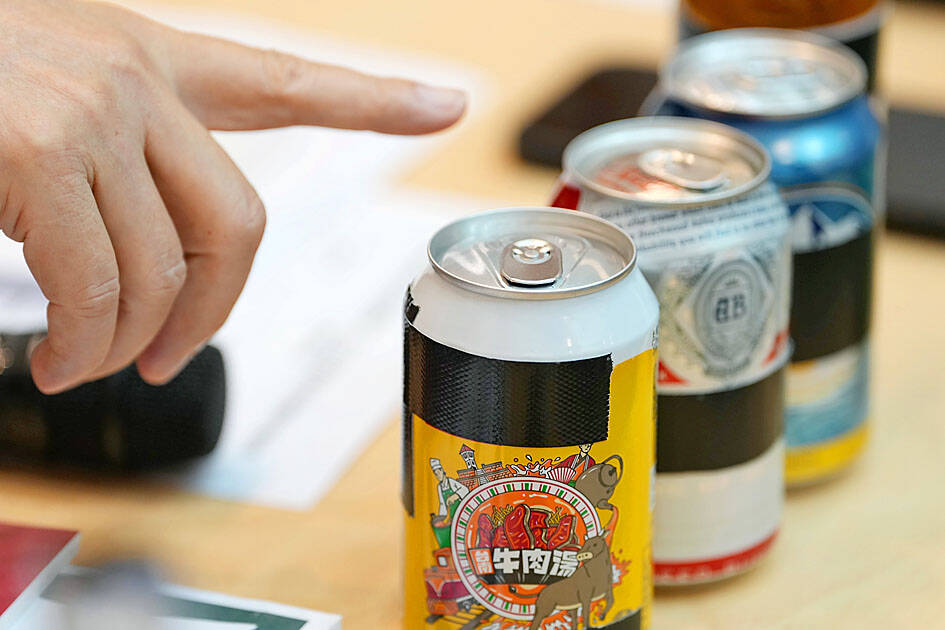
Photo: CNA
The changes were intended to support local brewers by reducing tariffs on key imported raw materials used in beer production, the bill’s sponsors said.
Domestic beer brands have long faced pressure from foreign competitors benefiting from lower prices and tariff advantages, they said.
The amendments were designed to provide tariff relief on malt and hops to help brewers survive and develop over the long term, they added.
The Ministry of Finance said in a report that the tariff cuts are expected to result in a loss of NT$74.35 million (US$2.35 million) in customs revenue.
However, the measures could enhance the competitiveness of domestically produced beer and boost demand, generating an estimated NT$169.74 million in additional tax revenue, the ministry said.
After accounting for the tariff revenue loss, the net fiscal benefit is projected at NT$95.39 million, it added.
The Ministry of Agriculture said that barley and hops used in brewing are primarily imported, as domestic cultivation lacks economic scale, adding that it respected the views of authorities regarding tariff cuts on beer-related raw materials.
The bill, which did not require cross-party negotiations, passed initial review during committee deliberations last month, during which some Democratic Progressive Party lawmakers urged authorities to strengthen enforcement against illicit transshipment and origin laundering involving Chinese products.

LOUD AND PROUD Taiwan might have taken a drubbing against Australia and Japan, but you might not know it from the enthusiasm and numbers of the fans Taiwan might not be expected to win the World Baseball Classic (WBC) but their fans are making their presence felt in Tokyo, with tens of thousands decked out in the team’s blue, blowing horns and singing songs. Taiwanese fans have packed out the Tokyo Dome for all three of their games so far and even threatened to drown out home team supporters when their team played Japan on Friday. They blew trumpets, chanted for their favorite players and had their own cheerleading squad who dance on a stage during the game. The team struggled to match that exuberance on the field, with
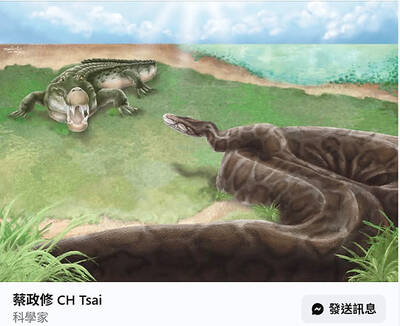
Taiwanese paleontologists have discovered fossil evidence that pythons up to 4m long inhabited Taiwan during the Pleistocene epoch, reporting their findings in the international scientific journal Historical Biology. National Taiwan University (NTU) Institute of Ecology and Evolutionary Biology associate professor Tsai Cheng-hsiu (蔡政修) led the team that discovered the largest snake fossil ever found in Taiwan. The single trunk vertebra was discovered in Tainan at the Chiting Formation, dated to between 400,000 and 800,000 years ago in the Middle Pleistocene, the paper said. The area also produced Taiwan’s first avian fossil, as well as crocodile, mammoth, saber-toothed cat and rhinoceros fossils, it said. Discoveries

Taiwanese paleontologists have discovered fossil evidence that pythons up to 4m long inhabited Taiwan during the Pleistocene epoch, reporting their findings in the international scientific journal Historical Biology. National Taiwan University (NTU) Institute of Ecology and Evolutionary Biology associate professor Tsai Cheng-hsiu (蔡政修) led the team that discovered the largest snake fossil ever found in Taiwan. A single trunk vertebra was discovered in Tainan at the Chiting Formation, dated to between 800,000 to 400,000 years ago in the Middle Pleistocene, the paper said. The area also produced Taiwan’s first avian fossil, as well as crocodile, mammoth, sabre-toothed cat and rhinoceros fossils, it said. Discoveries

Whether Japan would help defend Taiwan in case of a cross-strait conflict would depend on the US and the extent to which Japan would be allowed to act under the US-Japan Security Treaty, former Japanese minister of defense Satoshi Morimoto said. As China has not given up on the idea of invading Taiwan by force, to what extent Japan could support US military action would hinge on Washington’s intention and its negotiation with Tokyo, Morimoto said in an interview with the Liberty Times (sister paper of the Taipei Times) yesterday. There has to be sufficient mutual recognition of how Japan could provide


 RSS
RSS