


The underwater structures of offshore wind farms along the Taiwan Strait have become “marine ranches,” creating highly diversified reef ecosystems, a research team from National Taiwan Ocean University’s Institute of Marine Biology found.
Although offshore wind power construction used to be considered harmful to marine ecosystems, the team yesterday said it found that the submerged parts of wind turbines attract fish dwelling in different ocean layers.
Led by institute honorary chair professor Shao Kwang-tsao (邵廣昭) and professor Shao Yi-ta (邵奕達), the team studied the underwater structures of wind farms off Miaoli and Changhua counties through scuba diving and pole-and-line surveys.
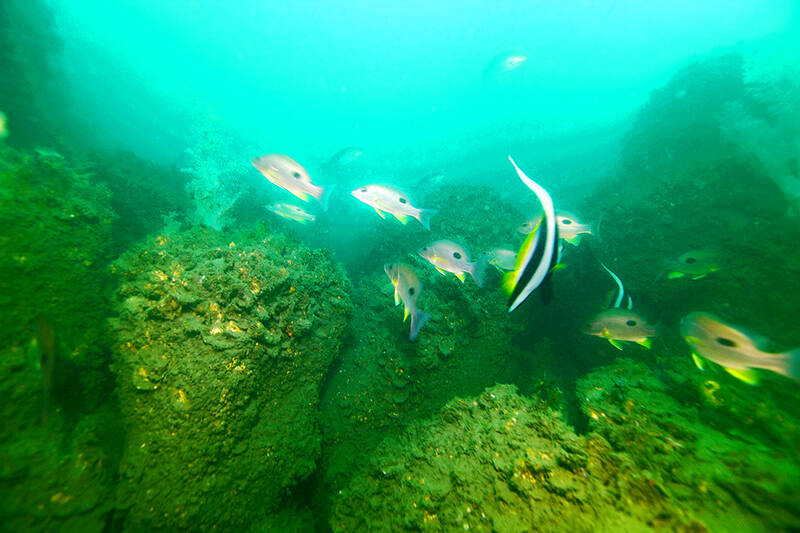
Photo courtesy of Lee Chun-ming via National Taiwan Ocean University
Vertical structures of turbine foundations extend from the surface to the bottom of the ocean, providing hard substrate surfaces, while also functioning as upright artificial reefs that can attract fish of the surface, middle and bottom layers of the ocean, the team found.
The fish species observed around the vertical structures significantly outnumbered those inhabiting traditional reefs, the study showed.
More than 80 reef-associated fishes were identified around the wind farms, none of which had been recorded in the surrounding sandy areas of the waters, it showed.

Photo courtesy of Lee Chun-ming via National Taiwan Ocean University
The reef ecosystems created by the turbines also harmoniously coexisted with the existing soft bottom ecosystems and did not affect the number or proportions of bottom-dwelling fish, it showed.
Within a few months following the completion of turbine construction, invertebrates such as barnacles, sponges or corals attach themselves to the surface of a turbine’s underwater structure, creating habitats for shrimp, crabs, bristle worms, isopods or gastropods, the research showed.
Such habitats also attracted high-value species such as groupers, snappers, chicken grunts or lobsters to search for food or lay eggs, achieving sustained cultivation of resources, it showed.
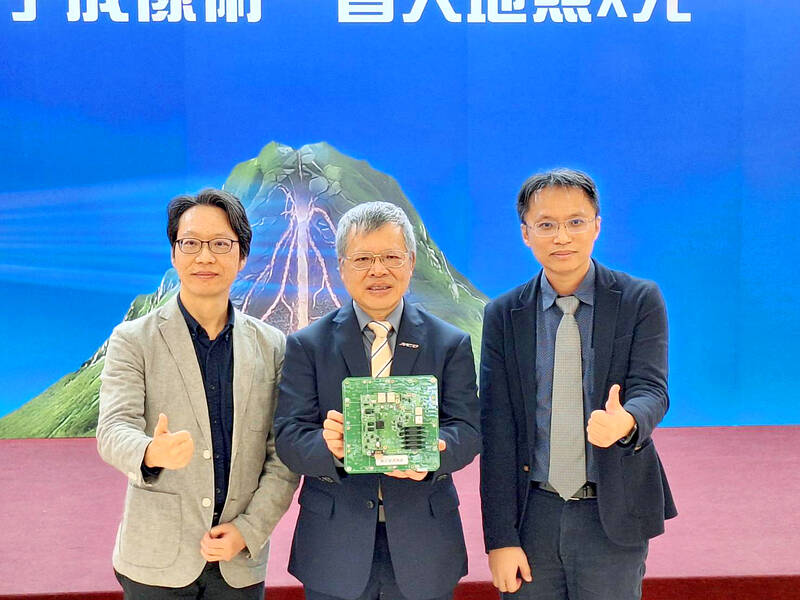
Photo: CNA
Although offshore wind farms were not built for conservation, they maintain biodiversity, the research team said, adding that more comprehensive fishery management rules should be established to promote offshore wind farms’ role in energy transition and marine conservation.
In other news, a National Central University (NCU) research team yesterday said it developed a muon detector and used muon radiography to identify the internal density structure of a volcano in Taipei’s Yangmingshan National Park, marking the beginning of the technique’s applications in Taiwan.
Led by NCU physics professor Kuo Chia-ming (郭家銘) and Earth sciences professor Chen Chien-chih (陳建志) in collaboration with Academia Sinica’s Institute of Physics, the research project was the first systemic development of muon radiography in Taiwan, with the goal of collecting data on underground structures.
Muons are fundamental particles produced from the interaction of cosmic rays and the atmosphere, which are highly penetrative and can travel through rocks as thick as hundreds of meters, Kuo said.
The research team developed a small, energy-efficient and highly stable muon sensor system that is suitable for extended use in the field, he said.
It markedly reduced the barriers for setting up and maintaining equipment, which is the key to applying the technique in Taiwan, he said.
The newly developed muon detector was used to explore the geological structure from above a desilting tunnel of Shihmen Reservoir (石門水庫) in Taoyuan last year, which was the first field experiment of muon exploration in Taiwan, Kuo said.
The research team also set up a station on Yangmingshan (陽明山) later last year, seeking to construct the image of a volcano’s internal density structure using muon radiography to deepen understanding of the volcanic hydrothermal system and its potential activities, he said.
The project would be expanded to include four sets of muon detector arrays to observe volcanic structures and activities from diverse directions, with the goal of shifting to real-time monitoring, he added.
Taiwan, with complex geological structures and steep terrain, faces a multitude of challenges from volcanos, earthquakes and landslides, as well as geothermal and underground construction, making it an ideal field for testing muon radiography, Chen said.
The technique is expected to be applied to other geothermal developments, underground carbon dioxide storage and the management of highly radioactive nuclear waste, which could bolster Taiwan’s net zero transition, he said.

NATIONAL SECURITY: Authorities are working to confirm the identities of the military personnel involved and investigating possible illegal conduct and regulatory violations Authorities are probing possible national security implications after Kinmen police and immigration officers on Sunday found a Chinese woman allegedly posing as a tourist while engaging in prostitution involving more than 10 military personnel. The woman, surnamed Chen (陳), has since been deported, authorities said, adding that investigators are still working to confirm the identities of those implicated, as the records only listed code names and aliases. The case stemmed from a report received by the Kinmen District Prosecutors’ Office on Friday last week from the Jinhu Precinct of the Kinmen County Police Bureau. On Sunday, police, along with the National Immigration

GLOBALGIVING: ‘ Caving to external pressure is not acceptable for an organization that has cultivated justice reform and human rights for 30 years,’ one NGO said A slew of non-government organizations (NGOs) have withdrawn from the GlobalGiving fundraising platform after it announced it would use “Chinese Taipei” instead of “Taiwan” from next month. The Taiwan Good Rice Association wrote on Facebook on Friday that it was informed on April 28 via a teleconference call of the change, which was made because the platform wanted to operate in China. Taiwan Good Rice is to terminate all cooperative relationships with GlobalGiving in response to the platform’s “unilateral and non-negotiable” decision to remove references to Taiwan, the NGO said. “Taiwan is in the official name of Taiwan Good Rice Association and the

HEAVY WEATHER: Typhoon Jangmi is due to crash straight into the Ryukyus as airlines look to shift flights to larger aircraft or cancel flights to Okinawa entirely Taiwan’s international air carriers announced flight adjustments over the weekend as Typhoon Jangmi is forecast to hit the Ryukyu Islands today and tomorrow. The Central Weather Administration (CWA) upgraded Jangmi from a tropical storm to a typhoon at 8am yesterday, with the eye located 580km south of Naha city. It was moving north at 19kph. Today, China Airlines’ CI-120, CI-121, CI-122 and CI-123 flights between Taoyuan and Naha, Okinawa, have been canceled as well as CI-132 and CI-133 between Kaohsiung and Naha. EVA Air’s BR-112, BR-113, BR-186 and BR-185 flights between Taoyuan and Naha are also canceled. Low-cost carrier Tigerair Taiwan canceled IT-230,

REASONS FOR TRAVEL: An assistant professor said that proposed amendments to penalize drivers if they used drugs overseas would not deter people from traveling People who operate a motor vehicle under the influence of marijuana would have their driver’s license revoked, even if they used the substance while overseas, the Ministry of Transportation and Communications said yesterday, citing proposed amendments to the Road Traffic Management and Penalty Act (道路交通管理處罰條例). The amendments would also authorize the government to revoke the licenses of people determined to have used Category 1 or Category 2 narcotics, even if they were not operating a vehicle while under the influence of drugs, as well as ban them from taking the license test for three years, the ministry said. People aged 18 or


 RSS
RSS