


Minister of Education Cheng Ying-yao (鄭英耀) yesterday said he is an “elegant Taiwanese,” adding that he is not afraid of being labeled by China as a “diehard Taiwan independence advocate,” after Beijing targeted him last week.
China’s Taiwan Affairs Office on Wednesday last week said it had designated Cheng, along with Minister of the Interior Liu Shyh-fang (劉世芳) and High Prosecutors’ Office prosecutor Chen Shu-yi (陳舒怡), as “diehard Taiwan independence advocates,” and would pursue punitive measures against them.
Asked for a response in an interview with the Chinese-language Liberty Times (sister paper of the Taipei Times), Chen said the label by Taiwan’s “bad neighbor” would not affect his commitment to educational professionalism or not shake his stance on governing according to the law.
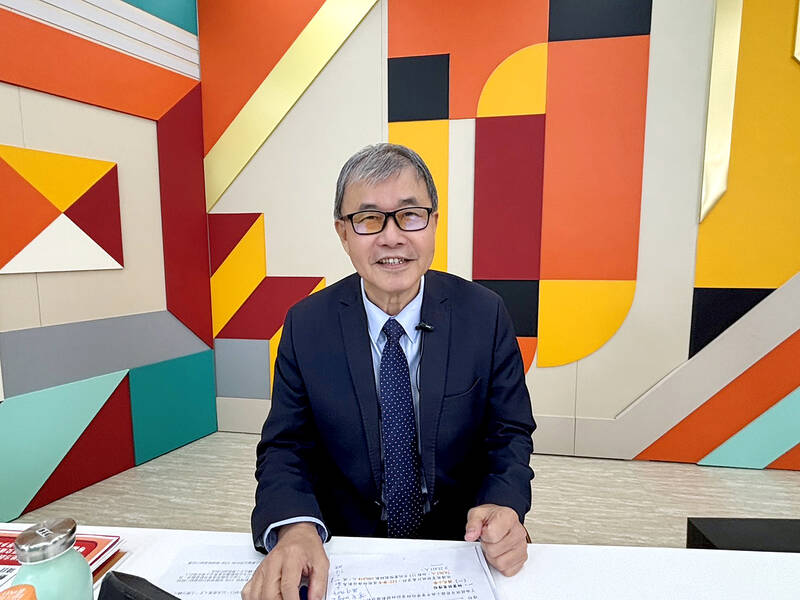
Photo: Rachel Lin, Taipei Times
Cheng said he would continue to fulfill the responsibilities stipulated by the Fundamental Act of Education (教育基本法) to cultivate “a new generation with a strong sense of national identity, love for Taiwan and appreciation for the Republic of China [ROC], while also being deeply rooted locally and globally minded.”
“The ROC is a sovereign and independent country, different from the ROC that retreated to Taiwan under [former president] Chiang Kai-shek’s (蔣介石) regime in 1949, and it has absolutely no relation to China,” he said.
If elementary and junior-high school students were still taught of the “begonia-shaped” territorial map of the ROC — which includes China and Mongolia — it would cause confusion among students, he said.
He said that when today’s elementary and junior-high school students are asked: “Where are you from?” They answer: “I am Taiwanese.”
He added that when they are asked: “Where do you live?” They say: “I live in Taipei, Taichung, Kaohsiung or Hualien.”
This reflects their everyday experience and represents the most natural form of identity, he said.
While some people’s ancestors came from China, they are ROC citizens, Cheng said.
“In daily life and in the international community, we are usually referred to as Taiwanese. These distinctions should be clearly explained to children through historical and international perspectives, rather than being conflated,” he said. “What we aim for is a democratic and law-governed society, and education should help children develop a clear, stable and noncontradictory understanding.”
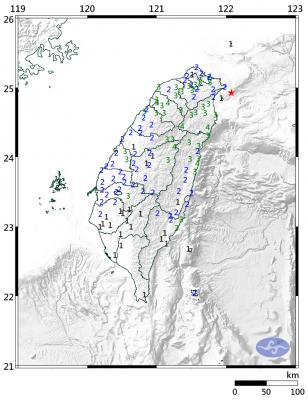
A magnitude 6.1 earthquake struck off the coast of Yilan County at 8:39pm tonight, the Central Weather Administration (CWA) said, with no immediate reports of damage or injuries. The epicenter was 38.7km east-northeast of Yilan County Hall at a focal depth of 98.3km, the CWA’s Seismological Center said. The quake’s maximum intensity, which gauges the actual physical effect of a seismic event, was a level 4 on Taiwan’s 7-tier intensity scale, the center said. That intensity level was recorded in Yilan County’s Nanao Township (南澳), Hsinchu County’s Guansi Township (關西), Nantou County’s Hehuanshan (合歡山) and Hualien County’s Yanliao (鹽寮). An intensity of 3 was
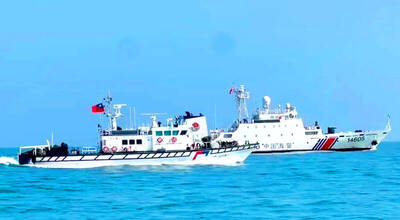
Instead of focusing solely on the threat of a full-scale military invasion, the US and its allies must prepare for a potential Chinese “quarantine” of Taiwan enforced through customs inspections, Stanford University Hoover fellow Eyck Freymann said in a Foreign Affairs article published on Wednesday. China could use various “gray zone” tactics in “reconfiguring the regional and ultimately the global economic order without a war,” said Freymann, who is also a nonresident research fellow at the US Naval War College. China might seize control of Taiwan’s links to the outside world by requiring all flights and ships entering or leaving Taiwan
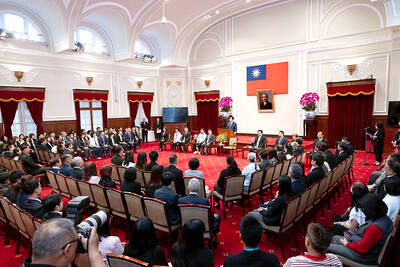
The next minimum wage hike is expected to exceed NT$30,000, President William Lai (賴清德) said yesterday during an award ceremony honoring “model workers,” including migrant workers, at the Presidential Office ahead of Workers’ Day today. Lai said he wished to thank the awardees on behalf of the nation and extend his most sincere respect for their hard work, on which Taiwan’s prosperity has been built. Lai specifically thanked 10 migrant workers selected for the award, saying that although they left their home countries to further their own goals, their efforts have benefited Taiwan as well. The nation’s industrial sector and small businesses lay
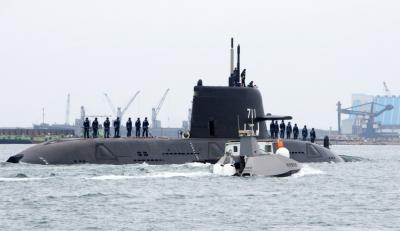
Taiwan's first indigenous defense submarine, the SS-711 Hai Kun (海鯤, or Narwhal), departed for its 13th sea trial at 7am today, marking its seventh submerged test, with delivery to the navy scheduled for July. The outing also marked its first sea deployment since President William Lai (賴清德) boarded the submarine for an inspection on March 19, drawing a crowd of military enthusiasts who gathered to show support. The submarine this morning departed port accompanied by CSBC Corp’s Endeavor Manta (奮進魔鬼魚號) uncrewed surface vessel and a navy M109 assault boat. Amid public interest in key milestones such as torpedo-launching operations and overnight submerged trials,


 RSS
RSS