


The Mainland Affairs Council today defended the Anti-infiltration Act (反滲透法) as useful despite a low prosecution rate, as lawmakers reviewed proposed amendments that would expand the scope of the law and set minimum penalties.
The amendments reviewed at the Legislative Yuan’s Internal Administration Committee today would allow “prospective candidates,” in addition to officially registered candidates, to be prosecuted for infiltration if instructed by an external actor, and set a minimum prison sentence of a year to address lenient sentencing.
The current penalty for receiving instructions, commissions or funding from infiltration sources to campaign, donate political funds or lobby is up to five years imprisonment.
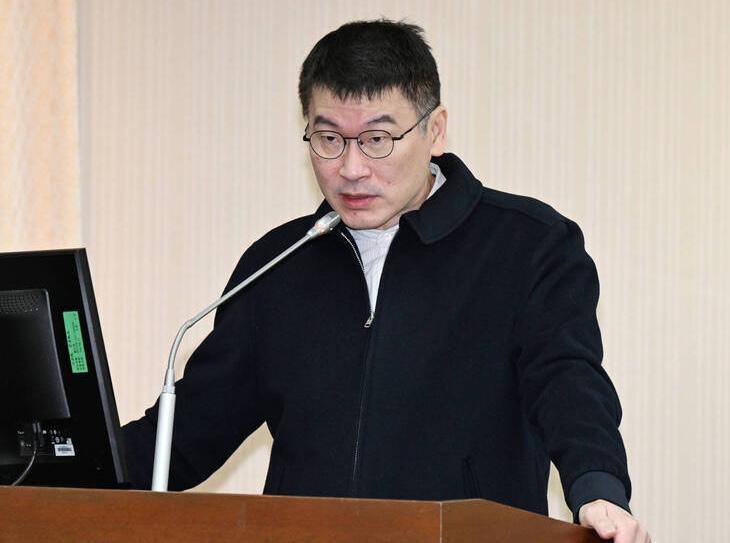
Photo: Liao Chen-huei, Taipei Times
Democratic Progressive Party (DPP) Legislator Su Chiao-hui (蘇巧慧) questioned how useful the law is, having been in place for six years with limited enforcement.
Over the six years of its implementation, prosecutors have indicted 127 people under the law and five have been convicted, with average prison sentences ranging from three to six months, the Liberty Times (sister paper of the Taipei Times) reported.
Since 2023, 80 percent of cases investigated under the act have not been prosecuted, Su said.
Council Deputy Minister Liang Wen-chieh (梁文傑) said he does not believe the law is “useless,” as defendants are often found not guilty and acquitted due to insufficient evidence, not necessarily because they are innocent.
Moreover, the conditions required to apply the act are very specific, he said.
For example, a person must already have registered as a candidate for the law to apply, he added.
The Chinese Communist Party (CCP) can act faster than Taiwan, and it often finds loopholes to exploit the system, Liang said.
The penalties under the act are also too light, as many forms of infiltration now involve inciting others to spread rumors, assault others or throw paint, he said, welcoming the proposed amendments in principle.
Enemy spies would infiltrate using any avenue available, with the situation only worsening due to the Internet facilitating cross-strait exchanges, Liang said.
The act is intended to block interference and plug loopholes, but many cases require explicit proof that a specific act is linked to instructions from an external actor, he said.
Although it proves difficult for judges and prosecutors to present such evidence, the work must still be done, he added.
The CCP interferes in every election in Taiwan, from the presidential to the local level, DPP Legislator Wang Mei-hui (王美惠) said, adding that it is more of a guarantee than a possibility that interference would continue and likely worsen.
Even before official registration, “prospective candidates” have already begun campaigning, and the law should be amended to regulate this, she added.
The Ministry of the Interior in its report said that there should be a clear definition of “prospective.”
Article 17 of the Constitution protects the right to stand for election as a fundamental right, a Ministry of Justice report said.
Under electoral law, whether a person intends to run remains in a ”fluid status” before registration, so there is no objective standard to judge “prospective candidates” or a person’s intention to run, it said.
Therefore, the proposed amendments are inconsistent with the relevant provisions of electoral law and may be incongruent with the principle of clarity in criminal punishment, it said.
Additional reporting by CNA

FUKUOKA SITUATION: Japanese media reported that the pathogen is expected to be identified by the summer, while the CDC downplayed the idea that it was hMPV A “mysterious cold-like illness” reported in Japan’s Fukuoka Prefecture does not seem to be a new disease, but Japanese authorities have been asked about the situation, the Centers for Disease Control (CDC) said yesterday. The Fukuoka Prefectural Medical Association on Wednesday told a news conference that a “mystery cold” that has become a hot topic on social media is “highly likely to be caused by some kind of viral infection,” Japan’s KBC News reported. “Many people are experiencing symptoms starting with a sore throat, followed by a runny nose, phlegm and a severe cough,” KBC News reported, citing association officials. Health authorities are

Nvidia Corp CEO Jensen Huang (黃仁勳) arrived in Taiwan yesterday ahead of upcoming AI and technology events, saying he plans to meet with clients and Taiwan Semiconductor Manufacturing Co Chairman C.C. Wei (魏哲家) during his visit. After landing at Taipei Songshan Airport, Huang posed for photos with fans and handed out Yakult drinks to reporters and supporters waiting at the scene, saying he has “a lot to do” during the trip. Asked about reports that Nvidia’s planned headquarters site in Taipei’s Beitou Shilin Technology Park could break ground on May 27, Huang said that if the company holds an event, he would

The Ministry of Finance this afternoon announced the winning numbers for the March-April uniform invoice lottery. The winning number for the NT$10 million (US$318,060) special prize is 19531471, and the winning number for the NT$2 million grand prize is 85941329. Three numbers were drawn for the NT$200,000 first prize: 07225810, 20231230 and 83518781. Those with receipts matching the last seven digits of any of the first-prize numbers will win the NT$40,000 second prize, while those matching the last six digits will win the NT$10,000 third prize. Those whose receipts match the last five digits of the first-prize numbers can claim the NT$4,000 fourth prize,

SIX SUBSIDIES: The monthly allowance for older farmers is to increase to NT$10,000, and NT$5,000 is to be given to homemakers under the national pension system, Lai said The government is to implement major welfare policies for disadvantaged groups, including raising the monthly allowance for older farmers to NT$10,000 and providing homemakers with NT$5,000 per month, President William Lai (賴清德) said yesterday. Lai made the remarks during a visit to Wangling Temple in Chiayi County, saying that the planned increases were being introduced amid economic growth and an increase in tax revenue. Touting a policy, in which the government plans to provide a monthly allowance of NT$5,000 for every child under the age of 18 in a bid to address Taiwan’s low birthrate, Lai said that if received for the


 RSS
RSS