


Taiwanese officials see the US’ capture of the president of Venezuela as a powerful deterrent to Beijing’s aggression and a timely reminder of the US’ ability to defeat militaries equipped with Chinese-made weapons.
The strikes that toppled Venezuelan President Nicolas Maduro signaled to authoritarian leaders, including Chinese President Xi Jinping (習近平), US President Donald Trump’s willingness to use military might for international affairs core to US interests, one senior official in Taipei’s security circle said.
That reassured Taiwan, the person said.
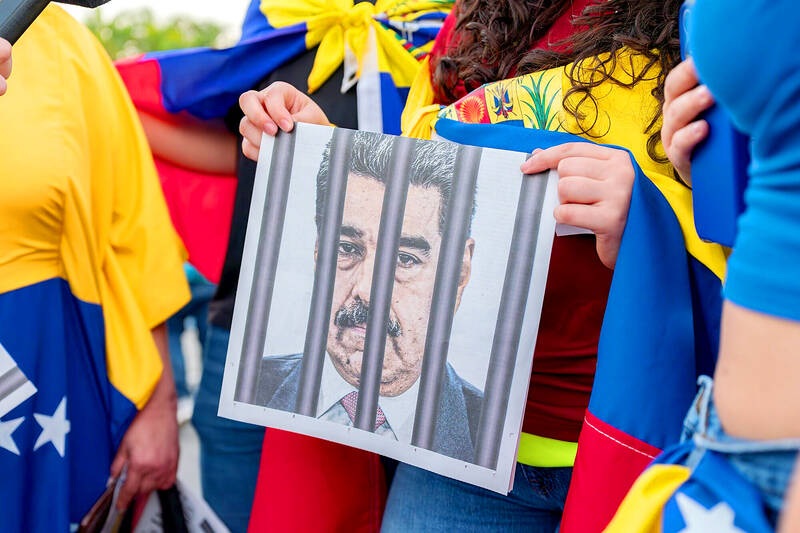
Photo: Bloomberg
Taipei has also dismissed the idea that Trump’s apparent violation of international law could embolden Beijing, said the official, who was not authorized to speak publicly about sensitive issues.
China considers Taiwan part of its own territory, so international laws do not factor into its calculations, the person said.
What Beijing lacks is capability, not precedent, they added.
The Chinese Ministry of Foreign Affairs did not immediately reply to a request for comment.
For decades, the US — Taiwan’s top weapons supplier — has been a restraining force on Chinese aggression, with the risk of sanctions and US military action looming over any invasion. While Trump has held off saying whether the US would defend Taipei from any attack by Beijing, last month he approved an US$11.1 billion weapons package for Taiwan — one of its largest-ever deals.
By contrast, Venezuela is the biggest buyer of Chinese weapons in South America, with sales totaling US$495 million in the decade ending 2020, according to the Center for Strategic and International Studies.
That was only topped by Russia, which supplied Caracas with 60 percent of its imported arms during that period.
“The level of sophistication of US equipment, compared with the weapons Venezuela obtained from Russia and China, was fully exposed in this operation,” Deputy Minister of National Defense Hsu Szu-chien (徐斯儉) told lawmakers at the Legislative Yuan yesterday.
“Venezuela’s problem is not just which country its weapons came from — the most critical issue is maintenance,” Hsu added.
Trump’s stunning late-night operation saw more than 150 US aircraft sweep into Venezuela, after the US neutralized the South American country’s air defenses. US forces then grabbed Maduro and his wife from a military base, and spirited them away by helicopter to a warship en route for trial in New York.
That Venezuela’s military power was dismantled within hours by US forces would give Beijing plenty to think about, a separate senior national security official in Taiwan said.
The bullish sentiment among Taiwanese officials — who have reason to talk up their position — contrasts with nationalist sentiment sweeping Chinese social media, where users said the strike offered a template for how Beijing could handle tensions with Taiwan.
On Taiwanese social media, opinions were divided. Some expressed concern the developments in Venezuela could embolden Beijing, while others voiced optimism that the episode signaled a tougher US stance toward countries with close ties to China and Russia and could prompt Washington to focus more on the Indo-Pacific region.
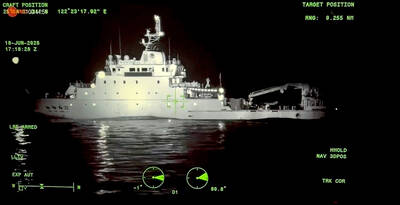
EXCUSES: Beijing is using government and research vessels as a pretext to harass the nation and enter its EEZ, and engage in ‘hegemonic expansion,’ the coast guard said The Coast Guard Administration yesterday said it drove away Chinese oceanographic research vessel Xiang Yang Hong 22 (向陽紅33) from restricted waters after warning it that it was in Taiwan’s exclusive economic zone (EEZ). The Chinese vessel entered restricted waters off the coast of Yilan County’s Suao (蘇澳) at 11:35pm on Thursday, the coast guard said, adding that it dispatched the Lanyu patrol vessel and the boat PP-10077 to shadow the Chinese ship and issue radio warnings ordering it to leave. China has no sovereignty over waters off Taiwan’s east coast, Lanyu’s crew told Xiang Yang Hong 22 over the radio, and demanded
BAIT AND SWITCH: Allowing KMT-run counties to sell to China while the threat of abrupt cancelations hangs overhead is another form of coercion, officials said Beijing is using agricultural purchase offers announced during the Straits Forum to deepen Taiwan’s dependence on the Chinese market, a Taiwanese official said yesterday as they criticized the Taitung County commissioner’s participation in the initiative. During the Straits Forum held in Xiamen on Saturday, Chinese officials announced a sales and purchase agreement for agricultural products from some counties led by the Chinese Nationalist Party (KMT). Taitung County Commissioner Yao Ching-ling (饒慶鈴), who was barred from attending the event in person by the Mainland Affairs Council, participated via video. Under the agreement, China would purchase atemoyas, pomeloes, tea and grouper harvested in Taitung,
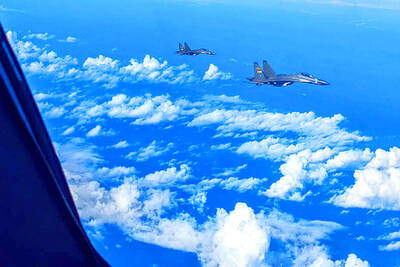
SHIFTING FIRE: While the tempo of purely military exercises around Taiwan has gone down somewhat, Beijing is working to isolate Lai diplomatically from support abroad Chinese President Xi Jinping (習近平) is shifting tactics in his campaign to pressure Taiwan, ramping up diplomatic isolation of the nation while dialing down provocative displays of military aggression. Taiwan recorded a daily average of five Chinese military aircraft crossing the Taiwan Strait’s buffer line with China through May this year — half the number logged in the same period last year. In March, Beijing did not send a single fighter jet near Taiwan for seven days, the longest absence on record outside of typhoon season. In comparison, China sent 153 planes near Taiwan during one day at its peak in
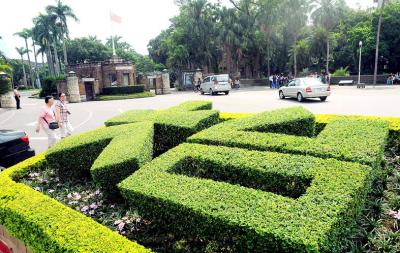
Four Taiwanese universities have been ranked among the world's top 200 institutions in the Quacquarelli Symonds (QS) World University Rankings for next year, the highest Taiwan has ever placed in the category, with National Taiwan University (NTU) achieving its best performance at 54th globally and 17th in Asia. The four Taiwanese institutions in the global top 200 are NTU (54th), National Tsing Hua University (142nd), National Yang Ming Chiao Tung University (177th) and National Cheng Kung University (191st), the rankings showed. All four universities achieved their highest-ever global rankings this year, QS data showed. National Cheng Kung University entered the top 200 for


 RSS
RSS