


Seven amendments that were passed last year, raising penalties for offenses including the intentional damage of undersea cables and other critical infrastructure, with maximum fines of up to NT$100 million (US$3.17 million), took effect on Wednesday last week.
The laws aim to prevent foreign vessels from falsifying their identities, concealing sailing routes, severing undersea cables and engaging in other illegal activities, said the Executive Yuan, which proposed the amendments.
The revisions amend the Telecommunications Management Act (電信管理法), the Electricity Act (電業法), the Natural Gas Enterprise Act (天然氣事業法), the Water Supply Act (自來水法), the Meteorological Act (氣象法), the Commercial Port Act (商港法) and the Law of Ships (船舶法). All seven amendments passed third readings in the legislature last month.
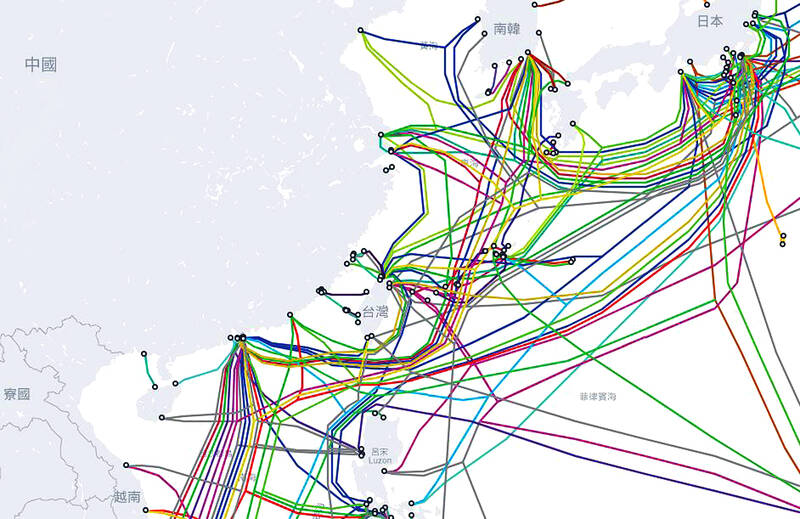
Photo: Screen grab from TeleGeography
Under the revised regulations, vessels of any nationality entering Taiwan’s territorial waters that disable their automatic identification system (AIS) or fail to properly disclose vessel identification information face fines of up to NT$10 million and the possible confiscation of the ship. Those who damage meteorological facilities, undersea cables or other infrastructure face fines ranging from NT$2 million to NT$100 million, depending on the offense.
The measures were introduced after several incidents last year involving foreign vessels severing undersea cables or lingering in Taiwan’s offshore waters, raising national security concerns.
Amendments to the Law of Ships, overseen by the Ministry of Transportation and Communications, require vessels operating in Taiwan’s territorial waters to accurately disclose AIS data, hull markings — including vessel name and identification number — and navigation logs. Offenders face fines of NT$30,000 to NT$10 million, and the Coast Guard Administration may escort vessels into port and confiscate the ships. The rules also apply to yachts, small boats and vessel charterers.
Under the Commercial Port Act amendments, port operators, the Maritime and Port Bureau or designated authorities may order vessels to leave a commercial port within three months or relocate if their presence interferes with berth scheduling or port safety. Foreign commercial vessels that fail to comply without justification may be confiscated regardless of ownership.
Maritime Safety Division deputy head Chi Tien-chien (祁天健) yesterday said that the Law of Ships amendments are intended to curb illegal activities carried out using falsified identities or concealed routes, preventing threats to port security, navigational order and national security.
The remaining five amended laws, including to the Meteorological Act, target those who steal, damage or unlawfully interfere with facilities related to meteorology, undersea cables, power generation, natural gas or water supply. Offenders face prison sentences of one to seven years and fines of up to NT$10 million, rising to three to 10 years and NT$50 million if national security or social stability is endangered.
Penalties may be increased by up to half if the offense causes a disaster. Offenses resulting in death are punishable by seven years to life imprisonment and fines of up to NT$100 million, while those causing serious injury carry sentences of five to 12 years and fines of up to NT$80 million. Attempted offenses are also punishable.
Negligently damaging or unlawfully disrupting the operation of meteorological facilities, submarine cables, landing stations, communications centers, or submarine gas and water pipelines is punishable by up to six months in prison or fines of up to NT$2 million, with tools, equipment and vessels subject to confiscation.

More than half of the bamboo vipers captured in Tainan in the past few years were found in the city’s Sinhua District (新化), while other districts had smaller catches or none at all. Every year, Tainan captures about 6,000 snakes which have made their way into people’s homes. Of the six major venomous snakes in Taiwan, the cobra, the many-banded krait, the brown-spotted pit viper and the bamboo viper are the most frequently captured. The high concentration of bamboo vipers captured in Sinhua District is puzzling. Tainan Agriculture Bureau Forestry and Nature Conservation Division head Chu Chien-ming (朱健明) earlier this week said that the

NAMING SPAT: The foreign ministry called on Denmark to propose an acceptable solution to the erroneous nationality used for Taiwanese on residence permits Taiwan has revoked some privileges for Danish diplomatic staff over a Danish permit that lists “Taiwan” as “China,” Eric Huang (黃鈞耀), head of the Ministry of Foreign Affairs’ Department of European Affairs, told a news conference in Taipei yesterday. Reporters asked Huang whether the Danish government had responded to the ministry’s request that it correct the nationality on Danish residence permits of Taiwanese, which has been listed as “China” since 2024. Taiwan’s representative office in Denmark continues to communicate with the Danish government, and the ministry has revoked some privileges previously granted to Danish representatives in Taiwan and would continue to review

The first bluefin tuna of the season, brought to shore in Pingtung County and weighing 190kg, was yesterday auctioned for NT$10,600 (US$333.5) per kilogram, setting a record high for the local market. The auction was held at the fish market in Donggang Fishing Harbor, where the Siaoliouciou Island-registered fishing vessel Fu Yu Ching No. 2 delivered the “Pingtung First Tuna” it had caught for bidding. Bidding was intense, and the tuna was ultimately jointly purchased by a local restaurant and a local company for NT$10,600 per kilogram — NT$300 ,more than last year — for a total of NT$2.014 million. The 67-year-old skipper

China has reserved offshore airspace over the Yellow Sea and East China Sea from March 27 to May 6, issuing alerts that are usually used to warn of military exercises, although no such exercises have been announced, the Wall Street Journal (WSJ) reported on Sunday. Reserving such a large area for 40 days without explanation is an “unusual step,” as military exercises normally only last a few days, the paper said. The alerts, known as notice to air missions (NOTAMs), “are intended to inform pilots and aviation authorities of temporary airspace hazards or restrictions,” the article said. The airspace reserved in the alert


 RSS
RSS