


A recent Microsoft survey ranked Taiwan 23rd in the world in artificial intelligence (AI) use, with 28.4 percent of Taiwanese reporting that they use the technology.
The Microsoft Al Economy Institute in a release on Thursday said that 16.3 percent of the global population used AI tools last year, showing the technology’s accelerating adoption worldwide.
In Taiwan, AI use last year increased to 28.4 percent, from 26.4 percent, overtaking the US (28.3 percent) by a small margin.

Photo: AFP
Although the US is the world’s leading country in AI research and development, the technology’s spread in the workforce has been slower than medium and small economies with a higher level of reliance on AI technology and digitization, the institute said.
The poll identified a divide between developed and developing economies, with AI usage rates of 24.7 percent and 14.1 percent respectively.
The United Arab Emirates had an AI usage rate of 54 percent, the highest in the world, the institute said.
Abu Dhabi in 2017 established the Emirati Ministry of State for Artificial Intelligence, Digital Economy and Remote Work Applications, boosting public trust in the technology to 67 percent, compared with 32 percent in the US, it said.
South Korea last year recorded the biggest increase in AI utilization, moving from 25th to 18th, the institute said.
The change can be attributed to an increase in algorithmic models’ Korean-language capabilities, it said.
Seoul’s passage of an AI basic law and creation of a strategic office to govern the technology and the trend of using ChatGPT to generate anime images resembling Studio Ghibli’s style have also played a role in increasing the technology’s popularity in the nation, it said.
China’s open-source AI DeepSeek successfully garnered a large number of users in its own territories, along with Russia, Belarus and Iran, it said.
The main challenge for the industry is spreading the benefits of AI to more regions to bridge the diffusion gap between nations, it added.
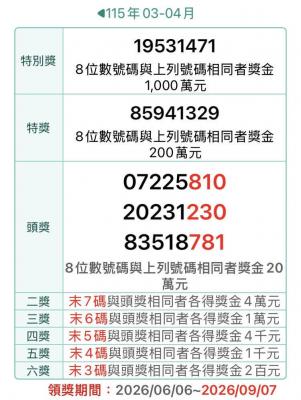
The Ministry of Finance this afternoon announced the winning numbers for the March-April uniform invoice lottery. The winning number for the NT$10 million (US$318,060) special prize is 19531471, and the winning number for the NT$2 million grand prize is 85941329. Three numbers were drawn for the NT$200,000 first prize: 07225810, 20231230 and 83518781. Those with receipts matching the last seven digits of any of the first-prize numbers will win the NT$40,000 second prize, while those matching the last six digits will win the NT$10,000 third prize. Those whose receipts match the last five digits of the first-prize numbers can claim the NT$4,000 fourth prize,

SIX SUBSIDIES: The monthly allowance for older farmers is to increase to NT$10,000, and NT$5,000 is to be given to homemakers under the national pension system, Lai said The government is to implement major welfare policies for disadvantaged groups, including raising the monthly allowance for older farmers to NT$10,000 and providing homemakers with NT$5,000 per month, President William Lai (賴清德) said yesterday. Lai made the remarks during a visit to Wangling Temple in Chiayi County, saying that the planned increases were being introduced amid economic growth and an increase in tax revenue. Touting a policy, in which the government plans to provide a monthly allowance of NT$5,000 for every child under the age of 18 in a bid to address Taiwan’s low birthrate, Lai said that if received for the
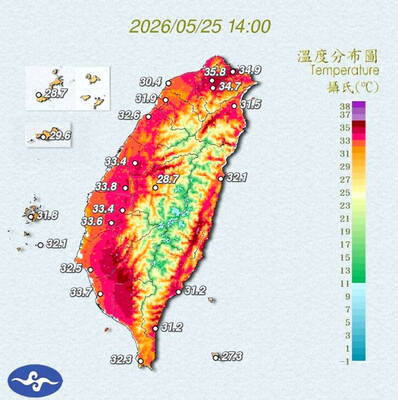
STAY COOL: The HPA recommended that people stay hydrated, use air-conditioning or fans while indoors, wear loose-fitting clothes and walk in the shade while outdoors Employers must implement measures such as installing cooling equipment, and providing drinking water and rest breaks for outdoor workers starting from Monday next week, the Taipei Department of Labor said on Sunday. Employers who fail to comply could face fines of NT$30,000 to NT$300,000 under the Occupational Safety and Health Act (職業安全衛生法), the department said. Businesses in Taipei employing fewer than 100 workers, as well as registered self-employed workers with labor insurance coverage, could receive on-site assessments and guidance from occupational safety consultants to help them apply for central government subsidies to implement or improve heat-protection measures, it said. Under the Ministry of

NATIONAL SECURITY: Authorities are working to confirm the identities of the military personnel involved and investigating possible illegal conduct and regulatory violations Authorities are probing possible national security implications after Kinmen police and immigration officers on Sunday found a Chinese woman allegedly posing as a tourist while engaging in prostitution involving more than 10 military personnel. The woman, surnamed Chen (陳), has since been deported, authorities said, adding that investigators are still working to confirm the identities of those implicated, as the records only listed code names and aliases. The case stemmed from a report received by the Kinmen District Prosecutors’ Office on Friday last week from the Jinhu Precinct of the Kinmen County Police Bureau. On Sunday, police, along with the National Immigration


 RSS
RSS