


The Chinese Nationalist Party’s (KMT) plan to review and pass part of the central government’s general budget would be “a good job half done” if the rest of the budget remains shelved, President William Lai (賴清德) said yesterday.
The KMT and the Taiwan People’s Party reportedly planned to transfer several budget bills relevant to people’s livelihoods such as the TPass program or birth subsidies to legislative committees for review, after the total budget proposed by the central government for this fiscal year had been put on hold at the legislature due to dissatisfaction from the opposition parties that the Executive Yuan did not “properly” adjust military and police pay.
In response to media queries for comment, Lai yesterday said it is good for the KMT to realize the significance of the central government’s budget to people’s livelihoods.
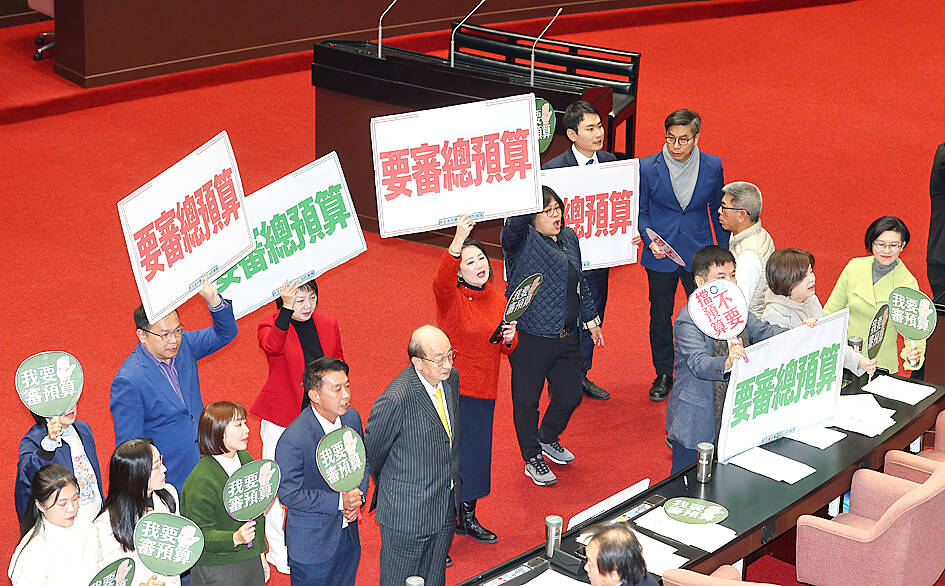
Photo: CNA
However, it would be a good job half done if only portions of the budget are reviewed and passed, as they are interconnected, he said.
Economic developments would come to a halt if there is no defense budget to sustain national security, while public finance and people’s livelihoods would be affected if funding for economic developments is removed, Lai said.
The KMT should allow all the central government’s budget bills to be reviewed by relevant legislative committees and facilitate their passage at the legislature as soon as possible, he said.
Asked about the NT$1.25 trillion (US$39.6 billion) special defense budget bill — which was blocked for the sixth time by opposition parties at a legislative meeting on Friday and could not enter committee meetings — Lai expressed gratitude to American Institute in Taiwan Director Raymond Greene for visiting opposition party leaders to help break the deadlock at the legislature.
That shows the international community values the security of Taiwan and cross-strait peace and stability, Lai said, adding that he hopes Greene’s effort was not a waste of time and the KMT would realize the importance of the defense budget.
KMT Legislator Wang Hung-wei (王鴻薇) said the opposition is at least doing a good job half done while Lai “is far from good by doing nothing.”
“Have you [Lai] made an effort to negotiate with opposition parties to facilitate the passage of the total budget? Or that you just have been obsessed with political manipulation and blaming opposition parties every day?” she said.

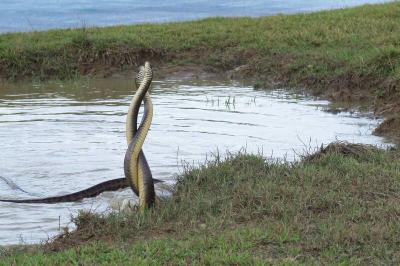
Kenting National Park service technician Yang Jien-fon (楊政峰) won a silver award in World Grand Prix Photography Awards Spring Season for his photograph of two male rat snakes intertwined in combat. Yang’s colleagues at Kenting National Park said he is a master of nature photography who has been held back by his job in civil service. The awards accept entries in all four seasons across six categories: architectural and urban photography, black-and-white and fine art photography, commercial and fashion photography, documentary and people photography, nature and experimental photography, and mobile photography. Awards are ranked according to scores and divided into platinum, gold and

More than half of the bamboo vipers captured in Tainan in the past few years were found in the city’s Sinhua District (新化), while other districts had smaller catches or none at all. Every year, Tainan captures about 6,000 snakes which have made their way into people’s homes. Of the six major venomous snakes in Taiwan, the cobra, the many-banded krait, the brown-spotted pit viper and the bamboo viper are the most frequently captured. The high concentration of bamboo vipers captured in Sinhua District is puzzling. Tainan Agriculture Bureau Forestry and Nature Conservation Division head Chu Chien-ming (朱健明) earlier this week said that the
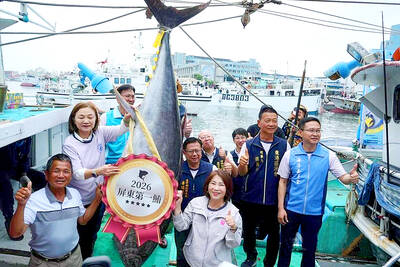
The first bluefin tuna of the season, brought to shore in Pingtung County and weighing 190kg, was yesterday auctioned for NT$10,600 (US$333.5) per kilogram, setting a record high for the local market. The auction was held at the fish market in Donggang Fishing Harbor, where the Siaoliouciou Island-registered fishing vessel Fu Yu Ching No. 2 delivered the “Pingtung First Tuna” it had caught for bidding. Bidding was intense, and the tuna was ultimately jointly purchased by a local restaurant and a local company for NT$10,600 per kilogram — NT$300 ,more than last year — for a total of NT$2.014 million. The 67-year-old skipper
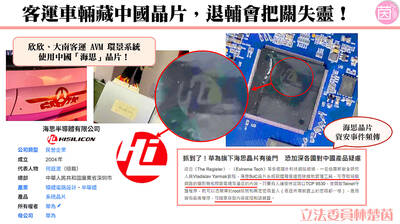
BREACH OF CONTRACT: The bus operators would seek compensation and have demanded that the manufacturer replace the chips with ones that meet regulations Two bus operators found to be using buses with China-made chips are to demand that the original manufacturers replace the systems and provide compensation for breach of contract, the Veterans Affairs Council said yesterday. Democratic Progressive Party Legislator Michelle Lin (林楚茵) yesterday said that Da Nan Bus Co and Shin-Shin Bus Co Ltd have fielded a total of 82 buses that are using Chinese chips. The bus models were made by Tron-E, while the systems provider was CYE Electronics, Lin said. Lin alleged that the buses were using chips manufactured by Huawei subsidiary HiSilicon Co, which presents a national security risk if the


 RSS
RSS