


Virtual YouTubers, or VTubers, have proliferated in Taiwan in the past few years, with their growing influence now extending into various sectors, experts said.
VTubers are YouTubers who stream using virtual avatars, typically anime-style characters, as their “skin,” with motion capture technology tracking real facial expressions for performances, complemented by live voice acting.
Avatars are not limited to human forms, and Kizuna AI, who started in 2016 in Japan, is widely regarded as the pioneer.

Photo courtesy of Chen Shan-ching
Beyond subculture circles, VTubers have also gained popularity among digital-native younger generations. They have recently become powerful cross-sector intermediaries, endorsing local art venues and partnering with sports organizations to promote the Olympics and national teams.
Public awareness of VTubers in Taiwan has risen sharply over the past three years, expanding beyond niche communities, said Wang Wei-chih (王威智), an assistant professor at National Tsing Hua University’s Institute of Taiwan Literature.
VTubers combine the recognizability of anime characters, the real-time interaction of livestreamers and the emotional attachment associated with idols, he said.
Unconstrained by physical bodies or real-world settings, virtual characters serve as the most effective cross-domain mediators in the media ecosystem, he said.
As technological barriers lower, “corporate-owned VTubers” could become standard for brands managing digital communities, he said.
Citing the collaboration between Juufuutei Raden, a member of the renowned Japanese agency Hololive, and the Tainan Art Museum as an example, he said it helped draw young digital natives into traditional arts spaces.
He also described the agency’s partnership with the Los Angeles Dodgers as a form of “cultural diplomacy.”
The core value of future idols would shift from physical presence to sustainability and deeper emotional connections, he said.
Issues such as digital life ethics, local practice, virtual tourism and community revitalization warrant further research, he said.
Chen Shan-ching (陳善清), head of Taiwanese VTuber agency Springfish Co (春魚創意), said the company is open to supporting cross-sector applications for its talent.
During the Paris Olympics, the company collaborated with the Chinese Taipei Olympic Committee to serve as virtual ambassadors, hosting livestreams and explaining sporting information, he said.
The agency has also worked with Chunghwa Post to promote mobile apps and stamp-collecting activities, and has entered the education sector by partnering with Nan I Book (南一書局) to create VTubers and virtual classrooms, he said.
“Our strength is being the medium best suited to communicating with young people,” he said.
Citing PLAVE, South Korea’s first virtual boy band, performing alongside rapper Lee Young-ji at last year’s MAMA Awards, and Netflix’s K-pop-themed animated movie KPop Demon Hunters as examples, he said virtual idols are able to cross into mainstream pop culture.
However, as the “novelty effect” begins to wane, the industry has to focus more on cost-efficiency and conversion rates, he said.
Taiwanese comic book artist Wei Zhong-cheng (韋宗成) said a polished VTuber appearance serves as an entry ticket to attract attention.
However, some designs attempt to cram in too many elements, diluting visual impact, he said, suggesting prioritizing strong visual identity.
Taiwanese VTubers benefit from localized language use, approachability and adept use of Internet memes, he added.
Many energetic independent creators can rival corporate-backed ones in viewership, but limited funding results in fewer large-scale projects and gaps in motion-capture technology, he said.
Cheng Chao-i (鄭朝益), social media marketing planner at Pili International Multimedia’s budaixi (霹靂布袋戲), said traditional glove puppetry could also be seen as a form of “virtual idol.”
Traditional glove puppetry shares similarities with VTubers in that both rely on human operators to imbue characters with life, and provide audiences with emotional attachment and companionship, he said.
Taiwan’s VTuber scene has flourished in recent years, with projects, programs and individual intellectual property management becoming increasingly mature, he said.
Although the number of corporate-backed VTubers remains limited, the market has significant room for growth, he said, urging creators to experiment boldly, identify distinctive niches and develop sustainable paths forward.

UPGRADE: The Kang Ding-class frigate is replacing its Chaparall missiles with Tien Chien II and Hua Yang VLS, which would provide it with long-range, 360° air defense Taiwan plans to produce 1,200 to 1,376 Hai Chien II missiles (海劍二, Sea Sword II) — also known as TC-2N — to serve as the standard air defense system of the navy’s surface combatant fleet, a source said yesterday. Last week, the Hai Chien II, the naval version of the Tien Kung II missile (天劍二, Sky Sword II), completed a live-fire test in waters off the National Chungshan Institute of Science and Technology’s Jiupeng facility (九鵬) in Pingtung County’s Manjhou Township (滿州). The MIM72 Chaparral and other dated air defense missiles that currently arm Taiwanese ships have inadequate range to combat Chinese

REASONS FOR TRAVEL: An assistant professor said that proposed amendments to penalize drivers if they used drugs overseas would not deter people from traveling People who operate a motor vehicle under the influence of marijuana would have their driver’s license revoked, even if they used the substance while overseas, the Ministry of Transportation and Communications said yesterday, citing proposed amendments to the Road Traffic Management and Penalty Act (道路交通管理處罰條例). The amendments would also authorize the government to revoke the licenses of people determined to have used Category 1 or Category 2 narcotics, even if they were not operating a vehicle while under the influence of drugs, as well as ban them from taking the license test for three years, the ministry said. People aged 18 or
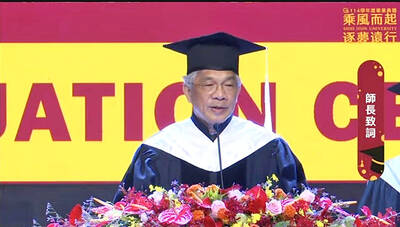
Shih Hsin University President Chen Ching-he (陳清河) yesterday issued a public apology for comments made in his commencement speech last week, stating that he has asked the school to suspend his duties and halt his wages for two months as a show of contrition. At the commencement ceremony on May 30, Chen said, “If you don’t manage your time well, or your own emotions, or your health, then I am telling every one of you — put a quick end to ‘you,’ because the world has no need for ‘you.’” The comments have sparked significant controversy online, and Chen through an open
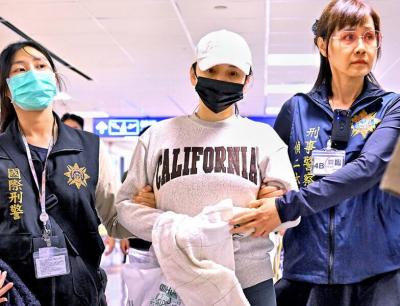
Johanne Liou (劉喬安), a Taiwanese woman who shot to unwanted fame during the Sunflower movement protests in 2014, returned to Taiwan last night after being deported from the US. She is to stand trial in Taiwan for charges involving embezzlement, fraud and drug crimes. The Criminal Investigation Bureau (CIB) said it took her into custody at Taiwan Taoyuan International Airport and would first question her before transferring her to the New Taipei District Prosecutors’ Office. She was arrested upon disembarking a flight from San Francisco that landed shortly before 7pm. Liou absconded to the US in 2019 after jumping bail


 RSS
RSS