


Many young Taiwanese are not unwilling to have children, but tend to be more cautious as they evaluate practical conditions before getting married and having kids, a counseling psychologist said.
The latest Ministry of the Interior statistics showed the number of newborns plunging to a historical low of 98,785 in the first 11 months of last year.
New Taipei City Counseling Psychologist Association president Lo Hui-chun (羅惠群) said that rather than saying young people “do not want to have children,” it is more like “they are thinking more comprehensively.”

Photo: CNA
Based on his clinical observation of many people of marriageable years, Lo said many of them conduct long-term, comprehensive evaluations — including couple relationships, personal conditions and future lifestyles — before deciding whether to get married or have children.
Many young people who come to him for pre-marital counseling more often discuss practical conditions rather than romantic issues, such as “where they would live” or “if they are capable of raising children,” he said.
Conditions including whether they already own a property or would need to rent or buy a house, nearly always come up in their discussions before getting married, Lo said, adding that concerns about housing instability directly affect people’s sense of security in deciding to get married or have children.
Regarding the phenomenon of late marriage and delayed childbearing, he said if couples do not plan to have children, late marriage is not an issue, but if they agree to have children, age becomes a reality they cannot ignore.
The prime marriage age is around 32 or 33 years old, but many couples do not want to get married and have children when they have just dated for a short period, while those who get married want to ensure they have a stable relationship before having children, he said.
Entering the parenting stage when the foundation of a marriage relationship is not solid enough often leads to increased risks of marital conflicts and separation, he added.
“Whether to have children or not” has become an important threshold for deciding to get married or not, Lo said.
If two people have different views on having children, then marriage might not be a possibility, so most couples start making childbearing plans before marriage or in the early stages of marriage, he said.
Many young people tend to avoid making significant commitments when conditions are uncertain, unlike the previous generation’s attitude that “I will have children because everyone is having them,” he said.
The real-life struggle is that many young people’s working conditions and asset accumulation cannot keep up with the ideal lifestyle they have in mind, Lo said.
If they do not find support from their family, they might continue to delay marriage and childbearing decisions, or just avoid the issue altogether, he said.
The difficulties and stress of taking care of children are challenges “after the child is born,” so what really affects the nation’s birthrate is whether a couple dares to make the decision in the first place, he added.
Lo said the change in making such decisions is not necessarily a bad thing, as it reflects people increasingly valuing their autonomy and quality of life.
In his counseling sessions, Lo said he helps couples make an inventory of their career, income and living conditions for the next three to five years, aiding those “who have an opportunity and the conditions” to get married, but are still hesitant about making a decision.
Social media often exaggerate the image of a “perfect life,” causing excessive stress on young people, he said.
What young people need is to get back to reality and engage in full conversations with their partner, family and professionals if they have trouble making decisions, he said.

NATIONAL SECURITY: Authorities are working to confirm the identities of the military personnel involved and investigating possible illegal conduct and regulatory violations Authorities are probing possible national security implications after Kinmen police and immigration officers on Sunday found a Chinese woman allegedly posing as a tourist while engaging in prostitution involving more than 10 military personnel. The woman, surnamed Chen (陳), has since been deported, authorities said, adding that investigators are still working to confirm the identities of those implicated, as the records only listed code names and aliases. The case stemmed from a report received by the Kinmen District Prosecutors’ Office on Friday last week from the Jinhu Precinct of the Kinmen County Police Bureau. On Sunday, police, along with the National Immigration

GLOBALGIVING: ‘ Caving to external pressure is not acceptable for an organization that has cultivated justice reform and human rights for 30 years,’ one NGO said A slew of non-government organizations (NGOs) have withdrawn from the GlobalGiving fundraising platform after it announced it would use “Chinese Taipei” instead of “Taiwan” from next month. The Taiwan Good Rice Association wrote on Facebook on Friday that it was informed on April 28 via a teleconference call of the change, which was made because the platform wanted to operate in China. Taiwan Good Rice is to terminate all cooperative relationships with GlobalGiving in response to the platform’s “unilateral and non-negotiable” decision to remove references to Taiwan, the NGO said. “Taiwan is in the official name of Taiwan Good Rice Association and the
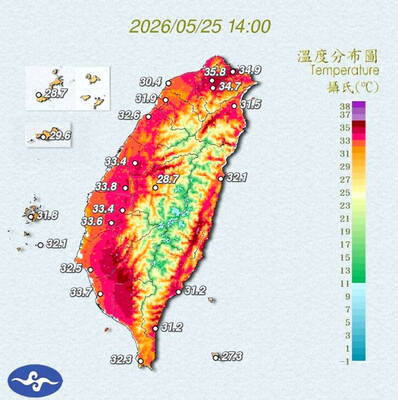
STAY COOL: The HPA recommended that people stay hydrated, use air-conditioning or fans while indoors, wear loose-fitting clothes and walk in the shade while outdoors Employers must implement measures such as installing cooling equipment, and providing drinking water and rest breaks for outdoor workers starting from Monday next week, the Taipei Department of Labor said on Sunday. Employers who fail to comply could face fines of NT$30,000 to NT$300,000 under the Occupational Safety and Health Act (職業安全衛生法), the department said. Businesses in Taipei employing fewer than 100 workers, as well as registered self-employed workers with labor insurance coverage, could receive on-site assessments and guidance from occupational safety consultants to help them apply for central government subsidies to implement or improve heat-protection measures, it said. Under the Ministry of

Chinese Nationalist Party (KMT) Chairwoman Cheng Li-wun (鄭麗文) yesterday briefed her party’s Central Standing Committee regarding her scheduled visit to the US between Monday next week and June 16, saying that her purpose would be to persuade the US that the Republic of China (ROC) Constitution was a “one China” constitution that would foster stable and peaceful cross-strait relations. The ROC Constitution is the most important defense for all Taiwanese citizens, as it upholds our democracy and has contributed to our robust economy, which aligns with international and US interests, she said. “We would not be troublemakers and drag the US under,”


 RSS
RSS