


The release of the newest national dietary guidelines could be postponed to the second quarter following the dramatic shift in the US’ dietary guidelines emphasizing protein and healthy fats, Minister of Health and Welfare Shih Chung-liang (石崇良) said yesterday.
International dietary recommendations certainly would change with the development of nutrition science, he said.
Although Taiwan’s updated dietary guidelines were slated to be released this quarter, more changes could be made based on the latest US dietary guidelines and recent studies, Shih said, adding that the finalized version could be published as late as the second quarter.
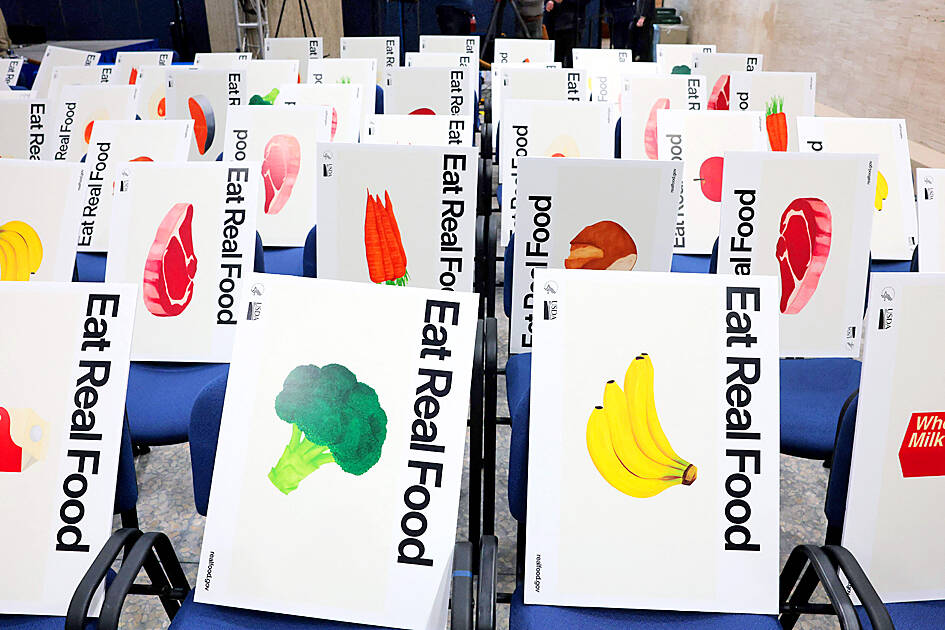
Photo: AFP
US President Donald Trump’s administration on Wednesday unveiled the newest US dietary guidelines showing an inverted pyramid prioritizing red meat, whole milk and animal-based fats such as beef tallow and butter — which it called “protein, dairy and healthy fats” — at the top, in line with vegetables and fruits, while whole grains make up the smallest portion at the bottom of the pyramid.
The latest US guidelines, which are updated every five years, markedly increased the amount of recommended daily protein intake from 0.8g to up to 1.6g per kilogram of body weight for adults.
That means an adult weighing 68kg is advised to take in 82g to 109g of protein per day, instead of 54g.
The new US guidelines also specified that beef tallow and butter — despite being mostly saturated fats — are good options for cooking oils such as olive oil, prompting debates in the nutrition science community.
The change was led by US Secretary of Health Robert Kennedy Jr, who reportedly had delayed releasing revisions to the guidelines for months as they were proposed by a scientific advisory committee under former US president Joe Biden with a focus on plant-based diets.
New York University nutrition professor Marion Nestle said the latest US dietary guidelines recommend “heavily meat-based diets” and protein has become “a euphemism for meat,” the news outlet Live Science reported.
Shih said recent studies showed that many food ingredients originally considered “unhealthy” are actually good nutritional sources when consumed in moderation, such as egg yolks or whole milk.
The point is “moderate consumption” instead of completely excluding such ingredients, he said.
The draft of Taiwan’s new dietary guidelines was completed last year, the Health Promotion Administration said.
Meetings with experts would be held to review the US’ and other international dietary guidelines and evaluate the dietary habits of Taiwanese and special needs of different demographic groups, it said.
Taiwan Dietitian Association deputy president Huang Tsui-hua (黃翠華) said the US dietary guidelines are “recommendations for Americans,” and Taiwan should have its own version based on its dietary needs.
The US guidelines send mixed messages by discouraging processed foods and added sugars while promoting red meat and full-fat dairy products, she said, adding that most research showed that excessive intake of red meat and processed meat would raise the risk of colorectal cancer.
Another drastic change to the new guidelines was the removal of alcohol intake limits of up to two drinks for men and up to one drink for women.
Instead, the new guidelines simply state that people are advised to “consume less alcohol for better overall health.”
About 47 percent of Taiwanese have poor alcohol metabolism and therefore higher risk of cancer with prolonged acetaldehyde exposure, Liver Disease Prevention and Treatment Research Foundation chief executive officer Nien Hsiao-ching (粘曉菁) said, calling on Taiwanese to drink as little alcohol as possible.
The harmful effects of alcohol cannot be measured simply by average daily consumption, as binge drinking or relying on liquor to fall asleep or relieve pressure are much more harmful to health, Mackay Memorial Hospital psychiatrist Fang Chun-kai (方俊凱) said.
Regarding gender and age, Fang said women could develop more harmful effects from alcohol faster than men, as their blood alcohol levels tend to be higher from consuming the same amount of alcohol.
Children and teenagers should refrain from drinking alcohol, as it could affect neurological development, he added.
Fang also suggested that Taiwan follow the example of Japan instead of the US, as Japan’s alcohol consumption guidelines published in 2024 measure consumption by “daily pure-alcohol intake limits” and stress that drinking less than the threshold does not guarantee safety.
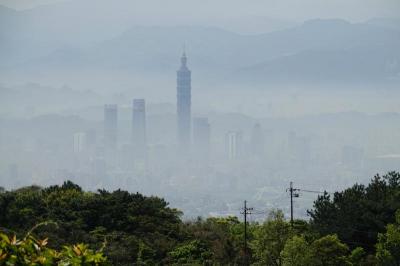
A strong continental cold air mass is to bring pollutants to Taiwan from tomorrow, the Ministry of Environment said today, as it issued an “orange” air quality alert for most of the country. All of Taiwan except for Hualien and Taitung counties is to be under an “orange” air quality alert tomorrow, indicating air quality that is unhealthy for sensitive groups. In China, areas from Shandong to Shanghai have been enveloped in haze since Saturday, the ministry said in a news release. Yesterday, hourly concentrations of PM2.5 in these areas ranged from 65 to 160 micrograms per cubic meter (mg/m³), and pollutants were
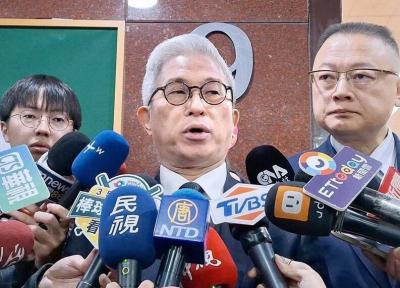
Taiwan’s armed forces have established response protocols for a wide range of sudden contingencies, including the “Wan Chun Plan” to protect the head of state, the Ministry of Defense (MND) said today. After US President Donald Trump on Saturday launched a series of airstrikes in Venezuela and kidnapped Venezuelan President Nicolas Maduro, concerns have been raised as to whether China would launch a similar “decapitation strike” on Taiwan. The armed forces regularly coordinate with relevant agencies and practice drills to ensure preparedness for a wide range of scenarios, Vice Minister of National Defense Hsu Szu-chien (徐斯儉) told reporters before a
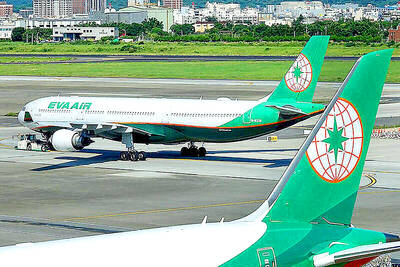
EVA Airways on Saturday said that it had suspended a pilot and opened an investigation after he allegedly lost his temper and punched the first officer several times as their plane was taxiing before takeoff at Los Angeles International Airport. According to a report published on Thursday by The Reporter, the incident occurred after the flight’s Malaysian first officer tried to warn the Taiwanese pilot, surnamed Wen (文), that he was taxiing faster than the speed limit of 30 knots (55.6kph). After alerting the pilot several times without response, the first officer manually applied the brakes in accordance with standard operating

The New Taipei City Social Welfare Department on Thursday celebrated Paralympic competitor Chen Tzu-wei (張孜維), who received last year’s national Golden Eagle award for exemplary achievement by Taiwanese with disabilities. Chen, who suffers from childhood-onset muscular dystrophy, did not attend the first award ceremony held by the Ministry of Health and Welfare in November due to illness. Chen was formally presented with the award at the department, where he gave thanks to government workers for supporting his education and livelihood, the department said in a statement. Chen was raised by the Ai-hsin Home for Persons with Disabilities in the city’s Bali District (八里)


 RSS
RSS