


Road and pedestrian safety advocacy groups today called for reform of Taiwan’s driving test and certification system, citing five key demands.
The system has long been dysfunctional and allows a large number of drivers with a lack of safety awareness onto the roads, the groups told a news conference at the Legislative Yuan in Taipei.
Among their demands were including commercial and urban areas with pedestrians in the driving test and establishing a nationwide curriculum.
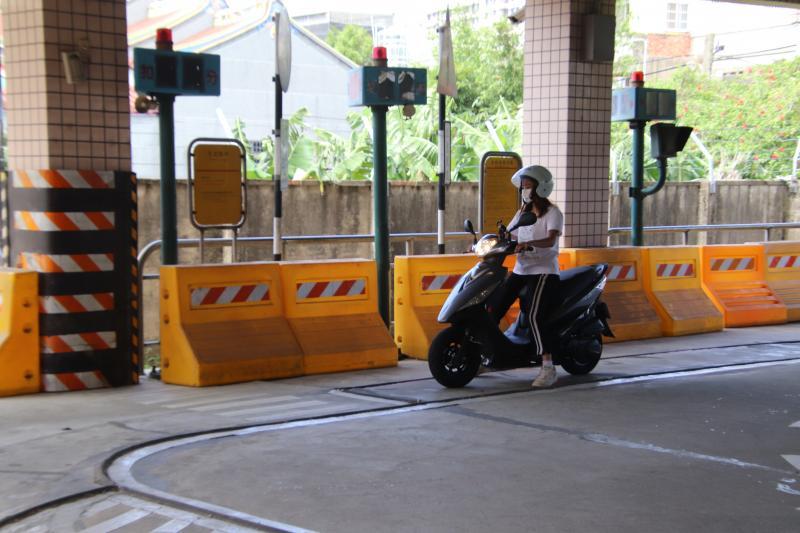
Photo: Huang Mei-chu, Taipei Times
The groups included the Taiwan Vision Zero Alliance and the Taiwan Traffic Safe Association, with Democratic Progressive Party Legislator Lin Yue-chin (林月琴) and Taiwan People’s Party Legislator Liu Shu-pin (劉書彬) also in attendance.
They urged the government to continue working toward the vision of zero traffic deaths so it does not become an “empty slogan” and seriously address the shortcomings of driver education.
Their first demand was to incorporate busy commercial and urban roads into training routes and driving tests to simulate realistic interactions with pedestrians, phasing out overly simplified off-site testing routes.
This would allow new drivers to learn in real environments how to yield to pedestrians and share the road with all users, they said.
They then called for a nationwide driving curriculum in line with international practices, and speed differentiation training to ensure safety for young people on the roads.
The groups also recommended increased oversight of driving schools to ensure that new drivers reach the legally mandated minimum hours of on-road training before taking the test.
Further, they asked for retraining of all citizens regardless of age, while performing assessments to identify high-risk drivers and providing re-education programs.
Finally, they said they hope that the government would gradually incorporate demands from previous civil group consensus documents.

LOUD AND PROUD Taiwan might have taken a drubbing against Australia and Japan, but you might not know it from the enthusiasm and numbers of the fans Taiwan might not be expected to win the World Baseball Classic (WBC) but their fans are making their presence felt in Tokyo, with tens of thousands decked out in the team’s blue, blowing horns and singing songs. Taiwanese fans have packed out the Tokyo Dome for all three of their games so far and even threatened to drown out home team supporters when their team played Japan on Friday. They blew trumpets, chanted for their favorite players and had their own cheerleading squad who dance on a stage during the game. The team struggled to match that exuberance on the field, with
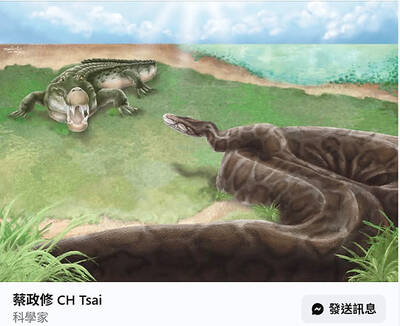
Taiwanese paleontologists have discovered fossil evidence that pythons up to 4m long inhabited Taiwan during the Pleistocene epoch, reporting their findings in the international scientific journal Historical Biology. National Taiwan University (NTU) Institute of Ecology and Evolutionary Biology associate professor Tsai Cheng-hsiu (蔡政修) led the team that discovered the largest snake fossil ever found in Taiwan. The single trunk vertebra was discovered in Tainan at the Chiting Formation, dated to between 400,000 and 800,000 years ago in the Middle Pleistocene, the paper said. The area also produced Taiwan’s first avian fossil, as well as crocodile, mammoth, saber-toothed cat and rhinoceros fossils, it said. Discoveries

Taiwanese paleontologists have discovered fossil evidence that pythons up to 4m long inhabited Taiwan during the Pleistocene epoch, reporting their findings in the international scientific journal Historical Biology. National Taiwan University (NTU) Institute of Ecology and Evolutionary Biology associate professor Tsai Cheng-hsiu (蔡政修) led the team that discovered the largest snake fossil ever found in Taiwan. A single trunk vertebra was discovered in Tainan at the Chiting Formation, dated to between 800,000 to 400,000 years ago in the Middle Pleistocene, the paper said. The area also produced Taiwan’s first avian fossil, as well as crocodile, mammoth, sabre-toothed cat and rhinoceros fossils, it said. Discoveries

Whether Japan would help defend Taiwan in case of a cross-strait conflict would depend on the US and the extent to which Japan would be allowed to act under the US-Japan Security Treaty, former Japanese minister of defense Satoshi Morimoto said. As China has not given up on the idea of invading Taiwan by force, to what extent Japan could support US military action would hinge on Washington’s intention and its negotiation with Tokyo, Morimoto said in an interview with the Liberty Times (sister paper of the Taipei Times) yesterday. There has to be sufficient mutual recognition of how Japan could provide


 RSS
RSS