


The Intellectual Property and Commercial Court yesterday ruled that a Taiwan Semiconductor Manufacturing Co (TSMC) employee be detained incommunicado for allegedly stealing the company’s 14-nanometer (nm) trade secrets.
The suspect, Chen Wei-chieh (陳韋傑), was indicted on Monday on charges of reproducing trade secrets relating to national core key technologies without authorization under the National Security Act (國家安全法).
Chen is suspected of the alleged offenses after investigators reviewed the evidence, including witness testimony, text message records, his nondisclosure agreement and employee monitoring system records provided by TSMC.

Photo: CNA
The court said that Chen’s statements regarding his actions were inconsistent and evasive, and that he replaced his personal mobile phone and office computer after learning that codefendant Chen Li-ming (陳力銘) was under investigation.
The court said that discarding or destroying devices suspected of being used to reproduce and transmit trade secrets could constitute destruction of evidence, indicating a risk of evidence tampering and collusion.
Moreover, the crime that he was allegedly involved in not only damaged TSMC, but also national security, industrial competitiveness and economic development, the court added.
The case came to light while the High Prosecutors' Office’s Intellectual Property Branch was investigating the alleged theft of TSMC trade secrets related to its 2nm technology.
The probe centered on former TSMC engineer Chen Li-ming, who was working at Tokyo Electron Taiwan Ltd and is suspected of transmitting the secrets to the company.
During the investigation, prosecutors discovered that Tokyo Electron Taiwan’s cloud storage also contained trade secrets linked to TSMC’s 14nm technology.
When confronted with the evidence, Chen Li-ming identified Chen Wei-chieh as being involved in the case, prosecutors said.
Chen Li-ming and two other suspects in the 2nm technology theft case have also been detained.
Meanwhile, Tokyo Electron Taiwan has also been indicted in both cases for failing to properly supervise Chen Li-ming.

LOUD AND PROUD Taiwan might have taken a drubbing against Australia and Japan, but you might not know it from the enthusiasm and numbers of the fans Taiwan might not be expected to win the World Baseball Classic (WBC) but their fans are making their presence felt in Tokyo, with tens of thousands decked out in the team’s blue, blowing horns and singing songs. Taiwanese fans have packed out the Tokyo Dome for all three of their games so far and even threatened to drown out home team supporters when their team played Japan on Friday. They blew trumpets, chanted for their favorite players and had their own cheerleading squad who dance on a stage during the game. The team struggled to match that exuberance on the field, with
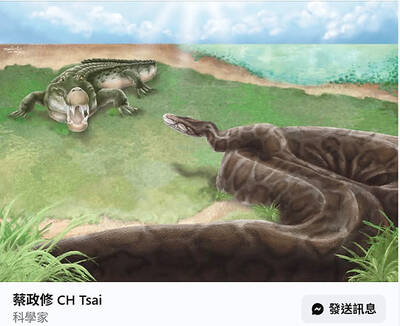
Taiwanese paleontologists have discovered fossil evidence that pythons up to 4m long inhabited Taiwan during the Pleistocene epoch, reporting their findings in the international scientific journal Historical Biology. National Taiwan University (NTU) Institute of Ecology and Evolutionary Biology associate professor Tsai Cheng-hsiu (蔡政修) led the team that discovered the largest snake fossil ever found in Taiwan. The single trunk vertebra was discovered in Tainan at the Chiting Formation, dated to between 400,000 and 800,000 years ago in the Middle Pleistocene, the paper said. The area also produced Taiwan’s first avian fossil, as well as crocodile, mammoth, saber-toothed cat and rhinoceros fossils, it said. Discoveries

Taiwanese paleontologists have discovered fossil evidence that pythons up to 4m long inhabited Taiwan during the Pleistocene epoch, reporting their findings in the international scientific journal Historical Biology. National Taiwan University (NTU) Institute of Ecology and Evolutionary Biology associate professor Tsai Cheng-hsiu (蔡政修) led the team that discovered the largest snake fossil ever found in Taiwan. A single trunk vertebra was discovered in Tainan at the Chiting Formation, dated to between 800,000 to 400,000 years ago in the Middle Pleistocene, the paper said. The area also produced Taiwan’s first avian fossil, as well as crocodile, mammoth, sabre-toothed cat and rhinoceros fossils, it said. Discoveries
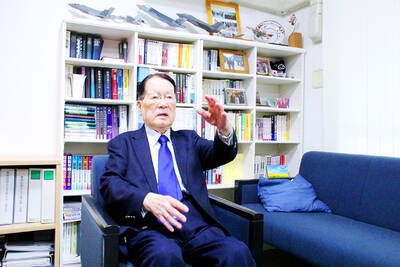
Whether Japan would help defend Taiwan in case of a cross-strait conflict would depend on the US and the extent to which Japan would be allowed to act under the US-Japan Security Treaty, former Japanese minister of defense Satoshi Morimoto said. As China has not given up on the idea of invading Taiwan by force, to what extent Japan could support US military action would hinge on Washington’s intention and its negotiation with Tokyo, Morimoto said in an interview with the Liberty Times (sister paper of the Taipei Times) yesterday. There has to be sufficient mutual recognition of how Japan could provide


 RSS
RSS