


Vehicle emissions and industrial pollution play a significant role in triggering poor air quality alerts in the nation’s south, the Ministry of Environment said yesterday, citing research by academics in Taiwan and the US.
NASA airplanes equipped with sophisticated sensors conducted three flyovers in 2024 in collaboration with Taiwanese academics to measure air pollution using LIDAR, drones, balloons and observation teams, the researchers told a news conference.
The US contributed significantly to the study, as the complex interaction of pollutants, meteorological events and terrain conditions could not be adequately studied from the ground, they said.
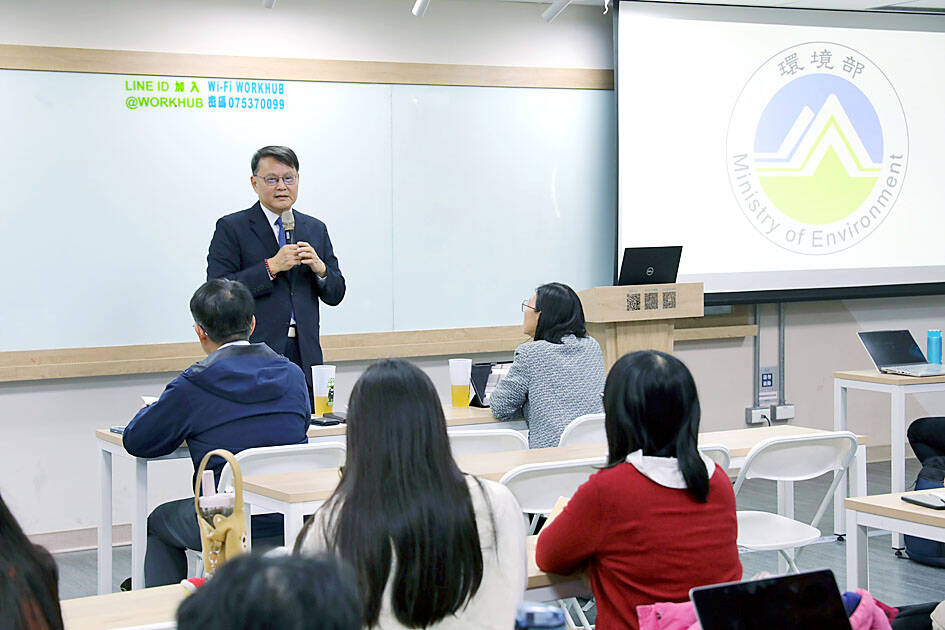
Photo: CNA
The data showed that seasonal winds and topography factors often trap pollution from domestic and foreign sources, including biomass burning in Indochina, in Kaohsiung and Pingtung County, they said.
Emissions from industrial activity and transportation accounted for the majority of air pollution in the region, said Wang Sheng-hsiang (王聖翔), a professor of atmospheric sciences at National Central University.
Volatile organic compounds from vehicles were detected at 200m to 800m above sea level, Wang said.
Pollutants from vehicles were notable in measurements on days of dangerously poor air quality, showing the effect that private vehicles have on air pollution, said You Chih-yuan (游智淵), a scientist in the Department of Atmospheric Environment.
The findings might prompt the ministry to devote more resources to regulating air pollution generated by daily life, You said.
Surges in pollution from industrial sources might have tipped the balance during periods of poor or dangerously poor air quality, said Wang Chia-lin (王家麟), a professor of chemistry at the university.
Lai Hsin-chih (賴信志), a professor of chemistry at Chang Jung Christian University, said that improved understanding of vertical atmospheric structures has important implications for governance.
Sensors run by local authorities should take local topography into account, as pollutants are far more likely to form high-concentration pockets in areas with limited geographical horizon, he said.
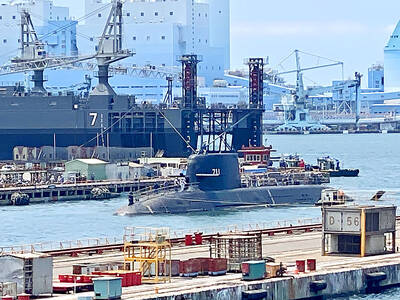
AGING: While Japan has 22 submarines, Taiwan only operates four, two of which were commissioned by the US in 1945 and 1946, and transferred to Taiwan in 1973 Taiwan would need at least 12 submarines to reach modern fleet capabilities, CSBC Corp, Taiwan chairman Chen Cheng-hung (陳政宏) said in an interview broadcast on Friday, citing a US assessment. CSBC is testing the nation’s first indigenous defense submarine, the Hai Kun (海鯤, Narwhal), which is scheduled to be delivered to the navy next month or in July. The Hai Kun has completed torpedo-firing tests and is scheduled to undergo overnight sea trials, Chen said on an SET TV military affairs program. Taiwan would require at least 12 submarines to establish a modern submarine force after assessing the nation’s operational environment and defense
Yangmingshan National Park authorities yesterday urged visitors to respect public spaces and obey the law after a couple was caught on a camera livestream having sex at the park’s Qingtiangang (擎天崗) earlier in the day. The Shilin Police Precinct in Taipei said it has identified a suspect and his vehicle registration number, and would summon him for questioning. The case would be handled in accordance with public indecency charges, it added. The couple entered the park at about 11pm on Thursday and began fooling around by 1am yesterday, the police said, adding that the two were unaware of the park’s all-day live
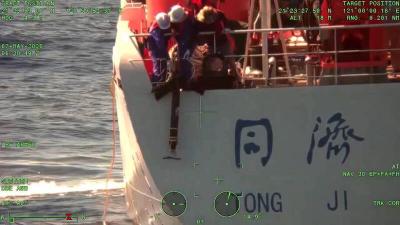
The coast guard today said that it had disrupted "illegal" operations by a Chinese research ship in waters close to the nation and driven it away, part of what Taipei sees a provocative pattern of China's stepped up maritime activities. The coast guard said that it on Thursday last week detected the Chinese ship Tongji (同濟號), which was commissioned only last year, 29 nautical miles (54km) southeast of the southern tip of Taiwan, although just outside restricted waters. The ship was observed lowering ropes into the water, suspected to be the deployment of scientific instruments for "illegal" survey operations, and the coast

A former soldier and an active-duty army officer were yesterday indicted for allegedly selling classified military training materials to a Chinese intelligence operative for a total of NT$79,440. The Taipei District Prosecutors’ Office indicted Chen Tai-yin (陳泰尹) and Lee Chun-ta (李俊達) for contravening the National Security Act (國家安全法) and the Anti-Corruption Act (貪污治罪條例). Chen left the military in September 2013 after serving alongside then-staff sergeant Lee, now an army lieutenant, at the 21st Artillery Command of the army’s Sixth Corps from 2011 to 2013, according to the indictment. Chen met a Chinese intelligence operative identified as “Wang” (王) through a friend in November


 RSS
RSS