


The Legislative Yuan today passed the third reading of a draft act protecting delivery workers’ rights and managing delivery platforms, stipulating that, per delivery, workers must earn at least 1.25 times the minimum hourly wage, or a minimum of NT$45.
The pay rate would be adjusted annually depending on the minimum wage, the draft says.
The act would take effect six months after its promulgation, and the Ministry of Labor would specify how it would be implemented after consulting with relevant businesses.
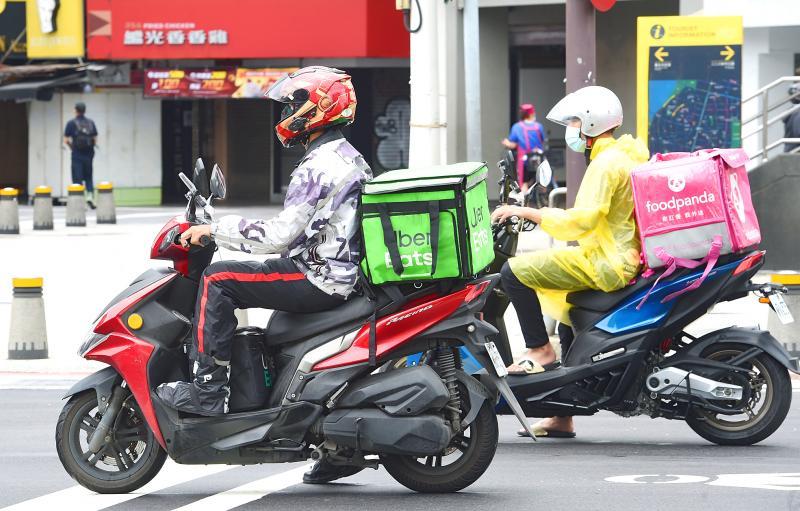
Photo: Liu Hsin-de, Taipei Times
The draft act requires delivery platforms to pay workers at least twice a month and provide clear payment statements showing how earnings and deductions are calculated.
It also requires delivery platforms to set up a complaint system, allowing delivery workers to raise concerns about pay, account suspensions or contract terminations, and disputes with cooperating businesses or customers.
Platforms must also set up a task force of no less than three people to handle complaints, including at least one union representative, and cannot treat workers unfairly due to complaints, the draft states.
Platforms cannot stipulate delivery personnel’s working hours, require them to keep working against their will, or treat them unfairly for refusing orders or going offline to rest, it states.
In addition, when a local government cancels work due to dangerous weather or natural disasters, delivery platforms should suspend operations in the area and inform local delivery personnel and cooperating business, it states.
Platforms must provide contracted delivery workers with accident and liability insurance, and workers cannot deliver until insured, the draft says.
In terms of fines, the bill stipulates that delivery platforms can be fined NT$30,000 to NT$300,000 for failing to report a work-related injury within eight hours, NT$30,000 to NT$150,000 for avoiding supervision and inspection, and NT$20,000 to NT$100,000 for contravening payment regulations.
Delivery workers’ unions said that the law is a milestone for the industry, as it establishes a minimum wage for delivery workers, guarantees them insurance and gives them a system through which to file complaints.
Establishing a minimum wage, insurance and grievance mechanisms under the law would clarify the rights and responsibilities of platforms and delivery workers, Taiwan Delivery Industry Rights Promotion Alliance spokesperson Su Pai-hao (蘇柏豪) said.
It not only protects workers’ rights, but is key to the healthy and sustainable growth of the industry, Su said.
Whether the system can truly improve delivery workers’ situations depends on how the act is implemented and applied, National Delivery Industrial Union chairperson Chen Yu-an (陳昱安) said.
Uber Eats said that it hopes the act is implemented taking into consideration how the market operates and the industry’s needs, balancing the interests of all parties.
Foodpanda said it would start running different operational tests to prepare for potential changes and impacts on the market.
Additional reporting by Lin Che-yuan

FUKUOKA SITUATION: Japanese media reported that the pathogen is expected to be identified by the summer, while the CDC downplayed the idea that it was hMPV A “mysterious cold-like illness” reported in Japan’s Fukuoka Prefecture does not seem to be a new disease, but Japanese authorities have been asked about the situation, the Centers for Disease Control (CDC) said yesterday. The Fukuoka Prefectural Medical Association on Wednesday told a news conference that a “mystery cold” that has become a hot topic on social media is “highly likely to be caused by some kind of viral infection,” Japan’s KBC News reported. “Many people are experiencing symptoms starting with a sore throat, followed by a runny nose, phlegm and a severe cough,” KBC News reported, citing association officials. Health authorities are

Nvidia Corp CEO Jensen Huang (黃仁勳) arrived in Taiwan yesterday ahead of upcoming AI and technology events, saying he plans to meet with clients and Taiwan Semiconductor Manufacturing Co Chairman C.C. Wei (魏哲家) during his visit. After landing at Taipei Songshan Airport, Huang posed for photos with fans and handed out Yakult drinks to reporters and supporters waiting at the scene, saying he has “a lot to do” during the trip. Asked about reports that Nvidia’s planned headquarters site in Taipei’s Beitou Shilin Technology Park could break ground on May 27, Huang said that if the company holds an event, he would

The Ministry of Finance this afternoon announced the winning numbers for the March-April uniform invoice lottery. The winning number for the NT$10 million (US$318,060) special prize is 19531471, and the winning number for the NT$2 million grand prize is 85941329. Three numbers were drawn for the NT$200,000 first prize: 07225810, 20231230 and 83518781. Those with receipts matching the last seven digits of any of the first-prize numbers will win the NT$40,000 second prize, while those matching the last six digits will win the NT$10,000 third prize. Those whose receipts match the last five digits of the first-prize numbers can claim the NT$4,000 fourth prize,

SIX SUBSIDIES: The monthly allowance for older farmers is to increase to NT$10,000, and NT$5,000 is to be given to homemakers under the national pension system, Lai said The government is to implement major welfare policies for disadvantaged groups, including raising the monthly allowance for older farmers to NT$10,000 and providing homemakers with NT$5,000 per month, President William Lai (賴清德) said yesterday. Lai made the remarks during a visit to Wangling Temple in Chiayi County, saying that the planned increases were being introduced amid economic growth and an increase in tax revenue. Touting a policy, in which the government plans to provide a monthly allowance of NT$5,000 for every child under the age of 18 in a bid to address Taiwan’s low birthrate, Lai said that if received for the


 RSS
RSS