


The US attack on Venezuela would embolden China to reinforce its territorial claims over areas such as Taiwan and parts of the South China Sea, but would not hasten any potential invasion of Taiwan, analysts said.
Chinese President Xi Jinping's (習近平) considerations about Taiwan and his timeline are separate from the situation in Latin America, influenced more by China's domestic situation than by US actions, they said.
Still, US President Donald Trump's audacious attack on Saturday, in which Venezuelan leader Nicolas Maduro was captured, hands China an unexpected opportunity that Beijing would likely use in the near term to amplify criticism of Washington and bolster its own standing on the international stage, analysts said.
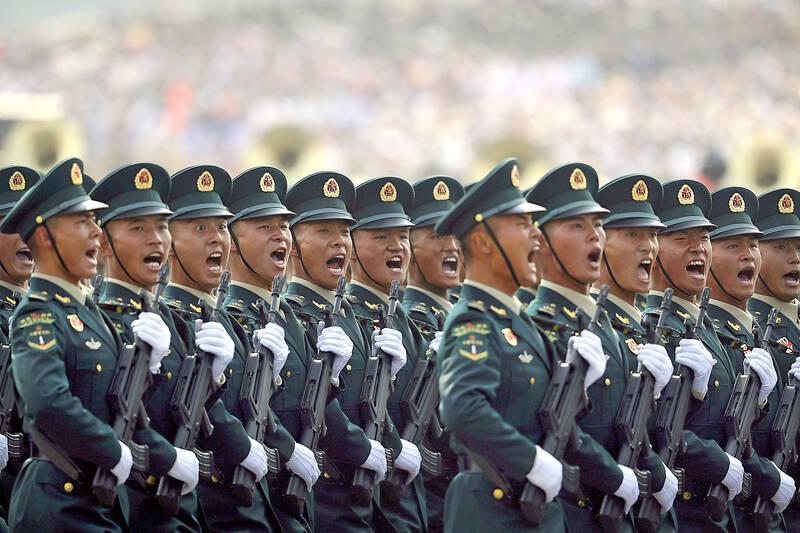
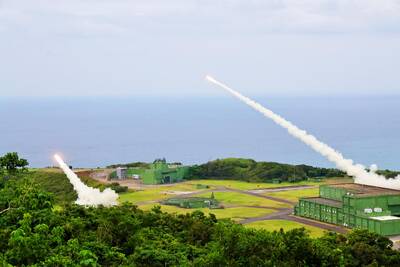
Photo: AP
Further out, Beijing could leverage Trump's move to defend its stance against the US on territorial issues including Taiwan, Tibet and islands in the East and South China seas.
"Washington's consistent, long-standing arguments are always that the Chinese actions are violating international law, but they are now damaging that," said William Yang, an analyst at International Crisis Group, a Brussels-based non-governmental organization.
"It's really creating a lot of openings and cheap ammunition for the Chinese to push back against the US in the future," Yang said.
China claims democratically governed Taiwan as its own — an assertion the nation’s government rejects — and claims almost all of the South China Sea, despite competing claims from other nations and an international court ruling that its assertion has no legal basis.
China’s Taiwan Affairs Office and Ministry of Foreign Affairs, and Taiwan’s Presidential Office did not immediately respond to requests for comment.
Beijing has condemned Trump's strike on Venezuela, saying it breached international law and threatened peace and security in Latin America. It has demanded the US release Maduro and his wife, who are being detained in New York awaiting trial.
Hours before his capture, Maduro met with a high-level Chinese delegation in Caracas, photographs he posted on his Instagram page showed.
The Chinese Ministry of Foreign Affairs did not immediately respond to a request for comment on the whereabouts of the delegation, which included Special Representative of the Chinese Government on Latin American and Caribbean Affairs Qiu Xiaoqi (邱小琪).
Xinhua news agency on Sunday called the US attack "naked hegemonic behavior."
"The US invasion has made everyone see more and more the fact that the so-called 'rules-based international order' in the mouth of the United States is actually just a 'predatory order based on US interests,'" the state-run agency said.
Taiwan, in particular, has been facing growing pressure from Beijing. China last week encircled the nation’s main island in its most extensive war games to date, showcasing Beijing's ability to cut it off from outside support in a conflict.
However, analysts said that they did not expect China to capitalize on the Venezuelan situation and escalate it into an attack anytime soon.
"Taking over Taiwan depends on China's developing, but still insufficient, capability rather than what Trump did in a distant continent," said Shi Yinhong (時殷弘), a professor of international relations at Renmin University in Beijing.
China sees Taiwan as an internal affair and so is unlikely to cite US actions against Venezuela as precedent for any cross-strait military strikes, said Neil Thomas, a fellow on Chinese politics at the Asia Society.
"Beijing will want a clear contrast with Washington to trumpet its claims to stand for peace, development and moral leadership," Thomas said. "Xi does not care about Venezuela more than he cares about China. He'll be hoping that it turns into a quagmire for the United States."
Democratic Progressive Party Legislator Wang Ting-yu (王定宇), who sits on the Legislative Yuan’s Foreign Affairs and National Defense Committee, rejected the idea that China might follow the US’ example and strike Taiwan.
"China has never lacked hostility toward Taiwan, but it genuinely lacks the feasible means," Wang wrote on Facebook. "China is not the United States, and Taiwan is certainly not Venezuela. If China could actually pull it off, it would have done so long ago!"
Still, the situation amplifies risks for Taiwan and could press Taipei to seek more favor from the Trump administration, some observers said.
On China's Sina Weibo social media platform, discussions of the US attack trended heavily on Sunday, with several users saying that Beijing should learn from what Trump did.
Lev Nachman, a political science professor at National Taiwan University, said that he expected Taiwan's government to express lightly worded support for the US’ action on Venezuela.
Taiwan has not yet made any statement.
"What I do think Trump's actions could do is to help Xi Jinping's narrative in the future to create more justification for action against Taiwan," he said.
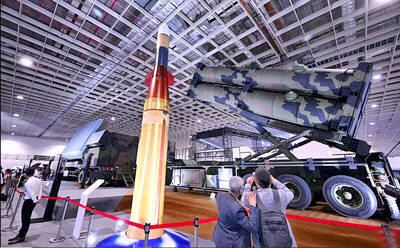
Taiwan is to commence mass production of the Tien Kung (天弓, “Sky Bow”) III, IV and V missiles by the second quarter of this year if the legislature approves the government’s NT$1.25 trillion (US$39.78 billion) special defense budget, an official said yesterday. Commenting on condition of anonymity, a defense official with knowledge of the matter said that the advanced systems are expected to provide crucial capabilities against ballistic and cruise missiles for the proposed “T-Dome,” an advanced, multi-layered air defense network. The Tien Kung III is an air defense missile with a maximum interception altitude of 35km. The Tien Kung IV and V
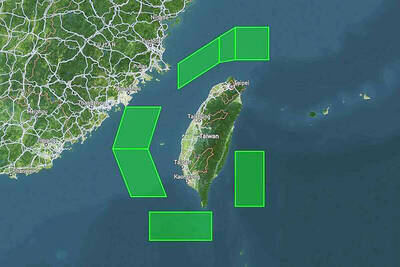
The disruption of 941 flights in and out of Taiwan due to China’s large-scale military exercises was no accident, but rather the result of a “quasi-blockade” used to simulate creating the air and sea routes needed for an amphibious landing, a military expert said. The disruptions occurred on Tuesday and lasted about 10 hours as China conducted live-fire drills in the Taiwan Strait. The Civil Aviation Administration (CAA) said the exercises affected 857 international flights and 84 domestic flights, affecting more than 100,000 travelers. Su Tzu-yun (蘇紫雲), a research fellow at the government-sponsored Institute for National Defense and Security Research, said the air
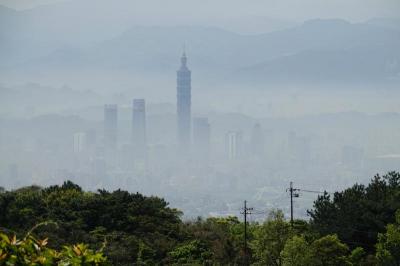
A strong continental cold air mass is to bring pollutants to Taiwan from tomorrow, the Ministry of Environment said today, as it issued an “orange” air quality alert for most of the country. All of Taiwan except for Hualien and Taitung counties is to be under an “orange” air quality alert tomorrow, indicating air quality that is unhealthy for sensitive groups. In China, areas from Shandong to Shanghai have been enveloped in haze since Saturday, the ministry said in a news release. Yesterday, hourly concentrations of PM2.5 in these areas ranged from 65 to 160 micrograms per cubic meter (mg/m³), and pollutants were
Taiwan lacks effective and cost-efficient armaments to intercept rockets, making the planned “T-Dome” interception system necessary, two experts said on Tuesday. The concerns were raised after China’s military fired two waves of rockets during live-fire drills around Taiwan on Tuesday, part of two-day exercises code-named “Justice Mission 2025.” The first wave involved 17 rockets launched at 9am from Pingtan in China’s Fujian Province, according to Lieutenant General Hsieh Jih-sheng (謝日升) of the Office of the Deputy Chief of the General Staff for Intelligence at the Ministry of National Defense. Those rockets landed 70 nautical miles (129.6km) northeast of Keelung without flying over Taiwan,


 RSS
RSS