


While some Venezuelans celebrated the arrest of their president in a US raid over the weekend, others were conflicted about the violation of the nation’s sovereignty and the future of their country, a Taiwanese resident of the South American nation said on Sunday.
The man, surnamed You (游), declined to give his full name or exact location for safety concerns, but said he has lived in Venezuela for more than 25 years.
From a town about a five-hour drive from the capital, Caracas, You spoke about his experiences in the country a day after the US launched airstrikes before seizing Venezuelan President Nicolas Maduro and his wife to face drug trafficking charges in New York.
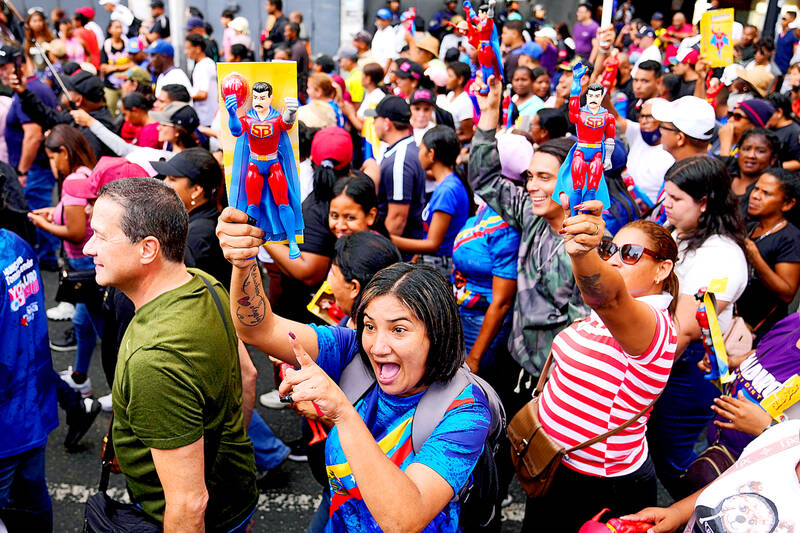
Photo: AP
You, 39, said he learned about the US strikes and seizure of Maduro after dawn on Saturday, when he woke up to people celebrating in the street.
People fell into three broad categories on the incident, with the main two being those who support the government, often because they work for or otherwise benefit from it, and the opposition, which welcomed the intervention, he said.
In the middle are many people who feel conflicted by the events, who hope for a change of government, but also view the seizure of the head of state as a violation of sovereignty or an invasion, he said.
While on a drive on Sunday, You said he was briefly stopped at a checkpoint by police looking for suspicious individuals, before being quickly released.
You, 39, came to Venezuela in 1998, when his father was sent by a Taiwan-based company to work in the South American nation.
At the time, the country had a prosperous economy, with a metro system in the capital more advanced than the one in Taipei, he said.
As a university student during the administration of former Venezuelan president Hugo Chavez — who used booming profits from the country’s oil sector to fund a range of social and welfare programs — You received government stipends to study pharmacology and later attend graduate school, he said.
You was working for a foreign company in 2016, when collapsing oil prices, combined with economic mismanagement under Maduro, who took office after Chavez’ death in 2013, gave rise to hyperinflation, shortages and widespread protests.
US sanctions further squeezed the economy as they were introduced over the next two years, he said.
Amid the turmoil, many Taiwanese businesspeople who did not have well-established businesses or family reasons to stay left the country in 2017 and 2018, You said.
Although his father had passed away, You said he had put down roots in Venezuela, with a family and a business exporting industrial bearings, and that leaving the country was “not an option.”
To illustrate the situation many Venezuelans find themselves in, You gave the example of a friend, a career soldier, who, even if he did oppose the government, could not express it without facing immediate and severe consequences.
Among poorer Venezuelans, many fear having their benefits cut if they speak out against the government, he said.
He expressed hope that the country could someday return to the “golden era” he found when he arrived in the late 1990s.
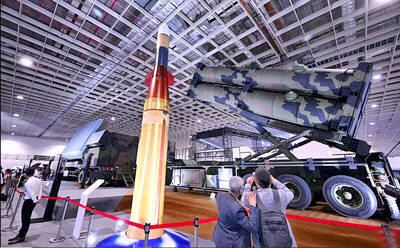
Taiwan is to commence mass production of the Tien Kung (天弓, “Sky Bow”) III, IV and V missiles by the second quarter of this year if the legislature approves the government’s NT$1.25 trillion (US$39.78 billion) special defense budget, an official said yesterday. Commenting on condition of anonymity, a defense official with knowledge of the matter said that the advanced systems are expected to provide crucial capabilities against ballistic and cruise missiles for the proposed “T-Dome,” an advanced, multi-layered air defense network. The Tien Kung III is an air defense missile with a maximum interception altitude of 35km. The Tien Kung IV and V
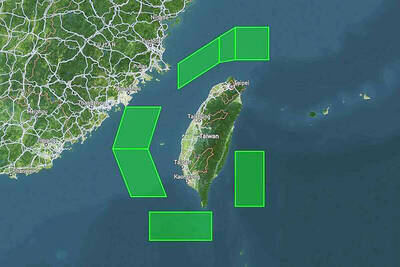
The disruption of 941 flights in and out of Taiwan due to China’s large-scale military exercises was no accident, but rather the result of a “quasi-blockade” used to simulate creating the air and sea routes needed for an amphibious landing, a military expert said. The disruptions occurred on Tuesday and lasted about 10 hours as China conducted live-fire drills in the Taiwan Strait. The Civil Aviation Administration (CAA) said the exercises affected 857 international flights and 84 domestic flights, affecting more than 100,000 travelers. Su Tzu-yun (蘇紫雲), a research fellow at the government-sponsored Institute for National Defense and Security Research, said the air
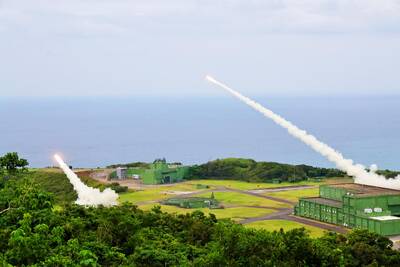
Taiwan lacks effective and cost-efficient armaments to intercept rockets, making the planned “T-Dome” interception system necessary, two experts said on Tuesday. The concerns were raised after China’s military fired two waves of rockets during live-fire drills around Taiwan on Tuesday, part of two-day exercises code-named “Justice Mission 2025.” The first wave involved 17 rockets launched at 9am from Pingtan in China’s Fujian Province, according to Lieutenant General Hsieh Jih-sheng (謝日升) of the Office of the Deputy Chief of the General Staff for Intelligence at the Ministry of National Defense. Those rockets landed 70 nautical miles (129.6km) northeast of Keelung without flying over Taiwan,
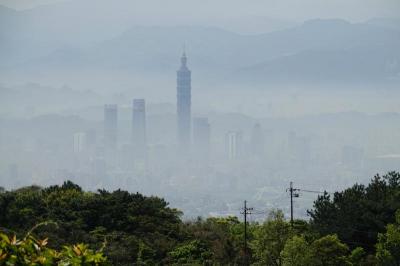
A strong continental cold air mass is to bring pollutants to Taiwan from tomorrow, the Ministry of Environment said today, as it issued an “orange” air quality alert for most of the country. All of Taiwan except for Hualien and Taitung counties is to be under an “orange” air quality alert tomorrow, indicating air quality that is unhealthy for sensitive groups. In China, areas from Shandong to Shanghai have been enveloped in haze since Saturday, the ministry said in a news release. Yesterday, hourly concentrations of PM2.5 in these areas ranged from 65 to 160 micrograms per cubic meter (mg/m³), and pollutants were


 RSS
RSS