


The Tourism Administration yesterday issued revised regulations governing applications by the hotel industry for foreign student internships, which require a minimum subsidy to ensure foreign interns’ welfare.
The hotel industry has seen a labor shortage and introduced a college intern program to partially sate the labor demand.
About 1,900 of more than 2,700 student applicants were approved last year, limiting their internship to half of their academic duration.
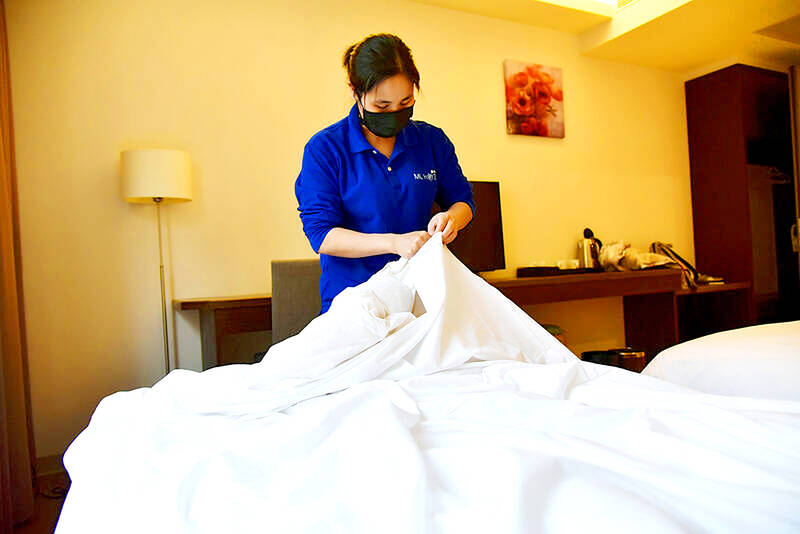
Photo courtesy of the Workforce Development Agency
For example, a foreign student of a four-year college program in their country can do internships in Taiwan for up to two years.
However, foreign interns get no salaries and whether they have internship subsidies, food, accommodation and reasonable work hours was part of the agreement between their school and local hotel operators, meaning many of their labor rights and benefits were not legally protected.
The Tourism Administration revised regulations, requiring hotels to offer each foreign intern a subsidy package of no less than the minimum wage enacted by the Ministry of Labor, which is NT$29,500 monthly or NT$196 hourly from the beginning of this year.
Board and lodging fees can be deducted from the subsidy package, but would be capped at NT$5,000 based on an administrative interpretation published in 2007 by then-Labor Affairs Council.
Work is capped at eight hours a day and no more than 40 hours a week. Work is generally forbidden from 10pm to 6am unless written consent has been obtained from the intern.
Hotels should grant interns a certificate after the internship is completed and report to the administration within 30 days following the internship completion.
Administration official Tsao Yi-shu (曹逸書) said the regulations were revised to enhance foreign interns’ rights, including ensuring a subsidy and preventing exploitation.
Under revised regulations, interns must have their age in line with their academic level to prevent applicants from impersonating a student to work in Taiwan via the foreign student internship program.
They must also have basic language proficiency in Mandarin or English. Students from non-
English-speaking countries must have certification of A1 or higher in the Test of Chinese as a Foreign Language or the Common European Framework of Reference for Languages.

Taiwan has received more than US$70 million in royalties as of the end of last year from developing the F-16V jet as countries worldwide purchase or upgrade to this popular model, government and military officials said on Saturday. Taiwan funded the development of the F-16V jet and ended up the sole investor as other countries withdrew from the program. Now the F-16V is increasingly popular and countries must pay Taiwan a percentage in royalties when they purchase new F-16V aircraft or upgrade older F-16 models. The next five years are expected to be the peak for these royalties, with Taiwan potentially earning
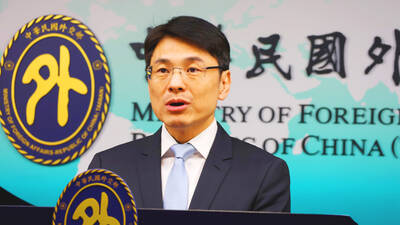
STAY IN YOUR LANE: As the US and Israel attack Iran, the ministry has warned China not to overstep by including Taiwanese citizens in its evacuation orders The Ministry of Foreign Affairs (MOFA) yesterday rebuked a statement by China’s embassy in Israel that it would evacuate Taiwanese holders of Chinese travel documents from Israel amid the latter’s escalating conflict with Iran. Tensions have risen across the Middle East in the wake of US and Israeli airstrikes on Iran beginning Saturday. China subsequently issued an evacuation notice for its citizens. In a news release, the Chinese embassy in Israel said holders of “Taiwan compatriot permits (台胞證)” issued to Taiwanese nationals by Chinese authorities for travel to China — could register for evacuation to Egypt. In Taipei, the ministry yesterday said Taiwan
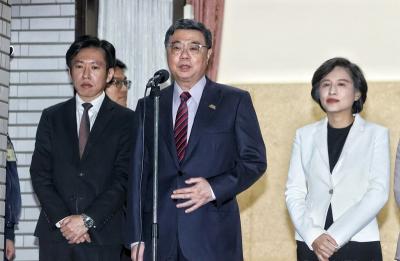
Taiwan is awaiting official notification from the US regarding the status of the Agreement on Reciprocal Trade (ART) after the US Supreme Court ruled US President Donald Trump's global tariffs unconstitutional. Speaking to reporters before a legislative hearing today, Premier Cho Jung-tai (卓榮泰) said that Taiwan's negotiation team remains focused on ensuring that the bilateral trade deal remains intact despite the legal challenge to Trump's tariff policy. "The US has pledged to notify its trade partners once the subsequent administrative and legal processes are finalized, and that certainly includes Taiwan," Cho said when asked about opposition parties’ doubts that the ART was
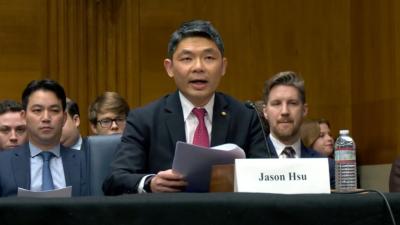
If China chose to invade Taiwan tomorrow, it would only have to sever three undersea fiber-optic cable clusters to cause a data blackout, Jason Hsu (許毓仁), a senior fellow at the Hudson Institute and former Chinese Nationalist Party (KMT) legislator, told a US security panel yesterday. In a Taiwan contingency, cable disruption would be one of the earliest preinvasion actions and the signal that escalation had begun, he said, adding that Taiwan’s current cable repair capabilities are insufficient. The US-China Economic and Security Review Commission (USCC) yesterday held a hearing on US-China Competition Under the Sea, with Hsu speaking on


 RSS
RSS