


Travel agents arranging tours to Japan should warn tourists about potential bear attacks when doing outdoor activities, the Tourism Administration said yesterday.
The nation’s tourism authority issued the notice to the travel agencies nationwide, reminding them to inform their clients about bear danger before leaving for Japan if the itineraries include outdoor activities in the mountainous areas. They must teach travelers how to protect themselves from bears.
The agencies must be ready to change itineraries if necessary, the administration said.
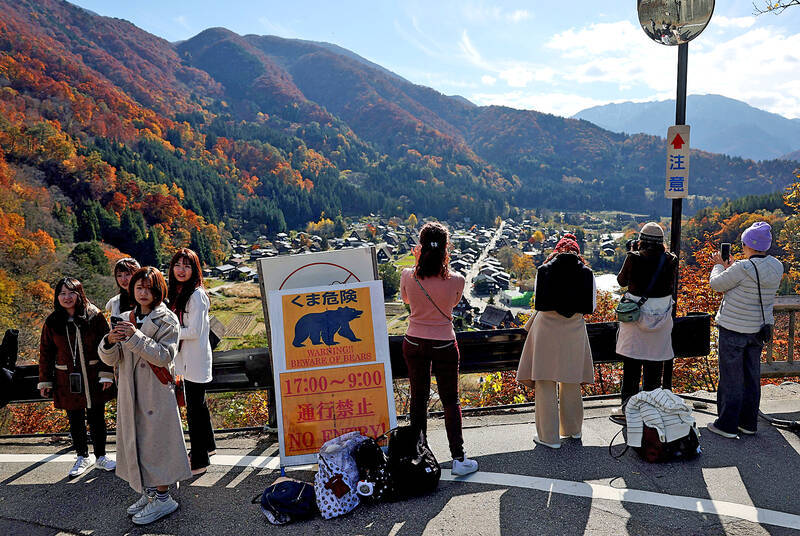
Photo: Reuters
About 230 people were attacked by bears from April to November last year, killing 13 people, according to statistics from the Japanese Ministry of the
Environment last month.
Even in winter, bear attacks were reported near popular tourist attractions in Japan.
Article 50-4 of Regulations Governing Travel Agencies (旅行業管理規則) and Article 39-1 of Regulations Governing Tour Managers (領隊人員管理規則) stipulate that service personnel sent by travel agencies, including tour guides and tour group leaders, are responsible for the safety of tourists during the trips, the Tourism Administration said.
Travel Quality Assurance Association’s public relations director Ringo Lee (李奇嶽) said Taiwanese traveling to Japan on group tours typically visit popular tourist attractions and are less likely to encounter bears during their trips.
Tour guides and tour bus drivers have been instructed to be alert, Lee said.
Goodday Tours general manager Aron Huang (黃清?) said that chances of bear attacks are lower in winter, as bears are in hibernation.
Reports of bear attacks do not seem to have dampened Taiwanese interest in visiting Japan, he said, adding that travel agencies are seeing a 10 to 20 percent increase in bookings for tours there during the Lunar New Year holiday.
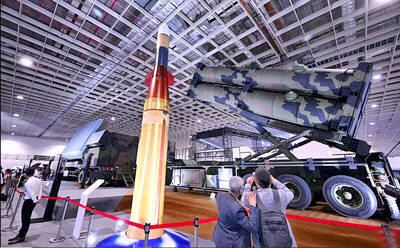
Taiwan is to commence mass production of the Tien Kung (天弓, “Sky Bow”) III, IV and V missiles by the second quarter of this year if the legislature approves the government’s NT$1.25 trillion (US$39.78 billion) special defense budget, an official said yesterday. Commenting on condition of anonymity, a defense official with knowledge of the matter said that the advanced systems are expected to provide crucial capabilities against ballistic and cruise missiles for the proposed “T-Dome,” an advanced, multi-layered air defense network. The Tien Kung III is an air defense missile with a maximum interception altitude of 35km. The Tien Kung IV and V
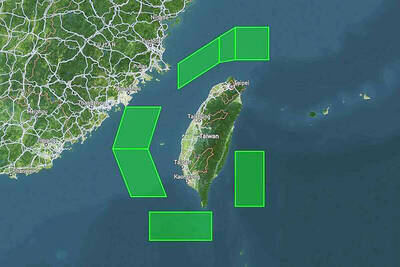
The disruption of 941 flights in and out of Taiwan due to China’s large-scale military exercises was no accident, but rather the result of a “quasi-blockade” used to simulate creating the air and sea routes needed for an amphibious landing, a military expert said. The disruptions occurred on Tuesday and lasted about 10 hours as China conducted live-fire drills in the Taiwan Strait. The Civil Aviation Administration (CAA) said the exercises affected 857 international flights and 84 domestic flights, affecting more than 100,000 travelers. Su Tzu-yun (蘇紫雲), a research fellow at the government-sponsored Institute for National Defense and Security Research, said the air
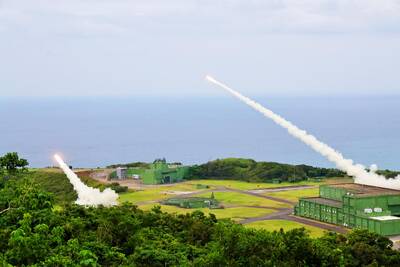
Taiwan lacks effective and cost-efficient armaments to intercept rockets, making the planned “T-Dome” interception system necessary, two experts said on Tuesday. The concerns were raised after China’s military fired two waves of rockets during live-fire drills around Taiwan on Tuesday, part of two-day exercises code-named “Justice Mission 2025.” The first wave involved 17 rockets launched at 9am from Pingtan in China’s Fujian Province, according to Lieutenant General Hsieh Jih-sheng (謝日升) of the Office of the Deputy Chief of the General Staff for Intelligence at the Ministry of National Defense. Those rockets landed 70 nautical miles (129.6km) northeast of Keelung without flying over Taiwan,
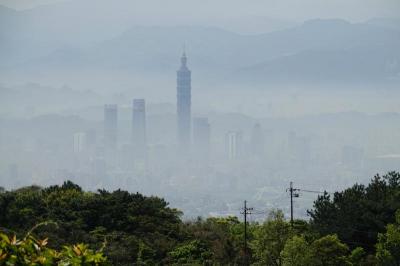
A strong continental cold air mass is to bring pollutants to Taiwan from tomorrow, the Ministry of Environment said today, as it issued an “orange” air quality alert for most of the country. All of Taiwan except for Hualien and Taitung counties is to be under an “orange” air quality alert tomorrow, indicating air quality that is unhealthy for sensitive groups. In China, areas from Shandong to Shanghai have been enveloped in haze since Saturday, the ministry said in a news release. Yesterday, hourly concentrations of PM2.5 in these areas ranged from 65 to 160 micrograms per cubic meter (mg/m³), and pollutants were


 RSS
RSS