


The Ministry of Environment today unveiled a new toilet-themed art installation as part of efforts to promote seated toilets and encourage people to flush toilet paper.
The ministry introduced the installation created in cooperation with the Friends of Daan Forest Park Foundation at an event in its main lobby.
The display features transparent toilet bowls to promote flushing toilet paper, as well as seated toilets over squat toilets for better hygiene and accessibility.
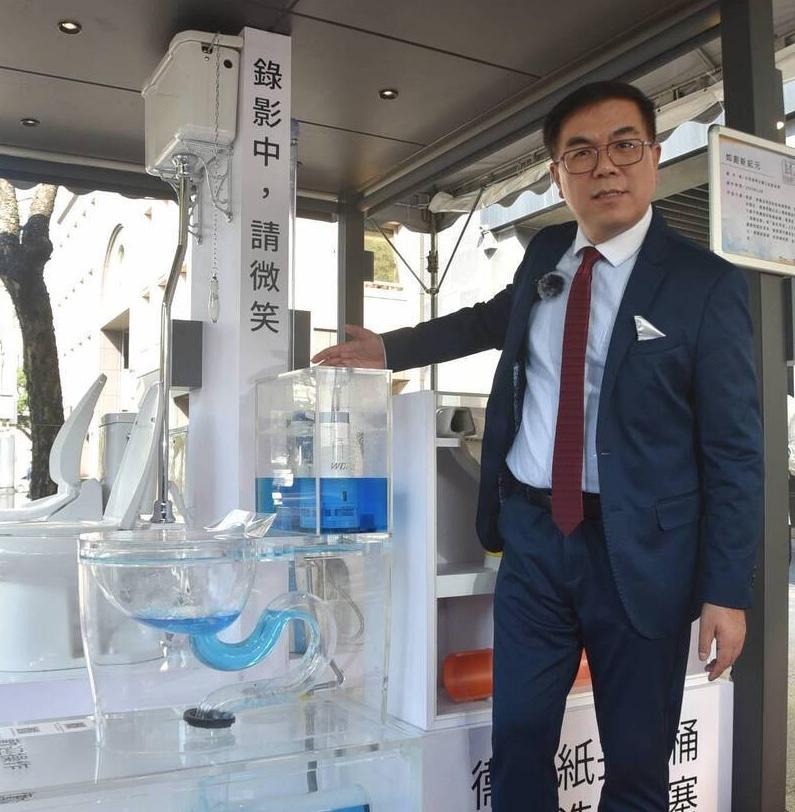
Photo: Wu Po-hsuan, Taipei Times
Squat toilets currently account for nearly half of all 45,000 public restrooms overseen by the ministry, although it hopes to raise the proportion of seated toilets to 80 percent within the next few years, Minister of Environment Peng Chi-ming (彭啟明) said.
The rollout would begin with government agencies, although no date has been set to entirely replace squat toilets, he added.
The ministry hopes to improve and modernize public restrooms, often described as “wet, dirty and smelly,” Peng said.
Squat toilets have a bacterial count hundreds of times higher than seated ones, he said, adding that the ministry has instructed restroom management units to provide alcohol wipes or disposable seat covers to ensure cleanliness.
Squat toilets do not exist in Western countries, leaving many US and European tourists “shocked” to find them in Taiwan, foundation managing director Tsai Chien-sheng (蔡建生) said.
Neighboring countries such as Japan and Singapore have also set goals to reduce the number of squat toilets, he added.
Meanwhile, the ministry said it has conducted testing with 26 different brands of toilet paper, showing that they are completely flushable.
However, it advised not to flush facial tissues.
Many business owners worry that toilet paper clogs pipes in old plumbing systems, although urine scale buildup or debris is usually to blame, both of which are easily resolved through professional cleaning services, Peng said.
Taiwan is one of the few countries in the world that still promotes throwing used toilet paper into trash cans rather than flushing it, which can lead to bacterial growth and negatively affect Taiwan’s tourism image and international reputation, Tsai added.
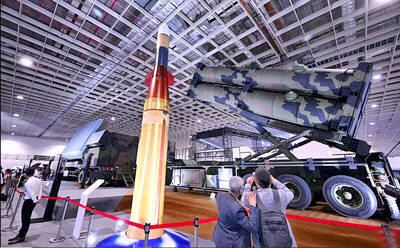
Taiwan is to commence mass production of the Tien Kung (天弓, “Sky Bow”) III, IV and V missiles by the second quarter of this year if the legislature approves the government’s NT$1.25 trillion (US$39.78 billion) special defense budget, an official said yesterday. Commenting on condition of anonymity, a defense official with knowledge of the matter said that the advanced systems are expected to provide crucial capabilities against ballistic and cruise missiles for the proposed “T-Dome,” an advanced, multi-layered air defense network. The Tien Kung III is an air defense missile with a maximum interception altitude of 35km. The Tien Kung IV and V
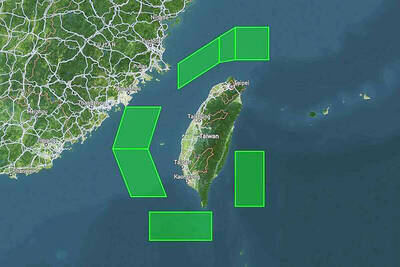
The disruption of 941 flights in and out of Taiwan due to China’s large-scale military exercises was no accident, but rather the result of a “quasi-blockade” used to simulate creating the air and sea routes needed for an amphibious landing, a military expert said. The disruptions occurred on Tuesday and lasted about 10 hours as China conducted live-fire drills in the Taiwan Strait. The Civil Aviation Administration (CAA) said the exercises affected 857 international flights and 84 domestic flights, affecting more than 100,000 travelers. Su Tzu-yun (蘇紫雲), a research fellow at the government-sponsored Institute for National Defense and Security Research, said the air
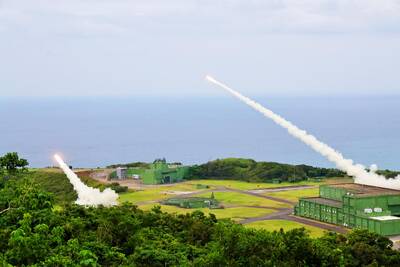
Taiwan lacks effective and cost-efficient armaments to intercept rockets, making the planned “T-Dome” interception system necessary, two experts said on Tuesday. The concerns were raised after China’s military fired two waves of rockets during live-fire drills around Taiwan on Tuesday, part of two-day exercises code-named “Justice Mission 2025.” The first wave involved 17 rockets launched at 9am from Pingtan in China’s Fujian Province, according to Lieutenant General Hsieh Jih-sheng (謝日升) of the Office of the Deputy Chief of the General Staff for Intelligence at the Ministry of National Defense. Those rockets landed 70 nautical miles (129.6km) northeast of Keelung without flying over Taiwan,
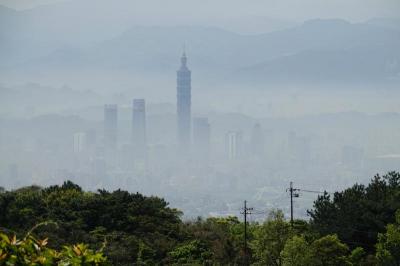
A strong continental cold air mass is to bring pollutants to Taiwan from tomorrow, the Ministry of Environment said today, as it issued an “orange” air quality alert for most of the country. All of Taiwan except for Hualien and Taitung counties is to be under an “orange” air quality alert tomorrow, indicating air quality that is unhealthy for sensitive groups. In China, areas from Shandong to Shanghai have been enveloped in haze since Saturday, the ministry said in a news release. Yesterday, hourly concentrations of PM2.5 in these areas ranged from 65 to 160 micrograms per cubic meter (mg/m³), and pollutants were


 RSS
RSS