


The proportion of people using artificial intelligence (AI) rose to 56.3 percent last year, primarily for transportation in daily life and research and analysis at work, a survey by the National Communications Commission (NCC) showed.
The NCC recently published its communications market report for last year, which included a survey on AI use.
The number of people using AI has been rising annually along with its continued development, with 56.3 percent of people using it last year compared with 52.5 percent in 2024, the NCC said.

Photo: AFP
In terms of daily life, 75 percent of people who use AI reported using it for transportation, including smart navigation, license plate recognition and autonomous driving, the survey showed.
The second most common use was language assistance, with 64 percent of users using it for voice input and control, translation and text-to-speech.
The third was security and monitoring, with 45 percent of users using AI for smart security systems and biometric authentication.
In terms of work, 41 percent of users reported using AI to look up, process and analyze data, the survey showed.
The second most common work-related use, at 25.6 percent, was communication and network traffic management.
The third was arts and content creation, with 16.6 percent using it to generate images, articles, illustrations, animations and scripts.
More than 30 percent of people reported not using AI at work, the NCC added.
The surge in AI applications shows no signs of slowing, with uses across fields that improve work efficiency, the NCC said, adding that the latest data show that AI is integrating into people’s daily lives.
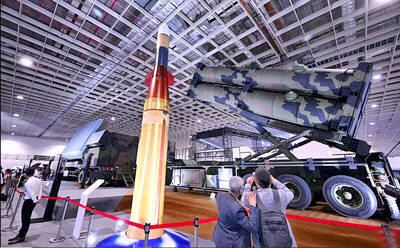
Taiwan is to commence mass production of the Tien Kung (天弓, “Sky Bow”) III, IV and V missiles by the second quarter of this year if the legislature approves the government’s NT$1.25 trillion (US$39.78 billion) special defense budget, an official said yesterday. Commenting on condition of anonymity, a defense official with knowledge of the matter said that the advanced systems are expected to provide crucial capabilities against ballistic and cruise missiles for the proposed “T-Dome,” an advanced, multi-layered air defense network. The Tien Kung III is an air defense missile with a maximum interception altitude of 35km. The Tien Kung IV and V
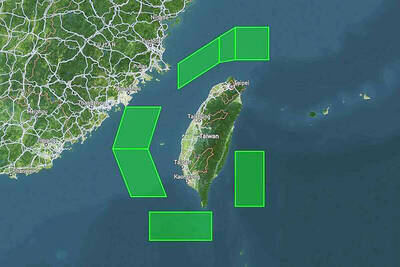
The disruption of 941 flights in and out of Taiwan due to China’s large-scale military exercises was no accident, but rather the result of a “quasi-blockade” used to simulate creating the air and sea routes needed for an amphibious landing, a military expert said. The disruptions occurred on Tuesday and lasted about 10 hours as China conducted live-fire drills in the Taiwan Strait. The Civil Aviation Administration (CAA) said the exercises affected 857 international flights and 84 domestic flights, affecting more than 100,000 travelers. Su Tzu-yun (蘇紫雲), a research fellow at the government-sponsored Institute for National Defense and Security Research, said the air
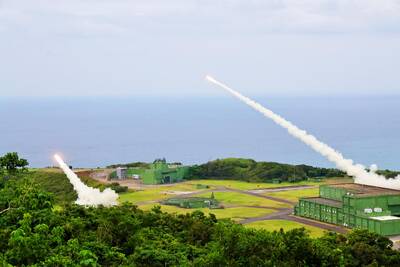
Taiwan lacks effective and cost-efficient armaments to intercept rockets, making the planned “T-Dome” interception system necessary, two experts said on Tuesday. The concerns were raised after China’s military fired two waves of rockets during live-fire drills around Taiwan on Tuesday, part of two-day exercises code-named “Justice Mission 2025.” The first wave involved 17 rockets launched at 9am from Pingtan in China’s Fujian Province, according to Lieutenant General Hsieh Jih-sheng (謝日升) of the Office of the Deputy Chief of the General Staff for Intelligence at the Ministry of National Defense. Those rockets landed 70 nautical miles (129.6km) northeast of Keelung without flying over Taiwan,
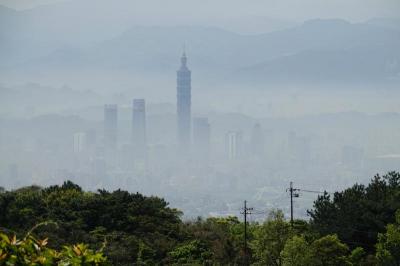
A strong continental cold air mass is to bring pollutants to Taiwan from tomorrow, the Ministry of Environment said today, as it issued an “orange” air quality alert for most of the country. All of Taiwan except for Hualien and Taitung counties is to be under an “orange” air quality alert tomorrow, indicating air quality that is unhealthy for sensitive groups. In China, areas from Shandong to Shanghai have been enveloped in haze since Saturday, the ministry said in a news release. Yesterday, hourly concentrations of PM2.5 in these areas ranged from 65 to 160 micrograms per cubic meter (mg/m³), and pollutants were


 RSS
RSS