


Tour operators in Kenting (墾丁) have seen a glimmer of hope for bringing visitors back to the once-popular travel destination in southern Taiwan, following an unexpected rise in older travelers.
Once credited by some as the nation’s tropical paradise, Kenting used to attract millions of tourists each year with its beautiful beaches and musical festival Spring Scream.
The number of tourists in Kenting peaked in 2014, when 8.37 million visited after the release of Taiwanese blockbuster film Cape No. 7 (海角七號).
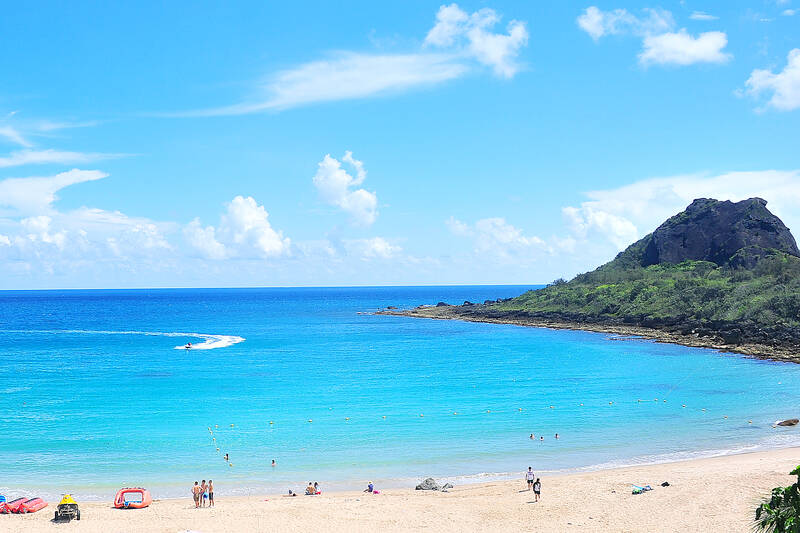
Photo: Tsai Tsung-hsien, Taipei Times
The number has since drastically declined as more young Taiwanese choose to travel overseas.
Kenting’s reputation also suffered a huge hit following extensive media coverage on overpriced hotel rooms and street vendors in Kenting Night Market overcharging tourists.
While Kenting might have lost its appeal among young people, it has appeared to find its way into the hearts of older travelers, who neither care for uploading pictures to Instagram nor reading travelers’ reviews online.
An 82-year-woman surnamed Lai (賴), while sitting in the Howard Beach Resort Kenting, told the Liberty Times (sister paper of the Taipei Times) that this was her eighth visit to Kenting in three years.
She said that overseas travel has stopped being her first choice due to the discomfort of long-distance travel and risks of seeking medical attention in a foreign country.
“Visiting Kenting gives you a quasi-feel for spending a vacation in a foreign country,” Lai said, adding that it has become a must-visit spot for her and her friends each year without having to worry about medical services and language problems.
An 84-year-man surnamed Cheng (鄭) said that his age no longer permits him to have an intense travel itinerary.
The Hengchun Peninsula (恆春半島) is a comfort zone in all types of weather, he said.
“Even when there is a downslope wind in Kenting in winter, you can stay in the hotel and chat with your friends or take the shuttle bus to the beach. It provides a sense of safety much like the one you experience at home,” Cheng said.
“Young people like to rush from one place to another and pursue excitement. All we have is time. All we need is a place to feel accepted,” he said.
A 72-year-old woman surnamed Lee (李) said that scenic spots in the Hengchun Peninsula are a little easier on the knees compared with those in central Taiwan.
However, traveling from northern Taiwan to Kenting might be a physical challenge to some older travelers, Lee said, adding that some might not want to come because some bed-and-breakfast operators do not offer shuttle bus services.
A tour guide surnamed Hsu (許) said that creating barrier-free environments for older travelers — who have money, tend to repeatedly return to the places they like and truly love Taiwan — would be key to rebooting tourism in Kenting.
Local governments need to focus on attracting older travelers, aside from attracting young tourists or family travelers, Hsu said.
Flagship accommodation providers such as Caesar Park and Howard Hotels have begun adjusting their business strategies to attract guests by emphasizing medical accessibility, health and wellness.
The Pingtung County Government has also rolled out tourism policies to support these efforts, aiming to position the Hengchun Peninsula as Taiwan’s top destination for older vacationers.
Caesar Park Kenting general manager Kuo Hsuan-tso (郭軒作) said older travelers focus more on a sense of safety.
Compared with scenic spots, Kenting offers not only a relaxing atmosphere of blue skies and ocean views, but also a well-designed, barrier-free environment, with just a 15-minute drive to three hospitals in Hengchun (恆春), Kuo said.
Hotels have also incorporated healthy diet, yoga and meditation into their accommodation offerings to attract older guests for long-term stays, he said.
The county government has also introduced a Senior and Barrier-Free Travel Guide, which provides detailed information on accessible shuttle services and scenic spot locations.

Yangmingshan National Park authorities yesterday urged visitors to respect public spaces and obey the law after a couple was caught on a camera livestream having sex at the park’s Qingtiangang (擎天崗) earlier in the day. The Shilin Police Precinct in Taipei said it has identified a suspect and his vehicle registration number, and would summon him for questioning. The case would be handled in accordance with public indecency charges, it added. The couple entered the park at about 11pm on Thursday and began fooling around by 1am yesterday, the police said, adding that the two were unaware of the park’s all-day live

A former soldier and an active-duty army officer were yesterday indicted for allegedly selling classified military training materials to a Chinese intelligence operative for a total of NT$79,440. The Taipei District Prosecutors’ Office indicted Chen Tai-yin (陳泰尹) and Lee Chun-ta (李俊達) for contravening the National Security Act (國家安全法) and the Anti-Corruption Act (貪污治罪條例). Chen left the military in September 2013 after serving alongside then-staff sergeant Lee, now an army lieutenant, at the 21st Artillery Command of the army’s Sixth Corps from 2011 to 2013, according to the indictment. Chen met a Chinese intelligence operative identified as “Wang” (王) through a friend in November

Minister of Digital Affairs Lin Yi-ching (林宜敬) yesterday cited regulatory issues and national security concerns as an expert said that Taiwan is among the few Asian regions without Starlink. Lin made the remarks on Facebook after funP Innovation Group chief executive officer Nathan Chiu (邱繼弘) on Friday said Taiwan and four other countries in Asia — China, North Korea, Afghanistan and Syria — have no access to Starlink. Starlink has become available in 166 countries worldwide, including Ukraine, Malaysia, the Philippines and Vietnam, in the six years since it became commercial, he said. While China and North Korea block Starlink, Syria is not
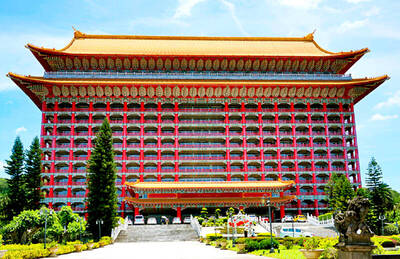
The Grand Hotel Taipei has rejected media reports claiming that the hotel had prevented CBS from broadcasting coverage of the Beijing summit between U.S. President Donald Trump and Chinese President Xi Jinping (習近平) on its premises. Media reports alleging that the hotel owner, dissatisfied with CBS’s coverage, prohibited the network from broadcasting political content on the hotel premises, are not true, the hotel said in a statement issued last night. The reports were “inconsistent with how the hotel actually handled the matter,” it said. The hotel said it received a refund request from a


 RSS
RSS