


The Taiwan Banana Research Institute has developed a Panama disease-resistant banana variety, Tai-Chiao No. 9 (TC9), which is expected to change the global banana supply landscape.
Bananas are an economically important fruit crop to the world, and Taiwan-developed disease-resistant bananas are recognized by experts as a fortress variety to safeguard bananas globally.
A research team formed by Academia Sinica’s Agricultural Biotechnology Research Center associate researcher Chen Ho-ming (陳荷明) and the institute in collaboration with researchers from National Taiwan University (NTU) found that the deletion of certain chromosomal segments in Taiwanese bananas significantly increased their resistance to Panama disease.
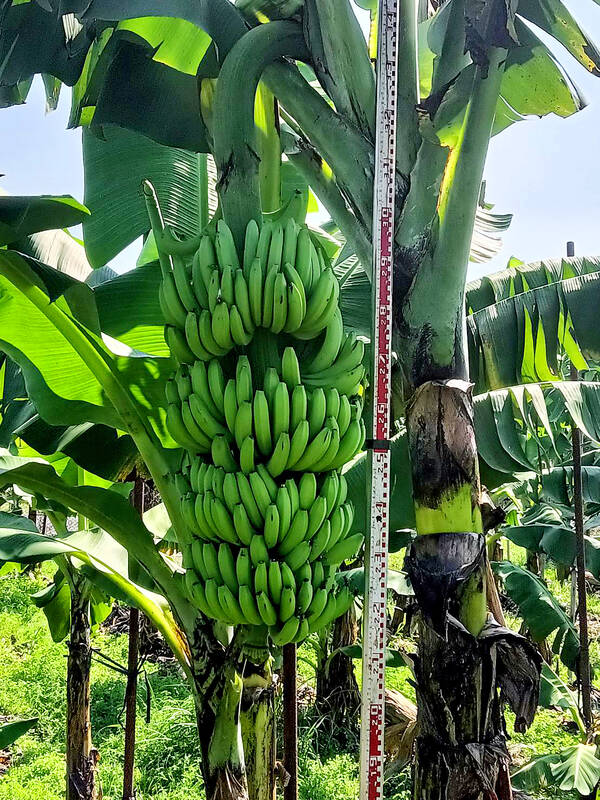
Photo courtesy of the Taiwan Banana Research Institute
The institute continued to utilize the findings to cultivate the new disease-resistance banana variety, TC9, with the goal of bringing it to the global market.
Established by the Ministry of Agriculture, the institute is one of the most important banana research institutions in the world and has developed several banana varieties that can resist tropical race 4 (TR4) — a race of Panama disease known as a “terminal illness” for bananas.
Bananas infected with TR4 could cause the whole plantation to wither, while the pathogenic fungi would incubate in the soil for decades.
Institute director Chiu Chu-ying (邱祝櫻) yesterday said that NTU plant pathology and microbiology professor Su Hong-ji (蘇鴻基) in 1967 unveiled the linkage between the TR4 fungus and Panama disease, and began to develop its disease spectrum by conducting tissue culture and seedling propagation.
The institute has for decades been screening for banana seedlings with disease resistance by mixing them with viruses and has previously identified Panama disease-resistant varieties such as Tai-Chiao No. 4, Tai-Chiao No. 5 and Tai-Chiao No. 7, she said.
Chen started collaborating with the institute 10 years ago to identify key differences between varieties with and without disease resistance by analyzing the genome, transcriptome and gene functions.
Most Panama disease-resistant Taiwanese banana varieties were found to have certain large chromosomal segments deleted, he said.
Such deletions significantly boosted the bananas’ resistance to Panama disease, Chen said.
These findings proved that structural variations in chromosomes played a crucial role in mutation-based banana breeding and could be used as actionable genomic targets for precise disease resistance breeding in the future, he said, adding that relevant studies were already published in the prestigious Proceedings of the National Academy of Sciences of the United States of America journal.
Chen is analyzing TC9’s molecular markers, but has yet to reveal the matter to the public given the major agricultural commercial interests involved, while the ministry has applied for its plant breeders’ rights.
Williams is the primary global commercial banana variety, largely grown in the Philippines and Latin America, but almost unable to resist Panama disease, Chiu said.
TC9 is a cultivar developed based on Williams and has at least 70 percent resistance to Panama disease, she said.
Although TC9’s plant breeders’ rights have been approved in Taiwan, a worldwide deployment of plant breeders’ rights obtained from other countries must be completed before exporting the cultivar’s seedlings, Chiu said.
Bananas can reproduce asexually and technical leakage likely would happen if the newly developed variety’s banana sprouts are stolen, she said.

NATIONAL SECURITY: Authorities are working to confirm the identities of the military personnel involved and investigating possible illegal conduct and regulatory violations Authorities are probing possible national security implications after Kinmen police and immigration officers on Sunday found a Chinese woman allegedly posing as a tourist while engaging in prostitution involving more than 10 military personnel. The woman, surnamed Chen (陳), has since been deported, authorities said, adding that investigators are still working to confirm the identities of those implicated, as the records only listed code names and aliases. The case stemmed from a report received by the Kinmen District Prosecutors’ Office on Friday last week from the Jinhu Precinct of the Kinmen County Police Bureau. On Sunday, police, along with the National Immigration

GLOBALGIVING: ‘ Caving to external pressure is not acceptable for an organization that has cultivated justice reform and human rights for 30 years,’ one NGO said A slew of non-government organizations (NGOs) have withdrawn from the GlobalGiving fundraising platform after it announced it would use “Chinese Taipei” instead of “Taiwan” from next month. The Taiwan Good Rice Association wrote on Facebook on Friday that it was informed on April 28 via a teleconference call of the change, which was made because the platform wanted to operate in China. Taiwan Good Rice is to terminate all cooperative relationships with GlobalGiving in response to the platform’s “unilateral and non-negotiable” decision to remove references to Taiwan, the NGO said. “Taiwan is in the official name of Taiwan Good Rice Association and the

HEAVY WEATHER: Typhoon Jangmi is due to crash straight into the Ryukyus as airlines look to shift flights to larger aircraft or cancel flights to Okinawa entirely Taiwan’s international air carriers announced flight adjustments over the weekend as Typhoon Jangmi is forecast to hit the Ryukyu Islands today and tomorrow. The Central Weather Administration (CWA) upgraded Jangmi from a tropical storm to a typhoon at 8am yesterday, with the eye located 580km south of Naha city. It was moving north at 19kph. Today, China Airlines’ CI-120, CI-121, CI-122 and CI-123 flights between Taoyuan and Naha, Okinawa, have been canceled as well as CI-132 and CI-133 between Kaohsiung and Naha. EVA Air’s BR-112, BR-113, BR-186 and BR-185 flights between Taoyuan and Naha are also canceled. Low-cost carrier Tigerair Taiwan canceled IT-230,

Chinese Nationalist Party (KMT) Chairwoman Cheng Li-wun (鄭麗文) yesterday briefed her party’s Central Standing Committee regarding her scheduled visit to the US between Monday next week and June 16, saying that her purpose would be to persuade the US that the Republic of China (ROC) Constitution was a “one China” constitution that would foster stable and peaceful cross-strait relations. The ROC Constitution is the most important defense for all Taiwanese citizens, as it upholds our democracy and has contributed to our robust economy, which aligns with international and US interests, she said. “We would not be troublemakers and drag the US under,”


 RSS
RSS