


A British national received a more than four-year sentence in a Keelung District Court ruling for cultivating cannabis and making related products.
The English-language teacher, named Paul, bought cannabis seeds in Amsterdam while on a trip to Europe in 2023, hiding them in his luggage on his return to Taiwan, investigators said.
Later that year, Paul used a Shopee account belonging to his ex-wife — a Taiwanese — to order lighting equipment, tents and chemical fertilizers to his residence in New Taipei City for the cultivation of cannabis, they said.

Photo: Taipei Times
Paul reportedly took online lessons on cultivating cannabis plants and how to set up the equipment before planting the seeds in January 2024, until the Ministry of Justice Investigation Bureau (MJIB) intervened in July, they said.
By monitoring and analyzing household electricity consumption, MJIB investigators observed abnormal energy usage at Paul’s residence, they said.
Following a raid of the residence, the MJIB uncovered 63 cannabis plants, 23 seedlings, cannabis paste, indoor cultivation equipment and chemical fertilizer, the bureau said.
Paul was quoted as saying that he previously had a habit of cannabis consumption, and therefore decided to grow cannabis for personal consumption.
He was indicted on contraventions of Article 4 of the Narcotics Hazard Prevention Act (毒品危害防制條例), which forbids “manufacturing, transporting or selling Category 2 narcotics.”
Paul admitted to growing the cannabis, making him eligible for sentence reduction, the court said.
The court handed Paul a four-year, eight-month prison sentence, reduced from the minimum 10-year term prescribed by the act.
He would be deported from the country upon completion of his sentence, the court said.
In other news, the Taiwan Weed Safety Education Association and Green Sensation groups last month launched a petition urging the government to ease restrictions on tetrahydrocannabinol (THC) content in cannabis products, as part of their years-long effort campaigning for medical-use decriminalization.
The petition contains three main requests, urging the government “to re-examine tolerance for THC, based on scientific facts,” adding that “Taiwan should join the ‘green gold rush’ as in many countries, to develop the cannabis industry.”
“Stop vilifying cannabis consumption, Taiwan should turn from ‘fear’ to ‘sensible’ management policies,” it said.
“Taiwan has set a 0.001 percent limit for THC content, with anything above that deemed to be narcotics, while the US defines narcotics as more than 0.3 percent,” the petition said, adding that research has proven that such levels do not lead to addiction.
The petition also cited a man surnamed Lee (李), who described his use of cannabis as medicine to relieve symptoms of irritable bowel syndrome and attention deficit hyperactivity disorder, urging the government to decriminalize medical use of the drug.

LOUD AND PROUD Taiwan might have taken a drubbing against Australia and Japan, but you might not know it from the enthusiasm and numbers of the fans Taiwan might not be expected to win the World Baseball Classic (WBC) but their fans are making their presence felt in Tokyo, with tens of thousands decked out in the team’s blue, blowing horns and singing songs. Taiwanese fans have packed out the Tokyo Dome for all three of their games so far and even threatened to drown out home team supporters when their team played Japan on Friday. They blew trumpets, chanted for their favorite players and had their own cheerleading squad who dance on a stage during the game. The team struggled to match that exuberance on the field, with
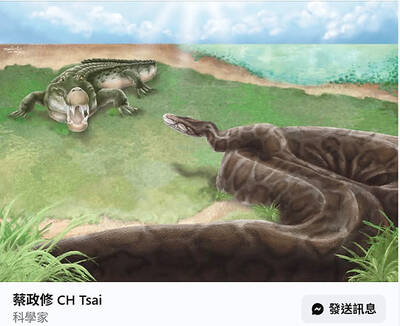
Taiwanese paleontologists have discovered fossil evidence that pythons up to 4m long inhabited Taiwan during the Pleistocene epoch, reporting their findings in the international scientific journal Historical Biology. National Taiwan University (NTU) Institute of Ecology and Evolutionary Biology associate professor Tsai Cheng-hsiu (蔡政修) led the team that discovered the largest snake fossil ever found in Taiwan. The single trunk vertebra was discovered in Tainan at the Chiting Formation, dated to between 400,000 and 800,000 years ago in the Middle Pleistocene, the paper said. The area also produced Taiwan’s first avian fossil, as well as crocodile, mammoth, saber-toothed cat and rhinoceros fossils, it said. Discoveries

Taiwanese paleontologists have discovered fossil evidence that pythons up to 4m long inhabited Taiwan during the Pleistocene epoch, reporting their findings in the international scientific journal Historical Biology. National Taiwan University (NTU) Institute of Ecology and Evolutionary Biology associate professor Tsai Cheng-hsiu (蔡政修) led the team that discovered the largest snake fossil ever found in Taiwan. A single trunk vertebra was discovered in Tainan at the Chiting Formation, dated to between 800,000 to 400,000 years ago in the Middle Pleistocene, the paper said. The area also produced Taiwan’s first avian fossil, as well as crocodile, mammoth, sabre-toothed cat and rhinoceros fossils, it said. Discoveries
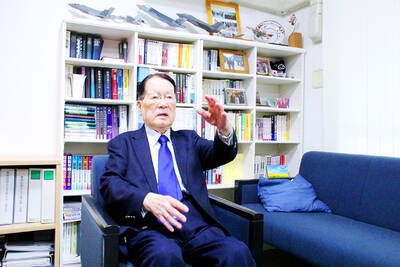
Whether Japan would help defend Taiwan in case of a cross-strait conflict would depend on the US and the extent to which Japan would be allowed to act under the US-Japan Security Treaty, former Japanese minister of defense Satoshi Morimoto said. As China has not given up on the idea of invading Taiwan by force, to what extent Japan could support US military action would hinge on Washington’s intention and its negotiation with Tokyo, Morimoto said in an interview with the Liberty Times (sister paper of the Taipei Times) yesterday. There has to be sufficient mutual recognition of how Japan could provide


 RSS
RSS