


The Chinese Nationalist Party (KMT) yesterday urged President William Lai (賴清德) and the Democratic Progressive Party (DPP) to show respect for legislative oversight, referring to the president’s call for cross-party cooperation in the new year.
The president in his New Year address said that the political gridlock of last year, driven by the opposition-controlled Legislative Yuan blocking many central government-proposed bills, must not continue this year.
KMT spokeswoman Chiang I-chen (江怡臻) said Lai’s speech “failed to address any of the opposition party’s demands,” and that he had instead resorted to “emotional blackmail.”
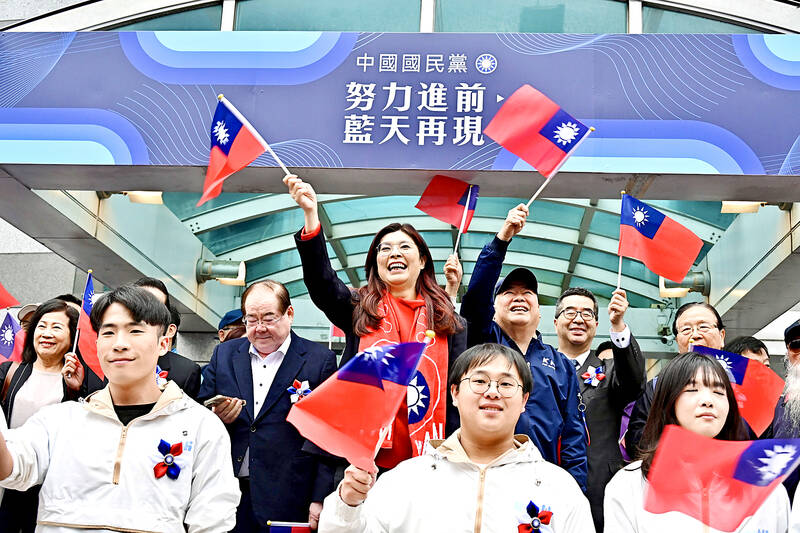
Photo: Tu Chien-jung, Taipei Times
While Lai listed numerous achievements from the past year, issues the public cares most about — including high housing prices, low wages, public safety and energy stability — were not addressed, Chiang said.
Lai has repeatedly called for cooperation between the ruling and opposition parties in the name of unity, but he should first respect legislative oversight instead of simplifying differing opinions as “boycotts or confrontations,” she added.
National defense is important, but so is funding for social welfare, she said, adding that every budget proposal must be subject to strict scrutiny.
One major source of the stalemate is parties’ differing views on a proposed bill authorizing a special defense budget of NT$1.25 trillion (US$39.76 billion).
The opposition has asked Lai to answer questions in the legislature regarding details of the proposal.
Lai has said he is willing to deliver a state-of-the-nation address, but would not submit to questioning, saying that doing so would violate the Constitution.
In a separate statement, the Taiwan People’s Party (TPP) accused the administration of failing to carry out what it said was the “most basic task” of earmarking funds in accordance with the law.
Amid delays in the delivery of weapons ordered from the US, Lai expects the opposition to back an “opaque” special defense spending plan without clearly specifying what items it would fund, the TPP said.
At a morning flag-raising ceremony at party headquarters in Taipei, KMT Chairwoman Cheng Li-wun (鄭麗文) called for political reconciliation, saying that cooperation was needed to enable the legislature to “function normally.”
Cheng, who became party leader in November last year, said that she hoped reconciliation could extend beyond Taiwan.
“I also hope for reconciliation between the two sides of the Taiwan Strait, and even more so for reconciliation between the US and China, and for the whole world to reconcile,” she said.
Responding to a New Year’s address by Chinese President Xi Jinping (習近平), Cheng said the meaning of the so-called “1992 consensus” was not open to doubt.
“The 1992 consensus means that both sides of the Taiwan Strait belong to one China, and this is beyond doubt,” she said.
“[I] respect that the other side has its own expectations, policies and positions,” Cheng said, adding that Taiwan and its outlying islands “also have their own way of life and systems.”
“I hope that through dialogue and exchanges, we can resolve differences and understand each other,” she said.
The “1992 consensus” — a term that former Mainland Affairs Council chairman Su Chi (蘇起) in 2006 admitted making up in 2000 — refers to a tacit understanding between the KMT and the Chinese Communist Party that both sides of the Taiwan Strait acknowledge that there is “one China,” with each side having its own interpretation of what “China” means.
Cheng also attended a New Year’s Day flag-raising ceremony at the Presidential Office, saying she was “very happy and very excited” to take part in it.
She added that she briefly greeted Premier Cho Jung-tai (卓榮泰) and met with Legislative Speaker Han Kuo-yu (韓國瑜), but did not meet with Lai in person.

FUKUOKA SITUATION: Japanese media reported that the pathogen is expected to be identified by the summer, while the CDC downplayed the idea that it was hMPV A “mysterious cold-like illness” reported in Japan’s Fukuoka Prefecture does not seem to be a new disease, but Japanese authorities have been asked about the situation, the Centers for Disease Control (CDC) said yesterday. The Fukuoka Prefectural Medical Association on Wednesday told a news conference that a “mystery cold” that has become a hot topic on social media is “highly likely to be caused by some kind of viral infection,” Japan’s KBC News reported. “Many people are experiencing symptoms starting with a sore throat, followed by a runny nose, phlegm and a severe cough,” KBC News reported, citing association officials. Health authorities are

Nvidia Corp CEO Jensen Huang (黃仁勳) arrived in Taiwan yesterday ahead of upcoming AI and technology events, saying he plans to meet with clients and Taiwan Semiconductor Manufacturing Co Chairman C.C. Wei (魏哲家) during his visit. After landing at Taipei Songshan Airport, Huang posed for photos with fans and handed out Yakult drinks to reporters and supporters waiting at the scene, saying he has “a lot to do” during the trip. Asked about reports that Nvidia’s planned headquarters site in Taipei’s Beitou Shilin Technology Park could break ground on May 27, Huang said that if the company holds an event, he would

Carrefour Taiwan is to begin using a new name from the start of July, but it cannot divulge the name until then, the chairman of the supermarket chain's parent company said today. President Chain Store Co chairman Lo Chih-hsien (羅智先) was asked by reporters after a shareholders' meeting to confirm whether the company has settled on a new name for the supermarket brand. In March, the government-registered name of two Carrefour Taiwan branches was quietly changed to "Le Chia Kang" (樂家康) in Chinese, raising speculation that has been selected as the name. Lo said that because of local regulations and contractual obligations, the
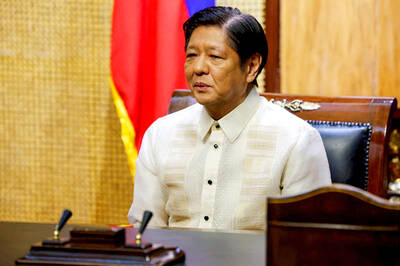
The Philippines would likely be involved in any conflict over Taiwan due to its proximity to the democracy claimed by China, President Ferdinand Marcos Jr said, reiterating a stance that risks angering Beijing. “In the Philippines, we do not have a choice because Taiwan is so close to the Philippines and we have almost 200,000 Filipino nationals living and working in Taiwan,” Marcos said in an interview with Japanese media in Manila on Monday. The Philippine leader’s comments come ahead of a state visit to Japan next week, where he is to meet with Japanese Prime Minister Sanae Takaichi to discuss security


 RSS
RSS