


The legislature yesterday passed amendments to increase penalties for fraud while offering sentence reductions for offenders who surrender and fully compensate victims.
The amended Fraud Crime Hazard Prevention Act (詐欺犯罪危害防制條例) authorizes judicial and prosecutorial authorities to notify financial institutions and virtual asset service providers to flag bank accounts, e-payment accounts, credit cards and virtual asset accounts suspected of being linked to fraud, and to suspend related transactions temporarily.
The amendments also lower the threshold for high-value fraud to NT$1 million (US$31,819) from NT$5 million.

Photo: Taipei Times
Fraud involving NT$1 million or more carries prison terms of three to 10 years and fines of up to NT$30 million, according to the amendments.
Additional penalty tiers apply to larger cases.
Offenders who swindle more than NT$10 million face five to 12 years in prison and fines of up to NT$300 million, while fraud involving more than NT$100 million carries a minimum sentence of seven years and fines of up to NT$500 million.
Citing a rise in cases in which fraud syndicates recruit minors and elderly people, the amendments stipulate that anyone who instigates, assists or collaborates with the groups would face a 50 percent increase in their sentence.
To speed up compensation for victims, the law allows courts to reduce or waive sentences for offenders who turn themselves in and fully compensate victims within six months of surrender, based on amounts agreed by both sides.
The amendments also introduce a “luxury ban” clause targeting high-profile fraud cases.
Courts may take into account extravagant or wasteful spending, such as purchasing luxury homes or vehicles, if it occurs before victims are fully compensated or settlement amounts are paid.
The legislature also passed a supplementary resolution urging the Ministry of Digital Affairs to strengthen oversight of online advertising platforms, enhance disclosure requirements in line with international practices and establish local customer service mechanisms to help prevent fraud.

LOUD AND PROUD Taiwan might have taken a drubbing against Australia and Japan, but you might not know it from the enthusiasm and numbers of the fans Taiwan might not be expected to win the World Baseball Classic (WBC) but their fans are making their presence felt in Tokyo, with tens of thousands decked out in the team’s blue, blowing horns and singing songs. Taiwanese fans have packed out the Tokyo Dome for all three of their games so far and even threatened to drown out home team supporters when their team played Japan on Friday. They blew trumpets, chanted for their favorite players and had their own cheerleading squad who dance on a stage during the game. The team struggled to match that exuberance on the field, with
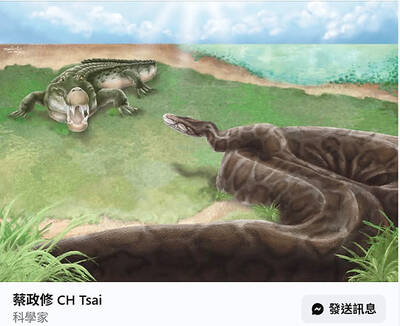
Taiwanese paleontologists have discovered fossil evidence that pythons up to 4m long inhabited Taiwan during the Pleistocene epoch, reporting their findings in the international scientific journal Historical Biology. National Taiwan University (NTU) Institute of Ecology and Evolutionary Biology associate professor Tsai Cheng-hsiu (蔡政修) led the team that discovered the largest snake fossil ever found in Taiwan. The single trunk vertebra was discovered in Tainan at the Chiting Formation, dated to between 400,000 and 800,000 years ago in the Middle Pleistocene, the paper said. The area also produced Taiwan’s first avian fossil, as well as crocodile, mammoth, saber-toothed cat and rhinoceros fossils, it said. Discoveries

Taiwanese paleontologists have discovered fossil evidence that pythons up to 4m long inhabited Taiwan during the Pleistocene epoch, reporting their findings in the international scientific journal Historical Biology. National Taiwan University (NTU) Institute of Ecology and Evolutionary Biology associate professor Tsai Cheng-hsiu (蔡政修) led the team that discovered the largest snake fossil ever found in Taiwan. A single trunk vertebra was discovered in Tainan at the Chiting Formation, dated to between 800,000 to 400,000 years ago in the Middle Pleistocene, the paper said. The area also produced Taiwan’s first avian fossil, as well as crocodile, mammoth, sabre-toothed cat and rhinoceros fossils, it said. Discoveries

Whether Japan would help defend Taiwan in case of a cross-strait conflict would depend on the US and the extent to which Japan would be allowed to act under the US-Japan Security Treaty, former Japanese minister of defense Satoshi Morimoto said. As China has not given up on the idea of invading Taiwan by force, to what extent Japan could support US military action would hinge on Washington’s intention and its negotiation with Tokyo, Morimoto said in an interview with the Liberty Times (sister paper of the Taipei Times) yesterday. There has to be sufficient mutual recognition of how Japan could provide


 RSS
RSS