


Significantly more seismic activity was recorded in Tainan and Chiayi County this year following a major earthquake in Chiayi’s Dapu Township (大埔) in January, the Central Weather Administration (CWA) said yesterday.
The agency at a news conference reviewed this year’s significant weather and seismic events, and presented a general weather forecast for spring.
From 2020 to last year, a yearly average of nine earthquakes in the “noticeable range” were recorded in the two counties, Seismological Center Director Wu Chien-fu (吳健富) said.
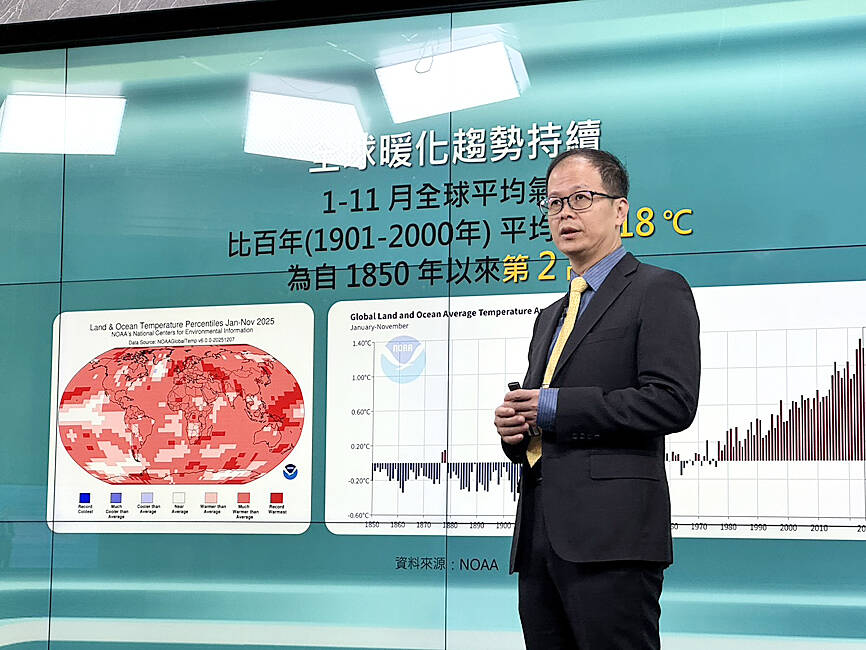
Photo: CNA
This year, the center detected 62 such quakes centered in the two counties, 6.9 times more than the average, Wu said.
They were mainly triggered by a magnitude 6.4 quake that struck Dapu on Jan. 21 at a depth of 9.7km, he said.
A total of 143 aftershocks were recorded in January, before the activity subsided in February, Wu said, adding that small quakes are still occurring.
On average, about 32,000 earthquakes occur in Taiwan annually, Wu said.
This year, there was one earthquake with a magnitude of 7, five earthquakes with a magnitude of 6 or higher, 41 with a magnitude of 5 or higher, and 306 with a magnitude of 4 or higher, Wu said.
There were 156 noticeable earthquakes, close to the 10-year average of 150, he said.
The largest this year was the magnitude 7 quake that struck off Yilan County on Saturday, followed by January’s magnitude 6.4 earthquake in Dapu and another magnitude 6.4 quake off Hualien County on June 11.
Meanwhile, Taiwan’s average temperature this year rose to 24.53°C, about 1.22°C higher than the average from 1901 to 2000.
Weather Forecast Center Director Huang Chun-hsi (黃椿喜) said that the average global temperature from January to last month reached 14°C, a 1.18°C increase.
It was the second-highest average global temperature since 1850, second to last year’s, Huang said.
As of Sunday, the average temperature in Taiwan was 24.53°C, about 1.22°C higher than the average from 1901 to 2000, he said.
It was the 12th-highest average temperature recorded in Taiwan since 1897, he said.
Except for lower average temperatures in January, February and July, monthly temperatures were within the normal range or higher than normal, he said, adding that the forecast center in September and October recorded extremely high temperatures.
Thanks to four typhoons and strong southwesterly airflow, Taiwan has had more rainfall than normal this year, particularly in spring and summer, he said.
Rainfall in July was the highest since 1951, but the number of rainy days was the ninth-lowest over the same period, he added.
Four of the 27 typhoons that formed in the northwestern Pacific Ocean this year made landfall in Taiwan, including Typhoon Danas, which severely impacted the nation’s southwest in July; Typhoon Podul in August; Typhoon Ragasa, which brought intense rainfall to Hualien and Taitung counties in September and caused a barrier lake on the Mataian River (馬太鞍溪) to collapse; and Typhoon Fung-wong last month, which caused severe flooding in Yilan, Huang said.
Currently, the La Nina effect remains the dominant influence in the tropical Pacific regions, he said.
“Based on simulations of meteorological data, the CWA forecast that temperatures from next month to March would fall within normal range or higher than climate average, while rainfall during the same period would be normal or lower than climate average. However, people should still be prepared for the arrival of cold waves and rain fronts,” he added.

The military has spotted two Chinese warships operating in waters near Penghu County in the Taiwan Strait and sent its own naval and air forces to monitor the vessels, the Ministry of National Defense (MND) said. Beijing sends warships and warplanes into the waters and skies around Taiwan on an almost daily basis, drawing condemnation from Taipei. While the ministry offers daily updates on the locations of Chinese military aircraft, it only rarely gives details of where Chinese warships are operating, generally only when it detects aircraft carriers, as happened last week. A Chinese destroyer and a frigate entered waters to the southwest
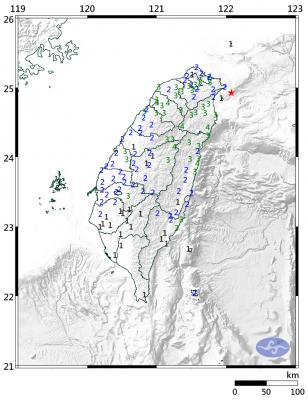
A magnitude 6.1 earthquake struck off the coast of Yilan County at 8:39pm tonight, the Central Weather Administration (CWA) said, with no immediate reports of damage or injuries. The epicenter was 38.7km east-northeast of Yilan County Hall at a focal depth of 98.3km, the CWA’s Seismological Center said. The quake’s maximum intensity, which gauges the actual physical effect of a seismic event, was a level 4 on Taiwan’s 7-tier intensity scale, the center said. That intensity level was recorded in Yilan County’s Nanao Township (南澳), Hsinchu County’s Guansi Township (關西), Nantou County’s Hehuanshan (合歡山) and Hualien County’s Yanliao (鹽寮). An intensity of 3 was

Japanese Prime Minister Sanae Takaichi’s comment last year on Tokyo’s potential reaction to a Taiwan-China conflict has forced Beijing to rewrite its invasion plans, a retired Japanese general said. Takaichi told the Diet on Nov. 7 last year that a Chinese naval blockade or military attack on Taiwan could constitute a “survival-threatening situation” for Japan, potentially allowing Tokyo to exercise its right to collective self-defense. Former Japan Ground Self-Defense Force general Kiyofumi Ogawa said in a recent speech that the remark has been interpreted as meaning Japan could intervene in the early stages of a Taiwan Strait conflict, undermining China’s previous assumptions

Taiwan Railways Corp (TRC) today announced that Shin Kong Mitsukoshi has been selected as the preferred bidder to operate the Taipei Railway Station shopping mall, replacing the current operator, Breeze Development Co Ltd. Among eight qualified firms that delivered presentations and were evaluated by a review committee, Shin Kong Mitsukoshi was ranked first, while Breeze was named the runner-up, the rail company said in a statement. Contract negotiations are to proceed in accordance with regulations, it said, adding that if negotiations with the top bidder fail, it could invite the second-ranked applicant to enter talks. Breeze in a statement today expressed doubts over


 RSS
RSS