


Democratic Progressive Party (DPP) caucus yesterday urged opposition parties not to obstruct military procurement and national defense budgets at the legislative Procedure Committee meeting today, given China’s latest exercise around Taiwan.
The central government’s fiscal budget proposal for next year has yet to be submitted for legislative committee review. The Executive Yuan’s proposed draft of “a special act for strengthening defense resilience and asymmetric warfare
capabilities” with a budget of NT$1.25 trillion (US$39.7 billion) over eight years has been blocked in the Legislative Yuan’s Procedure Committee for four weeks.
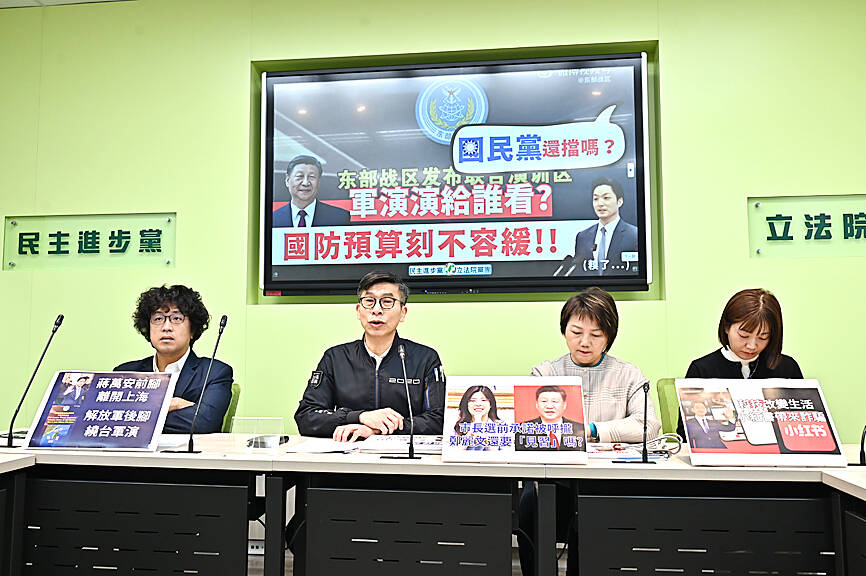
Photo: Tu Chien-jung, Taipei Times
The Executive Yuan’s failure to ready next year’s budget for military and police pay has upset opposition parties, which hold a majority in the legislature, leading to their unwillingness to assign the special budget to legislative committees for review.
DPP caucus chief executive Chung Chia-pin (鍾佳濱) yesterday said that investing in national defense is investing in
self-defense and peace.
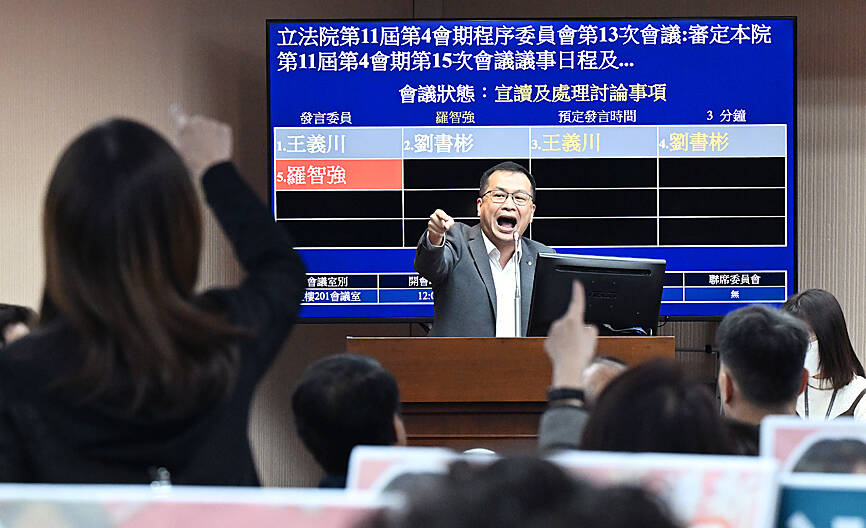
Photo: CNA
“Only by raising the cost of aggression can we avoid war. Boycotting the defense budget in the Legislative Yuan and weakening Taiwan’s defense capabilities is like removing armor in front of China, allowing China to invade Taiwan at the lowest cost,” he said, expressing hope that the opposition would no longer obstruct the budget review at the Procedure Committee meeting.
Chinese Nationalist Party (KMT) caucus secretary-general Lo Chih-chiang (羅智強) said the deadlock over the general budget has three keys, and they are in President William Lai’s (賴清德) hands.
“The Executive Yuan is requested to legally allocate the budget for military personnel salary increases, police and firefighter retirement benefits, as well as the suspension of pension cuts. The Legislative Yuan will then immediately review the general budget,” he said.

Photo: Lo Pei-de, Taipei Times
Taiwan People’s Party Chairman Huang Kuo-chang (黃國昌) said the party’s position has been clear, which is that Lai fulfill his commitment and deliver a national report in the Legislative Yuan.
Additional reporting by Lin Hsin-han and Lin Che-yuan

LOUD AND PROUD Taiwan might have taken a drubbing against Australia and Japan, but you might not know it from the enthusiasm and numbers of the fans Taiwan might not be expected to win the World Baseball Classic (WBC) but their fans are making their presence felt in Tokyo, with tens of thousands decked out in the team’s blue, blowing horns and singing songs. Taiwanese fans have packed out the Tokyo Dome for all three of their games so far and even threatened to drown out home team supporters when their team played Japan on Friday. They blew trumpets, chanted for their favorite players and had their own cheerleading squad who dance on a stage during the game. The team struggled to match that exuberance on the field, with
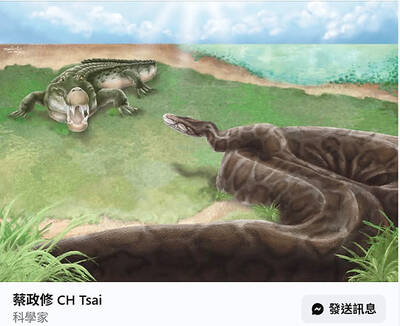
Taiwanese paleontologists have discovered fossil evidence that pythons up to 4m long inhabited Taiwan during the Pleistocene epoch, reporting their findings in the international scientific journal Historical Biology. National Taiwan University (NTU) Institute of Ecology and Evolutionary Biology associate professor Tsai Cheng-hsiu (蔡政修) led the team that discovered the largest snake fossil ever found in Taiwan. The single trunk vertebra was discovered in Tainan at the Chiting Formation, dated to between 400,000 and 800,000 years ago in the Middle Pleistocene, the paper said. The area also produced Taiwan’s first avian fossil, as well as crocodile, mammoth, saber-toothed cat and rhinoceros fossils, it said. Discoveries

Taiwanese paleontologists have discovered fossil evidence that pythons up to 4m long inhabited Taiwan during the Pleistocene epoch, reporting their findings in the international scientific journal Historical Biology. National Taiwan University (NTU) Institute of Ecology and Evolutionary Biology associate professor Tsai Cheng-hsiu (蔡政修) led the team that discovered the largest snake fossil ever found in Taiwan. A single trunk vertebra was discovered in Tainan at the Chiting Formation, dated to between 800,000 to 400,000 years ago in the Middle Pleistocene, the paper said. The area also produced Taiwan’s first avian fossil, as well as crocodile, mammoth, sabre-toothed cat and rhinoceros fossils, it said. Discoveries

Whether Japan would help defend Taiwan in case of a cross-strait conflict would depend on the US and the extent to which Japan would be allowed to act under the US-Japan Security Treaty, former Japanese minister of defense Satoshi Morimoto said. As China has not given up on the idea of invading Taiwan by force, to what extent Japan could support US military action would hinge on Washington’s intention and its negotiation with Tokyo, Morimoto said in an interview with the Liberty Times (sister paper of the Taipei Times) yesterday. There has to be sufficient mutual recognition of how Japan could provide


 RSS
RSS