


President William Lai (賴清德) yesterday said that he is willing to deliver a state-of-the-nation address in the legislature, but would not submit to questioning by lawmakers, as it would breach the Constitution.
The Constitution and relevant interpretations by the Constitutional Court allow a president to report to the legislature via established procedures, but do not permit legislative interpellation of the head of state, Lai said in a television interview.
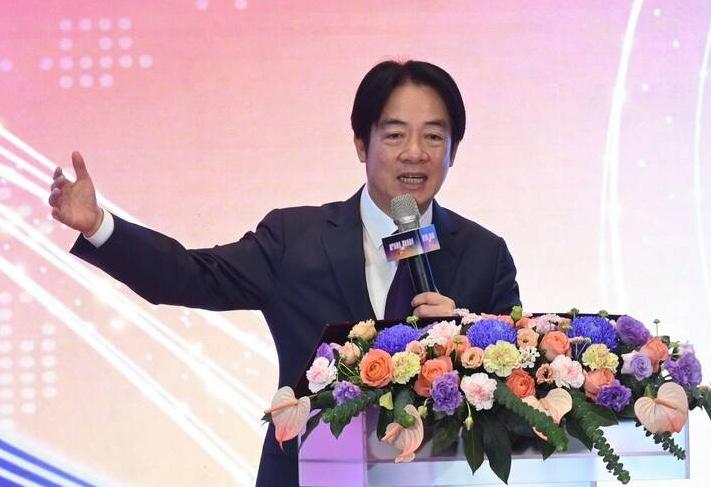
Photo: Taipei Times
He was commenting on a stalemate in the legislature over a proposed eight-year special defense budget of NT$1.25 trillion (US$39.81 billion), which has been blocked four times by opposition lawmakers, who have been calling on Lai to answer questions in the legislature.
The opposition lawmakers are fully responsible for the stalemate, Lai said, adding that they have publicly expressed support in both Taiwan and the international community for higher defense spending, even as they have been blocking a review of the proposed defense budget.
Lai also expressed concerns over a proposed meeting between Chinese Nationalist (KMT) Chairwoman Cheng Li-wun (鄭麗文) and Chinese President Xi Jinping (習近平), which reportedly would be subject to certain preconditions, including assurances that the KMT would not allow the passage of the defense bill or national security legislation, and would abandon its anti-communist stance.
While the KMT has denied that there were such preconditions, Lai said that its continued obstruction without justification raises public doubts.
It would be hard for the public to believe that a meeting between Cheng and Xi would not be subject to preconditions, Lai said.
He also criticized the opposition-led legislature for what he called its procedural abuses, including its decisions to skip the committee stage and fast-track controversial bills to a second reading, and its refusal to review the bills on arms procurement and the central government budget.
On the issue of a legislative motion passed on Friday to initiate impeachment proceedings against him, Lai said the opposition parties would ultimately face public judgement, as they are seeking to remove Taiwan's democratically elected president while also praising Russian President Vladimir Putin and embracing Xi.
On the question of cross-strait relations, Lai said that Taiwan maintains goodwill toward China, as evidenced by its disaster relief donations and the fact that more than 2 million Taiwanese travel there every year.

LOUD AND PROUD Taiwan might have taken a drubbing against Australia and Japan, but you might not know it from the enthusiasm and numbers of the fans Taiwan might not be expected to win the World Baseball Classic (WBC) but their fans are making their presence felt in Tokyo, with tens of thousands decked out in the team’s blue, blowing horns and singing songs. Taiwanese fans have packed out the Tokyo Dome for all three of their games so far and even threatened to drown out home team supporters when their team played Japan on Friday. They blew trumpets, chanted for their favorite players and had their own cheerleading squad who dance on a stage during the game. The team struggled to match that exuberance on the field, with
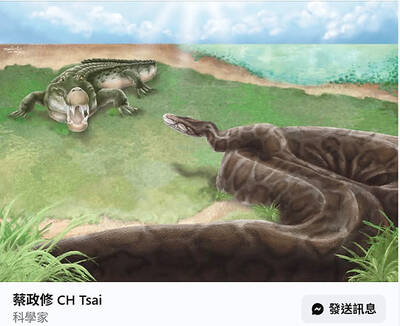
Taiwanese paleontologists have discovered fossil evidence that pythons up to 4m long inhabited Taiwan during the Pleistocene epoch, reporting their findings in the international scientific journal Historical Biology. National Taiwan University (NTU) Institute of Ecology and Evolutionary Biology associate professor Tsai Cheng-hsiu (蔡政修) led the team that discovered the largest snake fossil ever found in Taiwan. The single trunk vertebra was discovered in Tainan at the Chiting Formation, dated to between 400,000 and 800,000 years ago in the Middle Pleistocene, the paper said. The area also produced Taiwan’s first avian fossil, as well as crocodile, mammoth, saber-toothed cat and rhinoceros fossils, it said. Discoveries

Taiwanese paleontologists have discovered fossil evidence that pythons up to 4m long inhabited Taiwan during the Pleistocene epoch, reporting their findings in the international scientific journal Historical Biology. National Taiwan University (NTU) Institute of Ecology and Evolutionary Biology associate professor Tsai Cheng-hsiu (蔡政修) led the team that discovered the largest snake fossil ever found in Taiwan. A single trunk vertebra was discovered in Tainan at the Chiting Formation, dated to between 800,000 to 400,000 years ago in the Middle Pleistocene, the paper said. The area also produced Taiwan’s first avian fossil, as well as crocodile, mammoth, sabre-toothed cat and rhinoceros fossils, it said. Discoveries
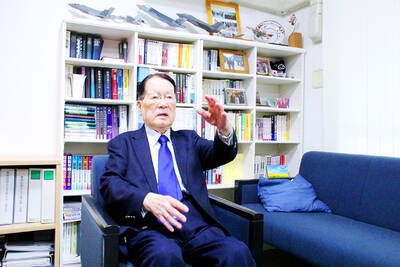
Whether Japan would help defend Taiwan in case of a cross-strait conflict would depend on the US and the extent to which Japan would be allowed to act under the US-Japan Security Treaty, former Japanese minister of defense Satoshi Morimoto said. As China has not given up on the idea of invading Taiwan by force, to what extent Japan could support US military action would hinge on Washington’s intention and its negotiation with Tokyo, Morimoto said in an interview with the Liberty Times (sister paper of the Taipei Times) yesterday. There has to be sufficient mutual recognition of how Japan could provide


 RSS
RSS