


Parents have raised concerns about the excessive weight of elementary-school students’ backpacks, saying children struggle to breathe under the strain.
The Liberty Times (sister paper of the Taipei Times) found that a second-grader who weighed 30kg was carrying a 5.8kg school bag, far heavier than the Ministry of Education’s recommendation that bags not exceed one-eighth of a student’s body weight.
The backpack contained a pencil case, a water bottle, a lunch box, a communication notebook, a Mandarin textbook, a math workbook, a Mandarin homework book, a Mandarin vocabulary notebook, picture books and folders.
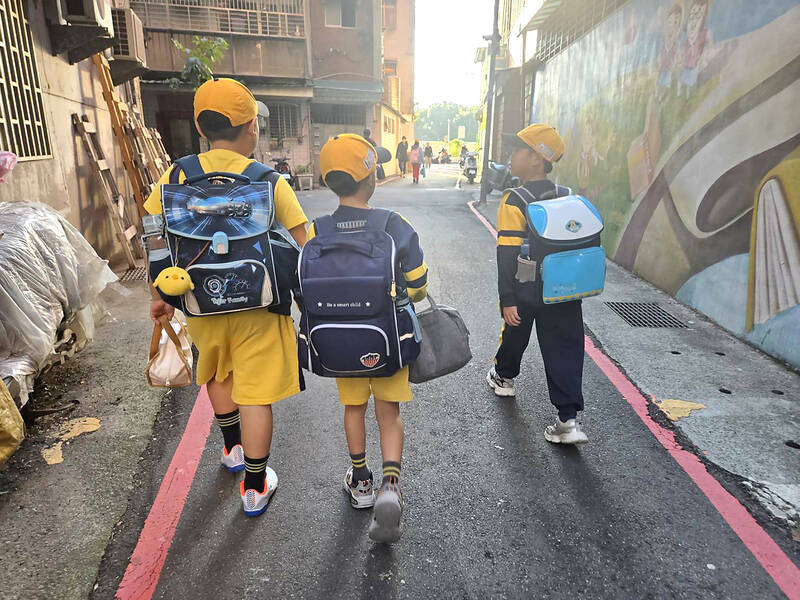
Photo: Lai Hsiao-tung, Taipei Times
Even after removing cram school materials, such as English textbooks, workbooks, homework books and notebooks, the bag still weighed about 4kg.
A nearly 6kg backpack is difficult for even an adult to carry, let alone a small, young student, a parent surnamed Liu (劉) said.
“They can’t even lift it with one hand,” he said, adding that carrying such weight places heavy strain on children and raises concerns about their growth and development.
Far Eastern Memorial Hospital Physical Medicine and Rehabilitation Department physician Strong Po-chun (莊博鈞) said excessive loads might contribute to poor posture and musculoskeletal discomfort.
While there has been no proof of a direct link between heavy bags and impaired growth, children are still developing, so carrying such weights could lead to compensatory posture that affect body alignment, he said.
Common problems include hunched backs, rounded shoulders, protruding abdomens, anterior pelvic tilt increased curvature of the thigh bones and lower back pain, which could worsen over time if left unaddressed, he added.
Children with weak core muscles, sedentary habits and insufficient exercise are more vulnerable to postural problems, he said.
Combined with prolonged use of electronic devices, children might also develop forward head posture, commonly known as “tech neck,” which could eventually contribute to bone spurs or spinal degeneration, Strong said.
Frequent pain or soreness during elementary-school years places invisible stress on the body and could potentially affect hormone regulation, including growth-related hormones, he added.
Backpacks should not be heavier than 15 percent of a child’s body weight, he said, adding that load tolerance varies per person.
To reduce strain, students are advised to distribute weight evenly, such as by carrying some items by hand and adjusting shoulder straps properly, he said.
Straps that are too loose could cause the backpack to sway while walking, increasing energy expenditure, while straps that are too tight could compress shoulder and neck muscles, leading to discomfort, Strong said.
Ideally, the backpack’s center should be near the lower edge of the ribcage, or about the middle of the torso, he said, adding that children should use backpacks that are comfortable and suit their body size.
Parents could help relieve soreness through massages, warm baths or heat therapy to relax children’s muscles, he said.
Prevention is equally important, Strong said, recommending exercises that strengthen core and back muscles, such as crawling or play-based movement, to improve load tolerance and reduce the likelihood of pain.
To safeguard students’ normal physical development and promote healthy growth, the ministry implemented a backpack weight reduction policy from 1999 to 2012, the New Taipei City Education Department said.
Although government subsidies ended after the 2012 academic year, New Taipei City has continued the initiative, it added.
Since 2016, reducing backpack weight has been incorporated into schools’ daily management, focused on the principle of “taking only necessary books home,” the department said, adding that it has allocated more than NT$15 million (US$476,872) to help schools replace lockers, which helps lessen the number of items students need to carry.
The department urged parents, teachers and students to address the issue from three aspects — choosing the right backpack, organizing their backpacks and properly carrying their bags — to truly lighten their load and improve children’s health.
The ministry began promoting backpack weight reduction more than a decade ago, encouraging students to bring home only essential textbooks and assignments, and store the rest in lockers, New Taipei Teacher’s Union Chairman Lin Sung-hung (林松宏) said.
The increase in online learning resources powered by artificial intelligence has also helped in efforts to reduce backpack weight, he said.
However, heavy bags are still common in schools, especially for shorter, young students, whose backpacks nearly match their body size, he added.
Many students carry reference books, handouts or homework from cram schools, while others fail to properly organize their backpacks, allowing unnecessary materials to accumulate and add weight, Lin said.
He suggested that parents purchase lightweight backpacks, check their contents regularly and help their children organize their bags to foster responsibility, good habits and parent-child interaction.
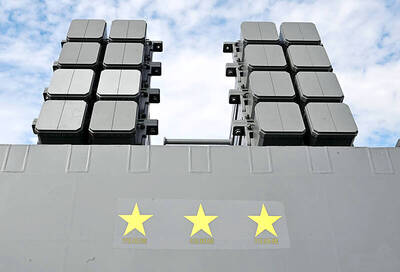
UPGRADE: The Kang Ding-class frigate is replacing its Chaparall missiles with Tien Chien II and Hua Yang VLS, which would provide it with long-range, 360° air defense Taiwan plans to produce 1,200 to 1,376 Hai Chien II missiles (海劍二, Sea Sword II) — also known as TC-2N — to serve as the standard air defense system of the navy’s surface combatant fleet, a source said yesterday. Last week, the Hai Chien II, the naval version of the Tien Kung II missile (天劍二, Sky Sword II), completed a live-fire test in waters off the National Chungshan Institute of Science and Technology’s Jiupeng facility (九鵬) in Pingtung County’s Manjhou Township (滿州). The MIM72 Chaparral and other dated air defense missiles that currently arm Taiwanese ships have inadequate range to combat Chinese

REASONS FOR TRAVEL: An assistant professor said that proposed amendments to penalize drivers if they used drugs overseas would not deter people from traveling People who operate a motor vehicle under the influence of marijuana would have their driver’s license revoked, even if they used the substance while overseas, the Ministry of Transportation and Communications said yesterday, citing proposed amendments to the Road Traffic Management and Penalty Act (道路交通管理處罰條例). The amendments would also authorize the government to revoke the licenses of people determined to have used Category 1 or Category 2 narcotics, even if they were not operating a vehicle while under the influence of drugs, as well as ban them from taking the license test for three years, the ministry said. People aged 18 or

HEAVY WEATHER: Typhoon Jangmi is due to crash straight into the Ryukyus as airlines look to shift flights to larger aircraft or cancel flights to Okinawa entirely Taiwan’s international air carriers announced flight adjustments over the weekend as Typhoon Jangmi is forecast to hit the Ryukyu Islands today and tomorrow. The Central Weather Administration (CWA) upgraded Jangmi from a tropical storm to a typhoon at 8am yesterday, with the eye located 580km south of Naha city. It was moving north at 19kph. Today, China Airlines’ CI-120, CI-121, CI-122 and CI-123 flights between Taoyuan and Naha, Okinawa, have been canceled as well as CI-132 and CI-133 between Kaohsiung and Naha. EVA Air’s BR-112, BR-113, BR-186 and BR-185 flights between Taoyuan and Naha are also canceled. Low-cost carrier Tigerair Taiwan canceled IT-230,
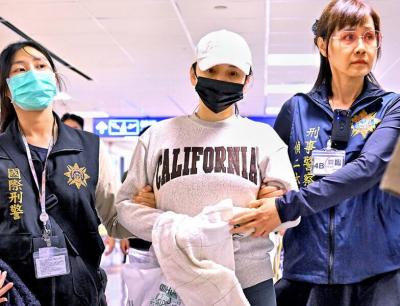
Johanne Liou (劉喬安), a Taiwanese woman who shot to unwanted fame during the Sunflower movement protests in 2014, returned to Taiwan last night after being deported from the US. She is to stand trial in Taiwan for charges involving embezzlement, fraud and drug crimes. The Criminal Investigation Bureau (CIB) said it took her into custody at Taiwan Taoyuan International Airport and would first question her before transferring her to the New Taipei District Prosecutors’ Office. She was arrested upon disembarking a flight from San Francisco that landed shortly before 7pm. Liou absconded to the US in 2019 after jumping bail


 RSS
RSS