


A pharmacist yesterday suggested that people prepare five types of medical items in an earthquake emergency kit, or “go bag,” which they could quickly grab if they need to evacuate immediately.
Federation of Taiwan Pharmacists Association deputy secretary-general Liu Liang-chun (劉亮君) made the comment after a magnitude 7.0 earthquake struck off the coast of Yilan County at 11:05pm on Saturday.
If people need to quickly evacuate their home due to a disaster, they might get a headache, or catch a cold from panic or bad weather, so preparing common household medicines and over-the-counter drugs is necessary, Liu said.
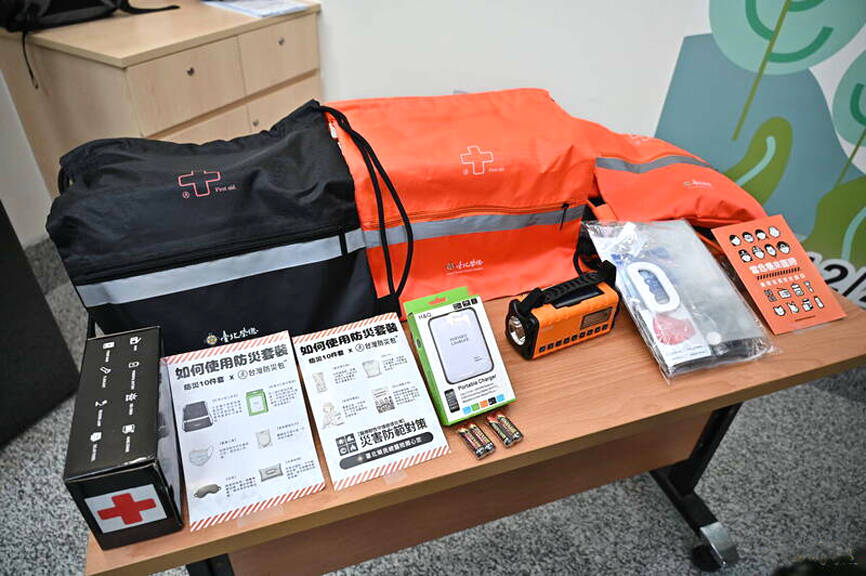
Photo: Taipei Times
Aside from basic food, the five types of medical items she recommended for emergency kits are bandages and gauze, antiseptics, cold medicine, painkillers and drugs for chronic diseases.
Liu suggested people bring acetaminophen, which is a painkiller and fever reducer, and avoiding painkillers that need to be prescribed by a doctor.
People who have chronic headaches or other diseases could consult with a pharmacist for suitable medication, she said, adding that those who often experience stomachaches due to temperature changes or pressure could also prepare antacids.
People with diabetes or other chronic diseases must keep their medication within reach at all times in case of an emergency, she added.
As prescriptions for chronic diseases usually provide a month of supply and allow refills 10 days before the next scheduled refill, she suggested preparing medicine for at least one week and refreshing the kit’s supply every month when they pick up their next refill.
Meanwhile, Mingtang Clinic traditional medicine doctor Chou Tzung-han (周宗翰) said some people might experience dizziness, vertigo and loss of balance in the wake of an earthquake.
Post-quake dizziness usually results from inner ear disturbances, rather than a brain disorder, and the symptoms usually resolve on their own, Chou said.
The inner ear is responsible for a person’s sense of balance, and violent tremors could disturb its vestibular system, causing dizziness, nausea, or instability, he said.
The symptoms often make people wonder if they have brain disorders, but it is because the ear’s vestibular system failed to adapt to the sudden vibrations, he added.
To alleviate the symptoms, Chou recommended a simple self-massage — gently rubbing both ears and pressing the hollow behind the ear, which could balance ear pressure and reduce vertigo.
It usually relieves the symptoms within a few minutes, but it might take 30 minutes in rare cases, he said, adding that the symptoms usually resolve on their own after a good night’s sleep.
However, poor lifestyle habits could prolong dizziness, Chou said, adding that the neurological systems of those who frequently stay up late or are under extreme fatigue might already be in a state of tension, so they are more susceptible to experiencing vertigo triggered by an earthquake.
Women who have premenstrual headaches might feel stronger discomfort if a major earthquake occurs during their premenstrual period, he added.
Additional reporting by Hou Chia-yu

LOUD AND PROUD Taiwan might have taken a drubbing against Australia and Japan, but you might not know it from the enthusiasm and numbers of the fans Taiwan might not be expected to win the World Baseball Classic (WBC) but their fans are making their presence felt in Tokyo, with tens of thousands decked out in the team’s blue, blowing horns and singing songs. Taiwanese fans have packed out the Tokyo Dome for all three of their games so far and even threatened to drown out home team supporters when their team played Japan on Friday. They blew trumpets, chanted for their favorite players and had their own cheerleading squad who dance on a stage during the game. The team struggled to match that exuberance on the field, with
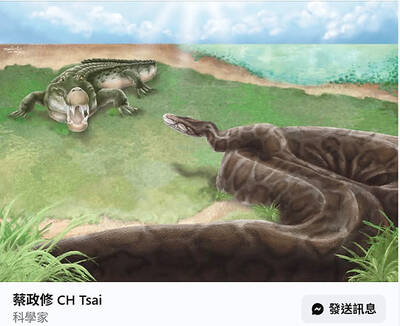
Taiwanese paleontologists have discovered fossil evidence that pythons up to 4m long inhabited Taiwan during the Pleistocene epoch, reporting their findings in the international scientific journal Historical Biology. National Taiwan University (NTU) Institute of Ecology and Evolutionary Biology associate professor Tsai Cheng-hsiu (蔡政修) led the team that discovered the largest snake fossil ever found in Taiwan. The single trunk vertebra was discovered in Tainan at the Chiting Formation, dated to between 400,000 and 800,000 years ago in the Middle Pleistocene, the paper said. The area also produced Taiwan’s first avian fossil, as well as crocodile, mammoth, saber-toothed cat and rhinoceros fossils, it said. Discoveries

Taiwanese paleontologists have discovered fossil evidence that pythons up to 4m long inhabited Taiwan during the Pleistocene epoch, reporting their findings in the international scientific journal Historical Biology. National Taiwan University (NTU) Institute of Ecology and Evolutionary Biology associate professor Tsai Cheng-hsiu (蔡政修) led the team that discovered the largest snake fossil ever found in Taiwan. A single trunk vertebra was discovered in Tainan at the Chiting Formation, dated to between 800,000 to 400,000 years ago in the Middle Pleistocene, the paper said. The area also produced Taiwan’s first avian fossil, as well as crocodile, mammoth, sabre-toothed cat and rhinoceros fossils, it said. Discoveries
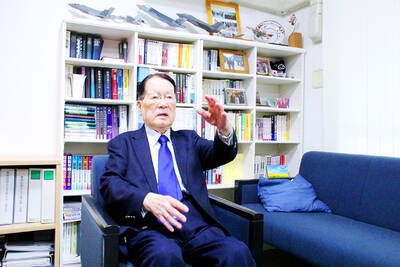
Whether Japan would help defend Taiwan in case of a cross-strait conflict would depend on the US and the extent to which Japan would be allowed to act under the US-Japan Security Treaty, former Japanese minister of defense Satoshi Morimoto said. As China has not given up on the idea of invading Taiwan by force, to what extent Japan could support US military action would hinge on Washington’s intention and its negotiation with Tokyo, Morimoto said in an interview with the Liberty Times (sister paper of the Taipei Times) yesterday. There has to be sufficient mutual recognition of how Japan could provide


 RSS
RSS