


More than 1,000 academics and lawyers have signed a petition in support of the Constitutional Court’s recent ruling that amendments to the Constitutional Court Procedure Act (憲法訴訟法) passed last year were unconstitutional.
The Legislative Yuan on Dec. 20 last year passed amendments stipulating that at least 10 justices must take part in constitutional deliberations, and at least nine justices must agree to find a bill or law unconstitutional. The amendments took effect on Jan. 25.
Seven of the 15 justices ended their terms on Oct. 31 last year. Opposition lawmakers twice rejected President William Lai’s (賴清德) nominees to fill the vacancies, first in December last year and again in July. Lai has not nominated anyone since.
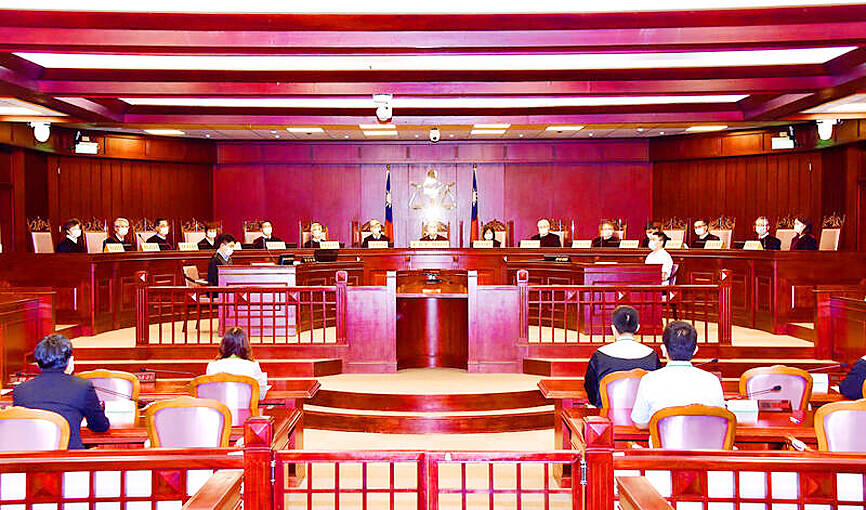
Photo: Tu Chien-jung, Taipei Times
Five of the remaining justices on Friday last week found the law unconstitutional, saying its legislative process contained “obvious and significant defects,” contravened legislative procedure and breached the constitutional principle of the separation of powers.
Three justices from the eight-member court dissented and were not counted toward the total number of justices presiding over the case.
To express support for the “revival” of the Constitutional Court’s operations, civic groups, academia and the legal community have initiated a joint statement titled: “Democracy must not regress, constitutional rulings must be followed — A joint statement of support from civil society, academia and the legal community for Constitutional Court Ruling No. 1 of 2025.”
According to the Economic Democracy Union, as of 9pm on Friday, 96 civic organizations, 603 lawyers and 690 academics had signed the petition, adding that among the academics, 651 are university professors and researchers, including 132 legal scholars.
The statement affirms the ruling of the five Constitutional Court justices, and added that when the legislative process violates the principles of transparency and public discussion, it would be declared unconstitutional and invalid.
The court’s ruling urges lawmakers to avoid the abuse of majority power, ensuring that the legislative process returns to a proper course of full public knowledge, communication and thorough deliberation, the statement said.
The ruling also establishes the principle that the Constitutional Court is only bound by a Constitutional Court Procedure Act that is constitutional, delineates the boundary between judicial and legislative powers, and ensures that the Constitutional Court would no longer be paralyzed by the Legislative Yuan.
The statement asserts that the Constitutional Court that made this ruling was by no means “illegally constituted.”
It said that over the past year, the long-term absence of three justices from the deliberation meetings, along with their choice to issue public statements through “extra-official” actions, has caused damage to public trust in the Constitutional Court.
This situation should be considered as if the three justices had voluntarily recused themselves, the statement said.
The Chinese Nationalist Party (KMT) caucus on Monday filed malfeasance charges against the five justices of the Constitutional Court.
The opposition argued that the ruling was made without enough justices, either by the standards of the 10-justice minimum stipulated by the amendments or two-thirds of the total number of incumbent justices based on the original version of the act.

LOUD AND PROUD Taiwan might have taken a drubbing against Australia and Japan, but you might not know it from the enthusiasm and numbers of the fans Taiwan might not be expected to win the World Baseball Classic (WBC) but their fans are making their presence felt in Tokyo, with tens of thousands decked out in the team’s blue, blowing horns and singing songs. Taiwanese fans have packed out the Tokyo Dome for all three of their games so far and even threatened to drown out home team supporters when their team played Japan on Friday. They blew trumpets, chanted for their favorite players and had their own cheerleading squad who dance on a stage during the game. The team struggled to match that exuberance on the field, with

Taiwanese paleontologists have discovered fossil evidence that pythons up to 4m long inhabited Taiwan during the Pleistocene epoch, reporting their findings in the international scientific journal Historical Biology. National Taiwan University (NTU) Institute of Ecology and Evolutionary Biology associate professor Tsai Cheng-hsiu (蔡政修) led the team that discovered the largest snake fossil ever found in Taiwan. The single trunk vertebra was discovered in Tainan at the Chiting Formation, dated to between 400,000 and 800,000 years ago in the Middle Pleistocene, the paper said. The area also produced Taiwan’s first avian fossil, as well as crocodile, mammoth, saber-toothed cat and rhinoceros fossils, it said. Discoveries

Taiwanese paleontologists have discovered fossil evidence that pythons up to 4m long inhabited Taiwan during the Pleistocene epoch, reporting their findings in the international scientific journal Historical Biology. National Taiwan University (NTU) Institute of Ecology and Evolutionary Biology associate professor Tsai Cheng-hsiu (蔡政修) led the team that discovered the largest snake fossil ever found in Taiwan. A single trunk vertebra was discovered in Tainan at the Chiting Formation, dated to between 800,000 to 400,000 years ago in the Middle Pleistocene, the paper said. The area also produced Taiwan’s first avian fossil, as well as crocodile, mammoth, sabre-toothed cat and rhinoceros fossils, it said. Discoveries

Whether Japan would help defend Taiwan in case of a cross-strait conflict would depend on the US and the extent to which Japan would be allowed to act under the US-Japan Security Treaty, former Japanese minister of defense Satoshi Morimoto said. As China has not given up on the idea of invading Taiwan by force, to what extent Japan could support US military action would hinge on Washington’s intention and its negotiation with Tokyo, Morimoto said in an interview with the Liberty Times (sister paper of the Taipei Times) yesterday. There has to be sufficient mutual recognition of how Japan could provide


 RSS
RSS