


The police could make greater use of an “overwatch” strategy to increase psychological pressure on potential offenders and counteract burnout in police officers, a security specialist said, as more police are being deployed in the wake of a deadly knife attack in Taipei on Dec. 19.
President William Lai (賴清德) and Premier Cho Jung-tai (卓榮泰) have instructed police to increase their use of visible policing in crowded places to prevent attacks similar to the one on Dec. 19, when four people were killed, including the alleged attacker.
In an article published on Friday on the Web site of the Institute for National Defense and Security Research, Su Tzu-yun (蘇紫雲), a research fellow at the institute, acknowledged the high-visibility strategy was effective at deterring attacks.
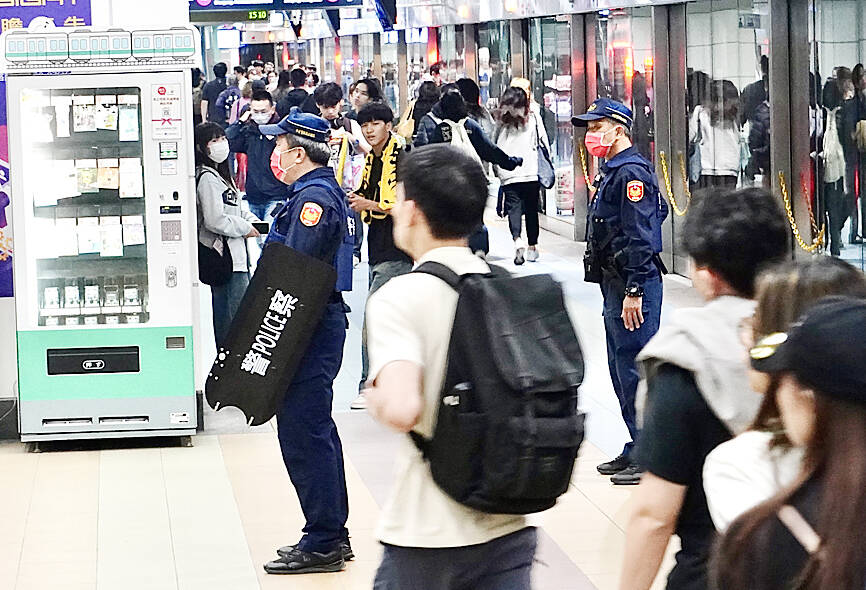
Photo: CNA
The strategy, which creates psychological pressure on potential perpetrators, is commonly used at airports and other transportation hubs in the US and Europe, he said.
The US Transportation Security Administration and British law enforcement organizations have doctrines of highly visible and unpredictable deployments to prevent terrorism and other crimes, Su wrote.
The downside of the strategy is that intensive, public-level patrolling can exhaust police personnel, Su said, especially in places such as Taiwan where officer numbers are already low.
An investigation of the Dec. 19 attacks, which occurred in or near Taiwan’s MRT system, found that mass transit police were slow to respond because of staffing shortages and scheduling issues that left many stations without any police presence.
Although staffing is being increased, Su said there was a less personnel-intensive way to execute the high-visibility strategy.
“What is more crucial than the number of officers deployed or patrol density is how to be seen,” Su wrote.
For transport hubs, which are symbolic and high-density critical infrastructure, security effectiveness often depends on whether elevated vantage points are used effectively,” he wrote.
Guidelines such as the International Civil Aviation Organization’s Aviation Security Manual and the UK’s Airport Security Planning Quick Guide recommend that visible officers be positioned on upper floors and mezzanines, in observation corridors or at intersections of passenger flows, Su wrote.
From these locations, officers can observe large areas while remaining visible to travelers at multiple levels, achieving psychological deterrence and broad surveillance without impeding movement, Su said.
For potential attackers, the sight of officers positioned above them conveys the message that they are already being observed, which is often enough to deter or delay an attack, Su said.
Compared with ground patrols, officers stationed at elevated points can more easily detect suspicious loitering or other patterns, making this approach particularly effective against lone-actor attacks, Su said.
Importantly, it achieves a low-disruption, high-deterrence effect without checkpoints or an oppressive atmosphere, a method commonly seen at major international airports, Su wrote.
By enhancing visibility through vantage-point deployments, the need for extensive foot patrols can be reduced, conserving the limited pool of uniformed bodies while reinforcing the perception of order and safety, he wrote.
This approach could be a useful reference for metro systems, railways and security planning for large-scale events such as New Year’s celebrations, he wrote.
Although Su believed deploying police officers at elevation could save personnel, the problem of the general lack of police officers in, for example, Taipei’s Rapid Transit Division, would have to be addressed. The division is responsible for covering 117 stations but can only field 80 officers at a time.
To deal with the broader staffing shortage, Samuel Lin (林書立), an assistant professor in Ming Chuan University’s Department of Criminal Justice, said technological fixes, such as AI surveillance, tracking systems, and scenario simulations, could all enhance overall security requiring more personnel.

Actor Darren Wang (王大陸) was sentenced to six months in prison, commutable to a fine, by the New Taipei District Court today for contravening the Personal Data Protection Act (個人資料保護法) in a case linked to an alleged draft-dodging scheme. Wang allegedly paid NT$3.6 million (US$114,380) to an illegal group to help him evade mandatory military service through falsified medical documents, prosecutors said. He transferred the funds to Chen Chih-ming (陳志明), the alleged mastermind of a draft-evasion ring, although he lost contact with him as he was already in detention on fraud charges, they said. Chen is accused of helping a

SECURITY: Starlink owner Elon Musk has taken pro-Beijing positions, and allowing pro-China companies to control Taiwan’s critical infrastructure is risky, a legislator said Starlink was reluctant to offer services in Taiwan because of the nation’s extremely high penetration rates in 4G and 5G services, the Ministry of Digital Affairs said yesterday. The ministry made the comments at a meeting of the legislature’s Transportation Committee, which reviewed amendments to Article 36 of the Telecommunications Management Act (電信管理法). Article 36 bans foreigners from holding more than 49 percent of shares in public telecommunications networks, while shares foreigners directly and indirectly hold are also capped at 60 percent of the total, unless specified otherwise by law. The amendments, sponsored by Chinese Nationalist Party (KMT) Legislator Ko

‘SAME OLD TRICK’: Even if Beijing resumes individual travel to Taiwan, it would only benefit Chinese tourism companies, the Economic Democracy Union convener said China’s 10 new “incentives” are “sugar-coated poison,” an official said yesterday, adding that Taiwanese businesses see them clearly for what they are, but that Beijing would inevitably find some local collaborators to try to drums up support. The official, speaking on condition of anonymity, made the remark ahead of a news conference the General Chamber of Commerce is to hold today. The event, titled “Industry Perspectives on China’s Recent Pro-Taiwan Policies,” is expected to include representatives from industry associations — such as those in travel, hotels, food and agriculture — to request the government cooperate with China’s new measures, people familiar with
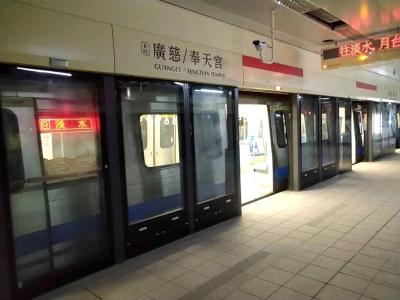
The eastern extension of the Taipei MRT Red Line could begin operations as early as late June, the Taipei Department of Rapid Transit Systems said yesterday. Taipei Rapid Transit Corp said it is considering offering one month of free rides on the new section to mark its opening. Construction progress on the 1.4km extension, which is to run from the current terminal Xiangshan Station to a new eastern terminal, Guangci/Fengtian Temple Station, was 90.6 percent complete by the end of last month, the department said in a report to the Taipei City Council's Transportation Committee. While construction began in October 2016 with an


 RSS
RSS