


The Executive Yuan is to countersign bills passed earlier this month reversing cuts to civil servants’ pensions, after which it would immediately file a petition for a constitutional judgement, Premier Cho Jung-tai (卓榮泰) said today.
The legislature on Dec. 12 passed amendments suspending cuts to civil servants’ pensions, reversing a fiscal reform that aimed to reduce the government deficit.
Today is the deadline for the president to promulgate the amendments to the Civil Servants Retirement, Discharge and Pensions Act (公務人員退休資遣撫卹法) and the Public School Employee Retirement, Discharge and Pensions Act (公立學校教職員退休資遣撫卹條例).
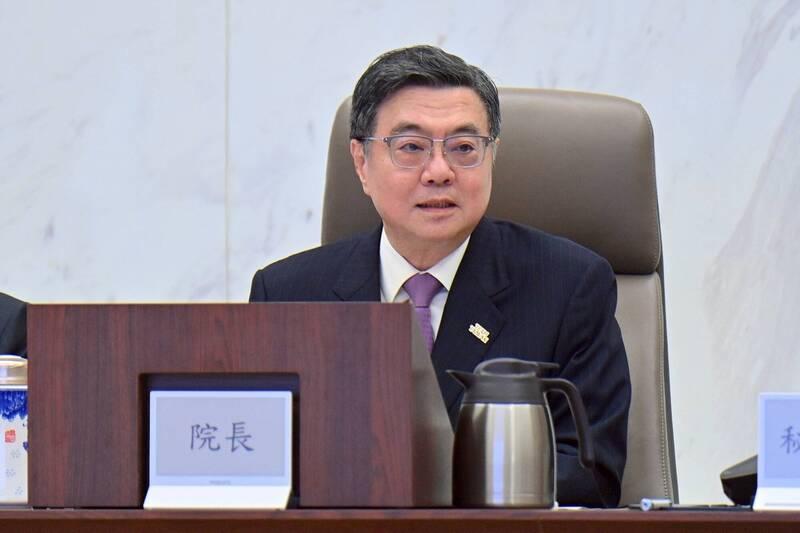
Photo courtesy of the Executive Yuan
Although the amendments contravene Article 70 of the Constitution and the separation of powers, and undermine the principle of adequate legislative deliberation, the Executive Yuan would fulfill its duties by countersigning the bill, allowing it to take effect, Cho was quoted as saying by Executive Yuan spokeswoman Michelle Lee (李慧芝) at a post-Cabinet meeting news conference.
With the Constitutional Court resuming operations, the Executive Yuan would immediately seek a constitutional interpretation, Cho said.
The court had been paralyzed for about a year after changes to the Constitutional Court Procedure Act (憲法訴訟法) required a quorum of 10 grand justices to take part in deliberations, despite there currently being only eight justices on the bench.
However, the court on Friday last week ruled those amendments unconstitutional, restoring its functioning.
Cho said that he hopes a final ruling could be reached through constitutional procedures and that constitutional dignity would be upheld.
The power to refuse to countersign is a constitutional authority vested in the premier, he said.
If future legislation were to undermine the constitutional system, weaken national defense or disrupt fiscal discipline in an irreparable way, the Executive Yuan would not abandon this authority, he said.
However, as long as there is a functioning legislature that does not compromise national security or fiscal stability, and the Constitutional Court remains operational, the Executive Yuan would not resort to refusing to countersign as a routine measure, he added.
Opposition lawmakers are seeking to impeach Cho over his refusal to countersign changes to the Act Governing the Allocation of Government Revenues and Expenditures (財政收支劃分法) passed by last month.
Additional reporting by Jonathan Chin

FUKUOKA SITUATION: Japanese media reported that the pathogen is expected to be identified by the summer, while the CDC downplayed the idea that it was hMPV A “mysterious cold-like illness” reported in Japan’s Fukuoka Prefecture does not seem to be a new disease, but Japanese authorities have been asked about the situation, the Centers for Disease Control (CDC) said yesterday. The Fukuoka Prefectural Medical Association on Wednesday told a news conference that a “mystery cold” that has become a hot topic on social media is “highly likely to be caused by some kind of viral infection,” Japan’s KBC News reported. “Many people are experiencing symptoms starting with a sore throat, followed by a runny nose, phlegm and a severe cough,” KBC News reported, citing association officials. Health authorities are

Nvidia Corp CEO Jensen Huang (黃仁勳) arrived in Taiwan yesterday ahead of upcoming AI and technology events, saying he plans to meet with clients and Taiwan Semiconductor Manufacturing Co Chairman C.C. Wei (魏哲家) during his visit. After landing at Taipei Songshan Airport, Huang posed for photos with fans and handed out Yakult drinks to reporters and supporters waiting at the scene, saying he has “a lot to do” during the trip. Asked about reports that Nvidia’s planned headquarters site in Taipei’s Beitou Shilin Technology Park could break ground on May 27, Huang said that if the company holds an event, he would

The Ministry of Finance this afternoon announced the winning numbers for the March-April uniform invoice lottery. The winning number for the NT$10 million (US$318,060) special prize is 19531471, and the winning number for the NT$2 million grand prize is 85941329. Three numbers were drawn for the NT$200,000 first prize: 07225810, 20231230 and 83518781. Those with receipts matching the last seven digits of any of the first-prize numbers will win the NT$40,000 second prize, while those matching the last six digits will win the NT$10,000 third prize. Those whose receipts match the last five digits of the first-prize numbers can claim the NT$4,000 fourth prize,

SIX SUBSIDIES: The monthly allowance for older farmers is to increase to NT$10,000, and NT$5,000 is to be given to homemakers under the national pension system, Lai said The government is to implement major welfare policies for disadvantaged groups, including raising the monthly allowance for older farmers to NT$10,000 and providing homemakers with NT$5,000 per month, President William Lai (賴清德) said yesterday. Lai made the remarks during a visit to Wangling Temple in Chiayi County, saying that the planned increases were being introduced amid economic growth and an increase in tax revenue. Touting a policy, in which the government plans to provide a monthly allowance of NT$5,000 for every child under the age of 18 in a bid to address Taiwan’s low birthrate, Lai said that if received for the


 RSS
RSS