


Short-form videos have become the most common media format consumed by Taiwanese, ahead of social media, the Taiwan Network Information Center said in a report released on Wednesday last week.
In a survey commissioned by the center, 78.46 percent of respondents had watched a short-form video in the past three months, surpassing the 76.86 percent who had used a social media platform.
More than three-fifths of respondents said they watched short videos daily across multiple platforms, while nearly half (49.98 percent) reported viewing short videos multiple times a day, compared with 8.06 percent who said they watched once a day.

Photo: CNA
The report defined a short-form video as content lasting between 15 seconds and three minutes on platforms such as TikTok, Instagram Reels, Facebook Reels and YouTube Shorts.
The social media platforms it surveyed were Facebook, Instagram, Threads, TikTok, PTT, X and Dcard.
The survey covered individuals aged 18 and older, and was conducted from July 28 to Sept. 1.
Tao Chen-chao (陶振超), a professor in the Department of Communication and Technology at National Yang Ming Chiao Tung University, said the survey included short-form video usage for the first time this year and described the results as striking.
The data showed that short videos have embedded themselves into daily life in a relatively short period, and their influence should not be underestimated, Tao said.
By age group, short-form video consumption was highest among respondents aged 18 to 29 and 30 to 39, at 96.73 percent and 93.86 percent respectively.
Usage also exceeded 85 percent among those aged 40 to 49 and 50 to 59, was more than 65 percent among respondents aged 60 to 69, and surpassed 30 percent among those aged 70 to 79.
Age was once considered a key indicator of media usage, Tao said, but recent trends suggest that it is no longer decisive.
Instead, whether technology meets users’ daily needs and life circumstances has become more important.
Elderly people and baby boomers also show high short-video usage because the format is easy to use, and provides accessible entertainment and information, he said.
The survey found that 56.09 percent of respondents said they spent more time scrolling short videos than expected, and 36.22 percent said that doing so interfered with other activities, yet most of them reported feeling happy rather than regretful about their viewing habits.
“Taiwanese people feel happy and genuinely enjoy it,” Tao said.
Tao said he was not pessimistic about whether short videos would replace reading, comparing the concern with earlier fears that television would erode reading.
That is because while media formats evolve, the demand for reading persists, even as delivery shifts toward digital formats such as e-books, Tao said.
Although attention is limited, people can still prioritize essential tasks through self-control, Tao said.
While platforms offer options to fast-forward, most viewers still watch entire videos for immersion or social interaction, he added.
“Short videos deliver fresh content quickly, but they will not replace all other forms of content,” Tao said.
Hsieh Pei-fang (謝佩芳), a board member of the Digital Marketing Association, said the rise of short videos is not inherently negative, calling them an efficient way to convey information.
However, she warned that excessive consumption could affect attention and cognitive abilities, underscoring the importance of media literacy so users know when to stop.

AGING: While Japan has 22 submarines, Taiwan only operates four, two of which were commissioned by the US in 1945 and 1946, and transferred to Taiwan in 1973 Taiwan would need at least 12 submarines to reach modern fleet capabilities, CSBC Corp, Taiwan chairman Chen Cheng-hung (陳政宏) said in an interview broadcast on Friday, citing a US assessment. CSBC is testing the nation’s first indigenous defense submarine, the Hai Kun (海鯤, Narwhal), which is scheduled to be delivered to the navy next month or in July. The Hai Kun has completed torpedo-firing tests and is scheduled to undergo overnight sea trials, Chen said on an SET TV military affairs program. Taiwan would require at least 12 submarines to establish a modern submarine force after assessing the nation’s operational environment and defense

Yangmingshan National Park authorities yesterday urged visitors to respect public spaces and obey the law after a couple was caught on a camera livestream having sex at the park’s Qingtiangang (擎天崗) earlier in the day. The Shilin Police Precinct in Taipei said it has identified a suspect and his vehicle registration number, and would summon him for questioning. The case would be handled in accordance with public indecency charges, it added. The couple entered the park at about 11pm on Thursday and began fooling around by 1am yesterday, the police said, adding that the two were unaware of the park’s all-day live
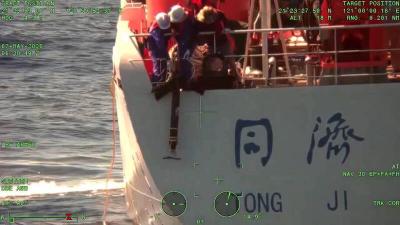
The coast guard today said that it had disrupted "illegal" operations by a Chinese research ship in waters close to the nation and driven it away, part of what Taipei sees a provocative pattern of China's stepped up maritime activities. The coast guard said that it on Thursday last week detected the Chinese ship Tongji (同濟號), which was commissioned only last year, 29 nautical miles (54km) southeast of the southern tip of Taiwan, although just outside restricted waters. The ship was observed lowering ropes into the water, suspected to be the deployment of scientific instruments for "illegal" survey operations, and the coast

A former soldier and an active-duty army officer were yesterday indicted for allegedly selling classified military training materials to a Chinese intelligence operative for a total of NT$79,440. The Taipei District Prosecutors’ Office indicted Chen Tai-yin (陳泰尹) and Lee Chun-ta (李俊達) for contravening the National Security Act (國家安全法) and the Anti-Corruption Act (貪污治罪條例). Chen left the military in September 2013 after serving alongside then-staff sergeant Lee, now an army lieutenant, at the 21st Artillery Command of the army’s Sixth Corps from 2011 to 2013, according to the indictment. Chen met a Chinese intelligence operative identified as “Wang” (王) through a friend in November


 RSS
RSS