


Cat owners who fail to put microchips in their pets could face fines of up to NT$15,000 (US$477) starting next month, according to the Ministry of Agriculture (MOA).
Under the Animal Protection Act, dog owners have been required to microchip and register their pets since 2008, with violators subject to fines ranging from NT$3,000 to NT$15,000.
The same requirement was extended to cat owners at the start of this year after an amendment to pet regulations was formally announced on Dec. 16 last year although penalties would not take effect until Jan. 1 next year.
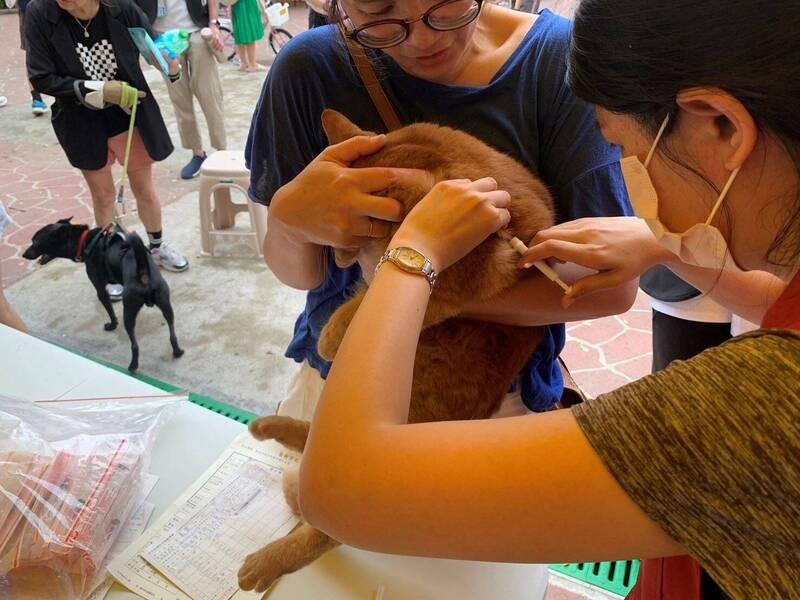
Photo provided by the Animal Protection Office
Starting from next Thursday, cat owners who fail to microchip their pets may face the same fines as for dogs and can be ordered to correct the violation within a set time period.
If the owner still fails to comply by the deadline, additional fines may be imposed for each subsequent offense.
According to the most recent survey of the MOA’s pet census conducted every two years, there were about 1.31 million cats nationwide in 2023.
As of last year, some 146,430 domestic cats had been microchipped through voluntary efforts pushed by animal rights and environmental groups, and that number has risen to 164,388 following a year of awareness-raising under the new regulations.
The requirement for all domestic cats to have microchips is aimed at strengthening owner responsibility and management by curbing irresponsible abandonment and prevent illegal breeding, the ministry said.
Microchipping cats not only increases the chances of recovering lost pets, but also allows authorities to track whether they have been spayed or neutered, the MOA said.

LOUD AND PROUD Taiwan might have taken a drubbing against Australia and Japan, but you might not know it from the enthusiasm and numbers of the fans Taiwan might not be expected to win the World Baseball Classic (WBC) but their fans are making their presence felt in Tokyo, with tens of thousands decked out in the team’s blue, blowing horns and singing songs. Taiwanese fans have packed out the Tokyo Dome for all three of their games so far and even threatened to drown out home team supporters when their team played Japan on Friday. They blew trumpets, chanted for their favorite players and had their own cheerleading squad who dance on a stage during the game. The team struggled to match that exuberance on the field, with
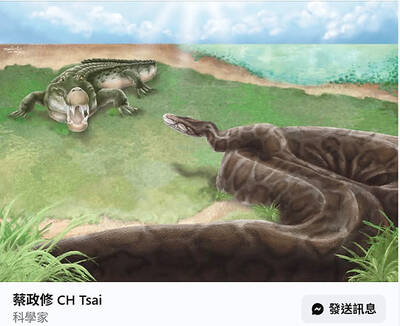
Taiwanese paleontologists have discovered fossil evidence that pythons up to 4m long inhabited Taiwan during the Pleistocene epoch, reporting their findings in the international scientific journal Historical Biology. National Taiwan University (NTU) Institute of Ecology and Evolutionary Biology associate professor Tsai Cheng-hsiu (蔡政修) led the team that discovered the largest snake fossil ever found in Taiwan. The single trunk vertebra was discovered in Tainan at the Chiting Formation, dated to between 400,000 and 800,000 years ago in the Middle Pleistocene, the paper said. The area also produced Taiwan’s first avian fossil, as well as crocodile, mammoth, saber-toothed cat and rhinoceros fossils, it said. Discoveries

Taiwanese paleontologists have discovered fossil evidence that pythons up to 4m long inhabited Taiwan during the Pleistocene epoch, reporting their findings in the international scientific journal Historical Biology. National Taiwan University (NTU) Institute of Ecology and Evolutionary Biology associate professor Tsai Cheng-hsiu (蔡政修) led the team that discovered the largest snake fossil ever found in Taiwan. A single trunk vertebra was discovered in Tainan at the Chiting Formation, dated to between 800,000 to 400,000 years ago in the Middle Pleistocene, the paper said. The area also produced Taiwan’s first avian fossil, as well as crocodile, mammoth, sabre-toothed cat and rhinoceros fossils, it said. Discoveries

Whether Japan would help defend Taiwan in case of a cross-strait conflict would depend on the US and the extent to which Japan would be allowed to act under the US-Japan Security Treaty, former Japanese minister of defense Satoshi Morimoto said. As China has not given up on the idea of invading Taiwan by force, to what extent Japan could support US military action would hinge on Washington’s intention and its negotiation with Tokyo, Morimoto said in an interview with the Liberty Times (sister paper of the Taipei Times) yesterday. There has to be sufficient mutual recognition of how Japan could provide


 RSS
RSS