


The Legislative Yuan’s refusal to fund the government could reduce the economic growth rate by up to 1.5 percent next year, the Directorate-General of Budget, Accounting and Statistics (DGBAS) told lawmakers yesterday.
Although the DGBAS has yet to make a formal assessment, growth is estimated to decline by 0.05 percent per NT$10 billion (US$317.7 million) in cuts to government spending, DGBAS Minister Chen Shu-tzu (陳淑姿) told a legislative hearing on the budget fight’s impact on the economy.
The legislative impasse affects general and special government budgets that totaled NT$299.2 billion, she said, adding that the 3.54 percent economic growth rate projected for next year must be revised downward.
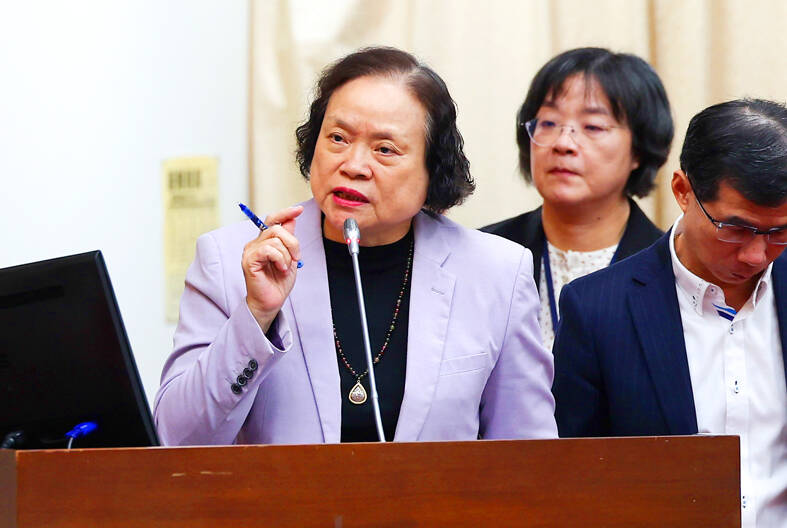
Photo: CNA
DGBAS officials told reporters that government spending is part of the economic activities that drive growth, and that reduced funding would be detrimental to the nation’s economy.
Affected funding items include a NT$10.2 billion project on 10 technologies, including uncrewed vehicles, robotics, silicone chips and quantum computing, the NT$7.5 billion TPass 2.0 program, and a NT$6 billion sustainable materials industry park, the DGBAS said in a report.
National Science and Technology Council Deputy Minister Su Chen-kang (蘇振綱) said the budget fight cast into doubt government investments in key technologies, including computing power, silicon photonics and smart robotics.
Loss of funding in these areas would disrupt the council’s plans to facilitate the growth of Taiwan’s artificial intelligence (AI) sector, he said, calling on lawmakers to pass the budget.
Democratic Progressive Party (DPP) Legislator Chen Kuan-ting (陳冠廷) said the withdrawal of state support could jeopardize Taiwan’s ability to obtain the advanced semiconductors for its AI program amid surging global demand for chips.
Separately, DPP Legislator Rosalia Wu (吳思瑤) wrote on social media that refusal to examine the budget by the Chinese Nationalist Party (KMT) and the Taiwan People’s Party (TPP) could render the nation defenseless against China.
The deadlock over funding jeopardizes the Ministry of National Defense’s budget of NT$78 billion, an amount accounting for 26 percent of next year’s budget, she said.
The spending would include the maintenance, spare parts and ammunition budget for the military’s aircraft, ships, ground vehicles and other equipment, as well as for the procurement of Harpoon missiles and F-16 targeting pods, and funding for training military reservists, she added.
“The KMT and TPP have opened a gap in the nation’s defenses, gladdened China and disheartened Taiwanese,” Wu said.

Yangmingshan National Park authorities yesterday urged visitors to respect public spaces and obey the law after a couple was caught on a camera livestream having sex at the park’s Qingtiangang (擎天崗) earlier in the day. The Shilin Police Precinct in Taipei said it has identified a suspect and his vehicle registration number, and would summon him for questioning. The case would be handled in accordance with public indecency charges, it added. The couple entered the park at about 11pm on Thursday and began fooling around by 1am yesterday, the police said, adding that the two were unaware of the park’s all-day live

Fast food chain McDonald's is to raise prices by up to NT$5 on some products at its restaurants across Taiwan, starting on Wednesday next week, the company announced today. The prices of all extra value meals and sharing boxes are to increase by NT$5, while breakfast combos and creamy corn soup would go up by NT$3, the company said in a statement. The price of the main items of those meals, if ordered individually, would remain the same. Meanwhile, the price of a medium-sized lemon iced tea and hot cappuccino would rise by NT$3, extra dipping sauces for chicken nuggets would go up
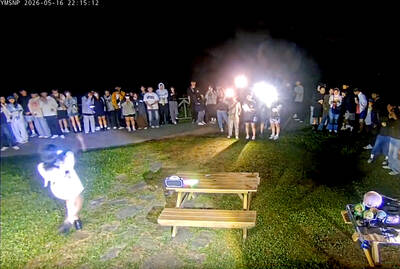
Yangmingshan National Park’s Qingtiangang (擎天崗) nature area has gone viral after a park livestream camera observed a couple in the throes of intimate congress, which was broadcast live on YouTube, drawing large late-night crowds and sparking a backlash over noise, bright lights and disruption to wildlife habitat. The area’s livestream footage appeared to show a couple engaging in sexual activity on a picnic table in the park on Friday last week, with the uncensored footage streamed publicly online. The footage quickly spread across social media, prompting a tide of visitors to travel to the site to “check in” and recreate the

Minister of Digital Affairs Lin Yi-ching (林宜敬) yesterday cited regulatory issues and national security concerns as an expert said that Taiwan is among the few Asian regions without Starlink. Lin made the remarks on Facebook after funP Innovation Group chief executive officer Nathan Chiu (邱繼弘) on Friday said Taiwan and four other countries in Asia — China, North Korea, Afghanistan and Syria — have no access to Starlink. Starlink has become available in 166 countries worldwide, including Ukraine, Malaysia, the Philippines and Vietnam, in the six years since it became commercial, he said. While China and North Korea block Starlink, Syria is not


 RSS
RSS