


Economic ties are no longer boosting cross-strait relations, as Taiwanese businesses continue to shift investment away from China amid deepening US-Beijing decoupling, an expert said at a seminar in Taipei yesterday.
Lai I-chung (賴怡忠), president of the government-affiliated think tank Prospect Foundation, said at the seminar that following the outbreak of the Washington-Beijing trade war, Taiwanese investment in the US has far outpaced investment in China.
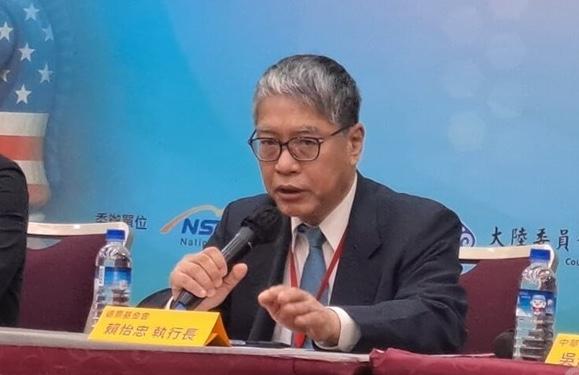
Photo: CNA
This shift has weakened the traditional role of economic interconnectedness as a "lubricant" in cross-strait relations, he said.
Before 2016, trade relations between Taiwan, China and the US were closely intertwined under a model described as "Taiwan taking orders, China producing and products sold to the West," Lai said.
However, during the first wave of the trade war in 2018, Taiwanese firms began ramping up investment in Southeast Asia, he said.
By 2022, such investment surpassed that in China for the first time since 1993.
Data from the investment review agency showed that during the first 11 months of this year, the US ranked as Taiwan's second-largest destination for outward foreign direct investment, reaching US$4.2 billion and accounting for 11.64 percent of the total.
Vietnam ranked fifth with US$987.8 million (2.72 percent), while China fell outside the top five and was not specifically listed in the top tier of regions.
While investment in Southeast Asia remained steady, capital flows into the US began to exceed that into China significantly, driven largely by market demand and supply chain security.
Data from the investment review agency showed that in the first 11 months of this year, approved investment (or capital increase) in foreign countries except China accounted for NT$36.29 billion (US$1.16 billion), down by 17.98 percent from a year earlier.
Over the same period, the amount in China was NT$13.94 billion, down by 61.32 percent from a year ago.
Looking ahead, Lai identified three factors shaping the trade war next year: potential US Supreme Court rulings on the legality of US President Donald Trump's tariffs, anticipated high-level meetings between Trump and Chinese President Xi Jinping (習近平) and the US midterm elections.
However, even if certain tariffs are challenged, Washington's use of them as strategic tools will likely persist, entrenching the decoupling trend, he said.

FUKUOKA SITUATION: Japanese media reported that the pathogen is expected to be identified by the summer, while the CDC downplayed the idea that it was hMPV A “mysterious cold-like illness” reported in Japan’s Fukuoka Prefecture does not seem to be a new disease, but Japanese authorities have been asked about the situation, the Centers for Disease Control (CDC) said yesterday. The Fukuoka Prefectural Medical Association on Wednesday told a news conference that a “mystery cold” that has become a hot topic on social media is “highly likely to be caused by some kind of viral infection,” Japan’s KBC News reported. “Many people are experiencing symptoms starting with a sore throat, followed by a runny nose, phlegm and a severe cough,” KBC News reported, citing association officials. Health authorities are

Nvidia Corp CEO Jensen Huang (黃仁勳) arrived in Taiwan yesterday ahead of upcoming AI and technology events, saying he plans to meet with clients and Taiwan Semiconductor Manufacturing Co Chairman C.C. Wei (魏哲家) during his visit. After landing at Taipei Songshan Airport, Huang posed for photos with fans and handed out Yakult drinks to reporters and supporters waiting at the scene, saying he has “a lot to do” during the trip. Asked about reports that Nvidia’s planned headquarters site in Taipei’s Beitou Shilin Technology Park could break ground on May 27, Huang said that if the company holds an event, he would

The Ministry of Finance this afternoon announced the winning numbers for the March-April uniform invoice lottery. The winning number for the NT$10 million (US$318,060) special prize is 19531471, and the winning number for the NT$2 million grand prize is 85941329. Three numbers were drawn for the NT$200,000 first prize: 07225810, 20231230 and 83518781. Those with receipts matching the last seven digits of any of the first-prize numbers will win the NT$40,000 second prize, while those matching the last six digits will win the NT$10,000 third prize. Those whose receipts match the last five digits of the first-prize numbers can claim the NT$4,000 fourth prize,
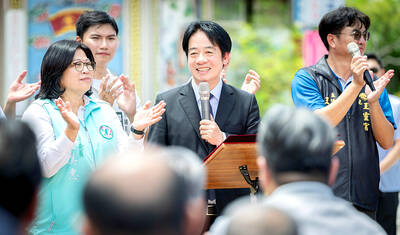
SIX SUBSIDIES: The monthly allowance for older farmers is to increase to NT$10,000, and NT$5,000 is to be given to homemakers under the national pension system, Lai said The government is to implement major welfare policies for disadvantaged groups, including raising the monthly allowance for older farmers to NT$10,000 and providing homemakers with NT$5,000 per month, President William Lai (賴清德) said yesterday. Lai made the remarks during a visit to Wangling Temple in Chiayi County, saying that the planned increases were being introduced amid economic growth and an increase in tax revenue. Touting a policy, in which the government plans to provide a monthly allowance of NT$5,000 for every child under the age of 18 in a bid to address Taiwan’s low birthrate, Lai said that if received for the


 RSS
RSS