


A coalition of civic groups yesterday released a report reviewing Taiwan's implementation of two major international human rights covenants from 2022 to this year, warning of persistent systemic shortcomings in rights protections.
Coauthored by 33 groups, including Covenants Watch and the Taiwan International Workers' Association (TIWA), the 2025 Parallel Report on the Two Covenants was released at a press event in Taipei.
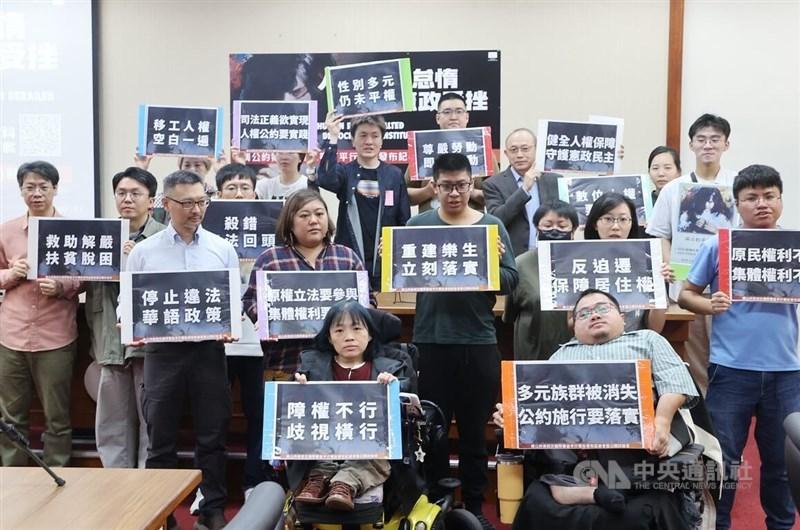
Photo: CNA
The report was issued in conjunction with the government's National Report earlier this year, and the two would be sent to independent international experts for review in May next year.
The "Two Covenants" referred to in the bilingual report are the International Covenant on Civil and Political Rights and the International Covenant on Economic, Social and Cultural Rights, both UN treaties that were incorporated into domestic law in Taiwan in 2009.
Covenants Watch policy center director Huang Sung-li (黃嵩立) cited criticism in the report of the National Human Rights Commission, saying that the body, which operates under the Control Yuan, has long focused on handling individual cases.
The commission "has yet to build a systematic capacity for rights monitoring and policy recommendations," Huang said.
Huang also said that the Constitutional Court — which he described as "the last line of defense for human rights" — has been "paralyzed for a long time due to political interference."
He was referring to the period from October last year to earlier this month, when a standoff between the ruling and opposition parties left the court largely unable to function.
TIWA chairperson Chen Hsiu-lien (陳秀蓮) said the government has long promoted an image of "protecting human rights" to win international recognition, "but for the nearly 820,000 migrant workers who have no political rights, substantive protections remain little more than slogans."
She cited what she called systemic problems in Taiwan's migrant labor regime, including a private brokerage system that she described as creating monopolies, and rules restricting workers' ability to change employers.
As a result, migrant workers are left dependent on employers and brokers in the absence of adequate systemic safeguards, with cases of sexual harassment, physical abuse and forced repatriation continuing to emerge, Chen said.
The report also addresses other rights issues, including those involving the LGBTQ+ community and indigenous peoples.
It is to be submitted to lawmakers in the hope of prompting legal revisions to bolster Taiwan's human-rights protections, the coalition said.

LOUD AND PROUD Taiwan might have taken a drubbing against Australia and Japan, but you might not know it from the enthusiasm and numbers of the fans Taiwan might not be expected to win the World Baseball Classic (WBC) but their fans are making their presence felt in Tokyo, with tens of thousands decked out in the team’s blue, blowing horns and singing songs. Taiwanese fans have packed out the Tokyo Dome for all three of their games so far and even threatened to drown out home team supporters when their team played Japan on Friday. They blew trumpets, chanted for their favorite players and had their own cheerleading squad who dance on a stage during the game. The team struggled to match that exuberance on the field, with
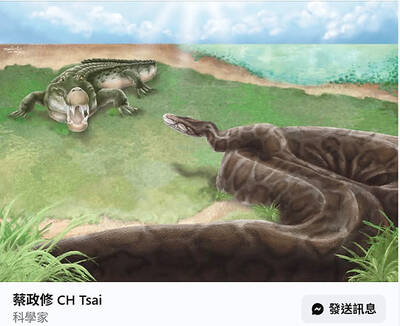
Taiwanese paleontologists have discovered fossil evidence that pythons up to 4m long inhabited Taiwan during the Pleistocene epoch, reporting their findings in the international scientific journal Historical Biology. National Taiwan University (NTU) Institute of Ecology and Evolutionary Biology associate professor Tsai Cheng-hsiu (蔡政修) led the team that discovered the largest snake fossil ever found in Taiwan. The single trunk vertebra was discovered in Tainan at the Chiting Formation, dated to between 400,000 and 800,000 years ago in the Middle Pleistocene, the paper said. The area also produced Taiwan’s first avian fossil, as well as crocodile, mammoth, saber-toothed cat and rhinoceros fossils, it said. Discoveries

Taiwanese paleontologists have discovered fossil evidence that pythons up to 4m long inhabited Taiwan during the Pleistocene epoch, reporting their findings in the international scientific journal Historical Biology. National Taiwan University (NTU) Institute of Ecology and Evolutionary Biology associate professor Tsai Cheng-hsiu (蔡政修) led the team that discovered the largest snake fossil ever found in Taiwan. A single trunk vertebra was discovered in Tainan at the Chiting Formation, dated to between 800,000 to 400,000 years ago in the Middle Pleistocene, the paper said. The area also produced Taiwan’s first avian fossil, as well as crocodile, mammoth, sabre-toothed cat and rhinoceros fossils, it said. Discoveries

Whether Japan would help defend Taiwan in case of a cross-strait conflict would depend on the US and the extent to which Japan would be allowed to act under the US-Japan Security Treaty, former Japanese minister of defense Satoshi Morimoto said. As China has not given up on the idea of invading Taiwan by force, to what extent Japan could support US military action would hinge on Washington’s intention and its negotiation with Tokyo, Morimoto said in an interview with the Liberty Times (sister paper of the Taipei Times) yesterday. There has to be sufficient mutual recognition of how Japan could provide


 RSS
RSS