


The Ministry of Foreign Affairs yesterday said that it is “taking action” to prevent Taiwanese from facing possible arrest when visiting China-friendly Laos, Cambodia or Belarus.
The ministry has beefed up emergency response mechanisms at its overseas offices and is working closely with like-minded countries to counter the threat of China’s “long-arm jurisdiction” tactics, ministry spokesman Hsiao Kuang-wei (蕭光偉) told a news conference at the ministry, without offering details.
The ministry would continue to remind Taiwanese not to visit countries that could be pressured by China into extraditing Taiwanese wanted by Beijing, Hsiao said in response to a question about a report in the Liberty Times (sister paper of the Taipei Times) that Beijing could easily pressure the three countries into arresting Taiwanese that it deems to be independence advocates.
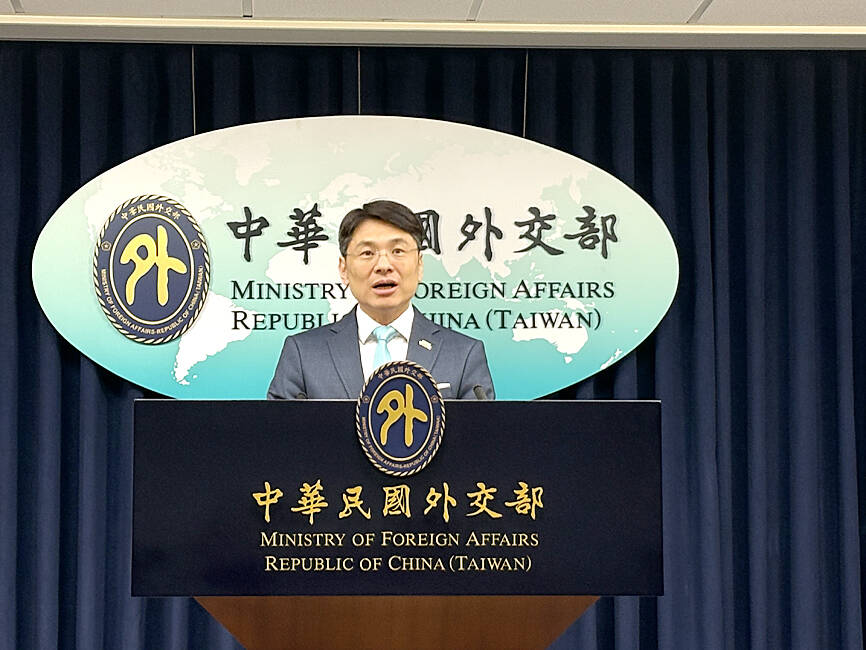
Photo: Huang Chin-hsuan, Taipei Times
A government official told the Liberty Times on condition of anonymity that Taiwanese should not visit Laos, Cambodia or Belarus, as the nations are highly likely to bow to Beijing’s demands and send Taiwanese to China to face prosecution.
Travel warnings for Laos and Cambodia mention extradition arrangements between the two countries and China, but not for Belarus.
The ministry has the highest-level “red” travel alert for Belarus due to the Russia-Ukraine war, as well as for parts of Cambodia due to its border conflict with Thailand.
It has an “orange” alert for Laos, citing the possibility of being lured into working for telecommunication fraud rings there.
Concern about so-called “long-arm jurisdiction” tactics by China heightened last month, when a Chinese legal expert told state-run China Central Television that Democratic Progressive Party Legislator Puma Shen (沈伯洋) should be pursued as a criminal.
The expert said that Shen was on China’s wanted list for advocating Taiwanese independence and should be pursued through Interpol and other global judicial assistance channels.

LOUD AND PROUD Taiwan might have taken a drubbing against Australia and Japan, but you might not know it from the enthusiasm and numbers of the fans Taiwan might not be expected to win the World Baseball Classic (WBC) but their fans are making their presence felt in Tokyo, with tens of thousands decked out in the team’s blue, blowing horns and singing songs. Taiwanese fans have packed out the Tokyo Dome for all three of their games so far and even threatened to drown out home team supporters when their team played Japan on Friday. They blew trumpets, chanted for their favorite players and had their own cheerleading squad who dance on a stage during the game. The team struggled to match that exuberance on the field, with
Taiwanese paleontologists have discovered fossil evidence that pythons up to 4m long inhabited Taiwan during the Pleistocene epoch, reporting their findings in the international scientific journal Historical Biology. National Taiwan University (NTU) Institute of Ecology and Evolutionary Biology associate professor Tsai Cheng-hsiu (蔡政修) led the team that discovered the largest snake fossil ever found in Taiwan. The single trunk vertebra was discovered in Tainan at the Chiting Formation, dated to between 400,000 and 800,000 years ago in the Middle Pleistocene, the paper said. The area also produced Taiwan’s first avian fossil, as well as crocodile, mammoth, saber-toothed cat and rhinoceros fossils, it said. Discoveries

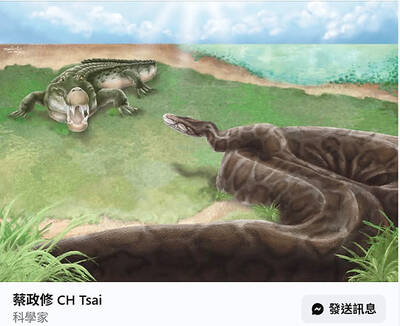
Taiwanese paleontologists have discovered fossil evidence that pythons up to 4m long inhabited Taiwan during the Pleistocene epoch, reporting their findings in the international scientific journal Historical Biology. National Taiwan University (NTU) Institute of Ecology and Evolutionary Biology associate professor Tsai Cheng-hsiu (蔡政修) led the team that discovered the largest snake fossil ever found in Taiwan. A single trunk vertebra was discovered in Tainan at the Chiting Formation, dated to between 800,000 to 400,000 years ago in the Middle Pleistocene, the paper said. The area also produced Taiwan’s first avian fossil, as well as crocodile, mammoth, sabre-toothed cat and rhinoceros fossils, it said. Discoveries

Whether Japan would help defend Taiwan in case of a cross-strait conflict would depend on the US and the extent to which Japan would be allowed to act under the US-Japan Security Treaty, former Japanese minister of defense Satoshi Morimoto said. As China has not given up on the idea of invading Taiwan by force, to what extent Japan could support US military action would hinge on Washington’s intention and its negotiation with Tokyo, Morimoto said in an interview with the Liberty Times (sister paper of the Taipei Times) yesterday. There has to be sufficient mutual recognition of how Japan could provide


 RSS
RSS