


The Chinese Nationalist Party (KMT) caucus yesterday proposed amendments that would allow rulings of the Constitutional Court to be overturned by a public referendum.
The Legislative Yuan’s Procedure Committee scheduled the Referendum Act (公民投票法) amendment for discussion on Friday.
Amendments to the Constitutional Court Procedure Act (憲法訴訟法) that passed a third reading at the end of last year have paralyzed the Constitutional Court by requiring that 10 justices be present before deliberations begin, while at least nine are needed to declare a law unconstitutional.
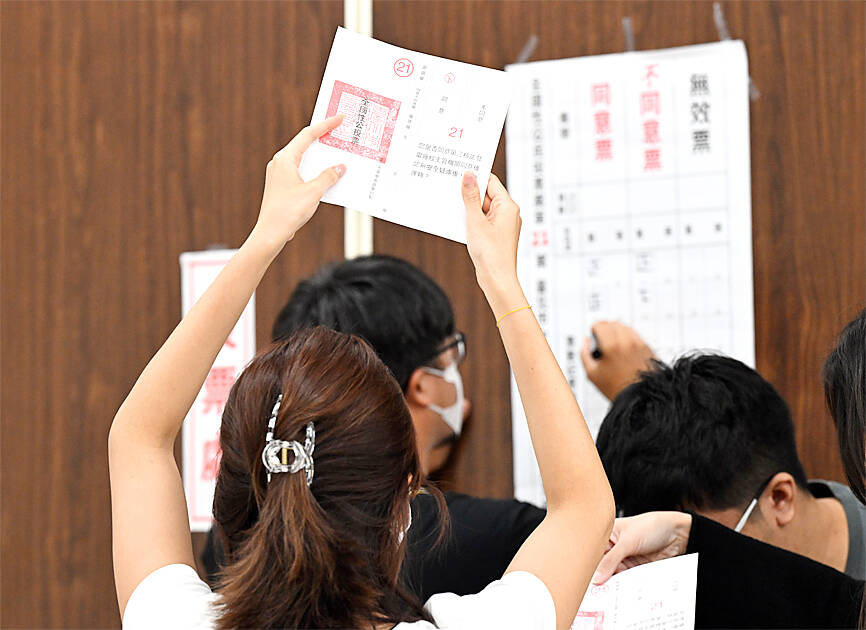
Photo: Liao Chen-huei, Taipei Times
The court has eight justices after the terms of seven ended on Oct. 31 last year.
The Constitution stipulates that the court has 15 grand justices.
The court on Friday said that the amendments were unconstitutional, as they contravened due legislative process and separation of powers. Five justices made the ruling, with the other three dissenting.
KMT caucus secretary-general Lo Chih-chiang (羅智強) said that President William Lai (賴清德) has spoken of “greater democracy,” asking whether the people should help to decide when conflict arises within the government.
The proposed changes would codify that principle, Lo said.
The bill would add a provision to Article 2 of the Referendum Act allowing public referendums to approve or reject Constitutional Court judgements, excluding rulings related to impeachment of the president or vice president.
Article 30 would be amended to stipulate that Constitutional Court judgements that have been deemed unconstitutional would lose effect starting from the third day after the referendum result is announced, with laws previously ruled unconstitutional regaining effect.
For referendums on major policies, the president or agency in charge would be required to implement the contents of the referendum within three months.
Major policies decided through a referendum could not be altered by administrative agencies for three years, the amendments say.
The KMT has already filed a complaint over “unlawful rulings” by the grand justices, Lo said.
The party is not ruling out any issues from being put to a referendum and, as they are held concurrently with elections, referendums could be held alongside next year’s local elections, he added.
There is no precedent worldwide among democratic countries for a public referendum to overturn a constitutional ruling, the Democratic Progressive Party (DPP) caucus said.
The Judicial Yuan is the highest legal authority, with the constitutionality of laws and regulations overseen by the Constitutional Court, DPP caucus chief executive Chung Chia-pin (鍾佳濱) said.
The KMT’s branding of the court’s judgements as illegal is “baffling,” Chung said.
The KMT is placing direct democracy above the principles of separation of powers and constitutional supremacy, he added.
Additional reporting by CNA

Fast food chain McDonald's is to raise prices by up to NT$5 on some products at its restaurants across Taiwan, starting on Wednesday next week, the company announced today. The prices of all extra value meals and sharing boxes are to increase by NT$5, while breakfast combos and creamy corn soup would go up by NT$3, the company said in a statement. The price of the main items of those meals, if ordered individually, would remain the same. Meanwhile, the price of a medium-sized lemon iced tea and hot cappuccino would rise by NT$3, extra dipping sauces for chicken nuggets would go up
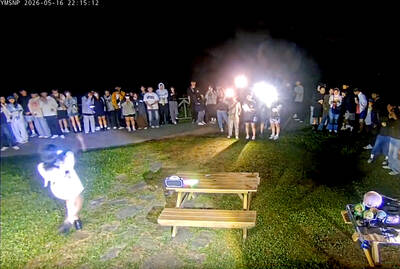
Yangmingshan National Park’s Qingtiangang (擎天崗) nature area has gone viral after a park livestream camera observed a couple in the throes of intimate congress, which was broadcast live on YouTube, drawing large late-night crowds and sparking a backlash over noise, bright lights and disruption to wildlife habitat. The area’s livestream footage appeared to show a couple engaging in sexual activity on a picnic table in the park on Friday last week, with the uncensored footage streamed publicly online. The footage quickly spread across social media, prompting a tide of visitors to travel to the site to “check in” and recreate the

Carrefour Taiwan is to begin using a new name from the start of July, but it cannot divulge the name until then, the chairman of the supermarket chain's parent company said today. President Chain Store Co chairman Lo Chih-hsien (羅智先) was asked by reporters after a shareholders' meeting to confirm whether the company has settled on a new name for the supermarket brand. In March, the government-registered name of two Carrefour Taiwan branches was quietly changed to "Le Chia Kang" (樂家康) in Chinese, raising speculation that has been selected as the name. Lo said that because of local regulations and contractual obligations, the

GROUNDED: A KMT lawmaker proposed eliminating drone development programs and freezing funding for counterdrone systems, despite China’s adoption of the technology China has deployed attack drones at air bases near the Taiwan Strait in a strategy aimed at overwhelming Taiwan’s air defense systems through saturation attacks, the Mainland Affairs Council (MAC) said. The council’s latest quarterly report on China said that satellite imagery and open-source intelligence indicate that the Chinese People’s Liberation Army (PLA) had converted retired J-6 fighter jets into J-6W drones, which the PLA has stationed at six air bases near Taiwan, five in China’s Fujian Province and one in Guangdong Province. The report cited J. Michael Dahm, a senior fellow at the US-based Mitchell Institute, as saying that China has


 RSS
RSS