


The Chinese Nationalist Party (KMT) and Taiwan People’s Party (TPP), using their combined legislative majority, today again declined to schedule the government’s proposed special defense budget for discussion.
It is the fourth time that the budget has been blocked.
President William Lai (賴清德) last month announced the NT$1.25 trillion (US$39.67 million) supplementary budget to underscore the nation’s determination to defend itself.
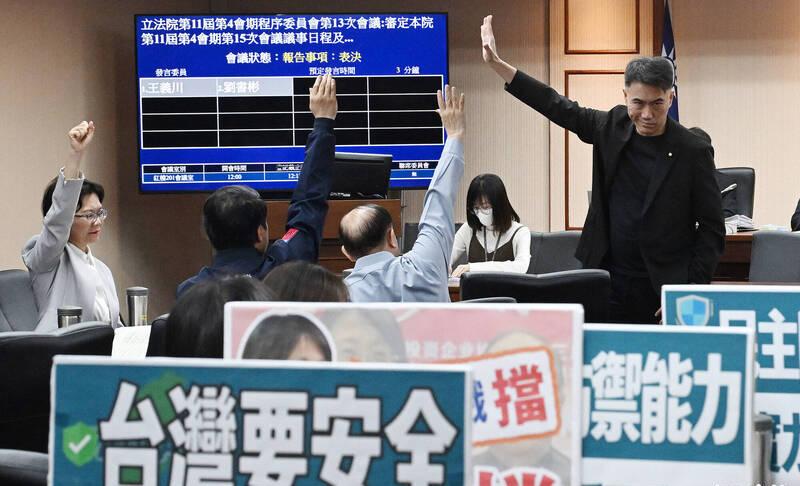
Photo: Liao Chen-hui, Taipei Times
The Executive Yuan on Nov. 27 passed the draft act for the budget, which would be spent over eight years from next year through 2033.
During today’s meeting of the Legislative Yuan’s Procedure Committee, nine members voted in favor of putting the bill on the agenda, while nine members and KMT Legislator Weng Hsiao-ling (翁曉玲), who chairs the committee, voted against doing so.
The KMT claims it wants to strengthen Taiwan’s national defense, but in practice it is unwilling to even allow the budget onto the agenda, Democratic Progressive Party (DPP) Legislator Wang Yi-chuan (王義川) said, adding that the budget being blocked was “laughable.”
KMT Legislator Lo Chih-chiang (羅智強) said that Lai was the one stalling the process, as he proposed the special budget but has not appeared before the legislature to present it or answer questions.
The KMT and the TPP deliberately disregard basic legislative procedure, DPP spokeswoman Han Ying (韓瑩) said in a statement.
The KMT is “taking orders from the Chinese government,” as Weng yesterday admitted that she had contacted officials from China’s Taiwan Affairs Office during a recent trip to China and openly declared that she would block the special defense budget, Han said.
The KMT has refused to acknowledge public support for improving national defense and turned its back on Taiwanese, she said.
According to legislative procedure, bills and budget proposals must first pass the Procedure Committee and then be referred to a committee before they can be explained and substantively debated, she said.
“Now they are not even allowing the bill to enter discussion at all,” she said. “This is opposition for the sake of opposition, with no sincerity whatsoever.”
The public does not support spending additional funds on weapons purchases, Weng said, adding that the budget would be an unbearable burden on the nation’s finances.
Apart from the special defense budget, several other amendments were also shelved from the agenda for plenary sessions scheduled from Friday through Tuesday next week.
They include DPP lawmakers’ proposals to amend the Act Governing Relations Between the People of the Taiwan Area and the Mainland Area (臺灣地區與大陸地區人民關係條例) and the Act Governing Relations with Hong Kong and Macau (香港澳門關係條例) to regulate legislators’ trips to China, as well as the Executive Yuan’s proposed amendments to the Act Governing the Allocation of Government Revenues and Expenditures (財政收支劃分法).
Additional reporting by Lin Hsin-han

NATIONAL SECURITY: Authorities are working to confirm the identities of the military personnel involved and investigating possible illegal conduct and regulatory violations Authorities are probing possible national security implications after Kinmen police and immigration officers on Sunday found a Chinese woman allegedly posing as a tourist while engaging in prostitution involving more than 10 military personnel. The woman, surnamed Chen (陳), has since been deported, authorities said, adding that investigators are still working to confirm the identities of those implicated, as the records only listed code names and aliases. The case stemmed from a report received by the Kinmen District Prosecutors’ Office on Friday last week from the Jinhu Precinct of the Kinmen County Police Bureau. On Sunday, police, along with the National Immigration

GLOBALGIVING: ‘ Caving to external pressure is not acceptable for an organization that has cultivated justice reform and human rights for 30 years,’ one NGO said A slew of non-government organizations (NGOs) have withdrawn from the GlobalGiving fundraising platform after it announced it would use “Chinese Taipei” instead of “Taiwan” from next month. The Taiwan Good Rice Association wrote on Facebook on Friday that it was informed on April 28 via a teleconference call of the change, which was made because the platform wanted to operate in China. Taiwan Good Rice is to terminate all cooperative relationships with GlobalGiving in response to the platform’s “unilateral and non-negotiable” decision to remove references to Taiwan, the NGO said. “Taiwan is in the official name of Taiwan Good Rice Association and the

HEAVY WEATHER: Typhoon Jangmi is due to crash straight into the Ryukyus as airlines look to shift flights to larger aircraft or cancel flights to Okinawa entirely Taiwan’s international air carriers announced flight adjustments over the weekend as Typhoon Jangmi is forecast to hit the Ryukyu Islands today and tomorrow. The Central Weather Administration (CWA) upgraded Jangmi from a tropical storm to a typhoon at 8am yesterday, with the eye located 580km south of Naha city. It was moving north at 19kph. Today, China Airlines’ CI-120, CI-121, CI-122 and CI-123 flights between Taoyuan and Naha, Okinawa, have been canceled as well as CI-132 and CI-133 between Kaohsiung and Naha. EVA Air’s BR-112, BR-113, BR-186 and BR-185 flights between Taoyuan and Naha are also canceled. Low-cost carrier Tigerair Taiwan canceled IT-230,

Chinese Nationalist Party (KMT) Chairwoman Cheng Li-wun (鄭麗文) yesterday briefed her party’s Central Standing Committee regarding her scheduled visit to the US between Monday next week and June 16, saying that her purpose would be to persuade the US that the Republic of China (ROC) Constitution was a “one China” constitution that would foster stable and peaceful cross-strait relations. The ROC Constitution is the most important defense for all Taiwanese citizens, as it upholds our democracy and has contributed to our robust economy, which aligns with international and US interests, she said. “We would not be troublemakers and drag the US under,”


 RSS
RSS