


More than half of people disapprove of opposition lawmakers stalling review of the government’s proposed special defense budget, a poll found yesterday.
Last month, President William Lai (賴清德) proposed a NT$1.25 trillion (US$39.7 billion) special defense budget to be spent over the next eight years.
The Chinese Nationalist Party (KMT) and Taiwan People’s Party (TPP), using their combined legislative majority, have twice declined to schedule the bill for discussion.
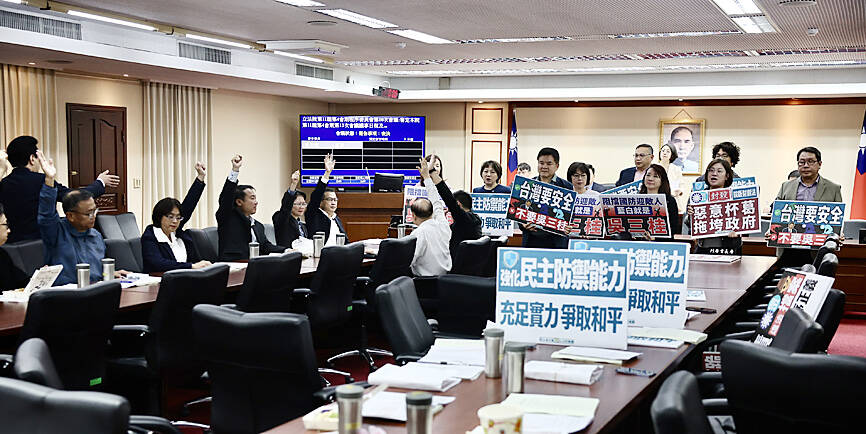
Photo: CNA
The KMT said the Cabinet’s plan lacks transparency, includes unproven weapons systems and items without strategic validation and risks wasteful spending.
The TPP added that Lai should honor his campaign pledge to brief lawmakers on national security, cross-strait developments, US arms purchases and defense budget planning before any review of the special budget
KMT Legislator Weng Hsiao-ling (翁曉玲) yesterday said the legislative Procedure Committee when it meets today would not place the bill on the schedule, saying the opposition would continue to refuse until Lai clearly explains the budget plan.
In a poll conducted by the Taiwanese Public Opinion Foundation, 53.7 percent of respondents said they disapproved of the
opposition parties blocking review of the budget, while 30.2 percent approved.
Even when controlling for age or education level, the majority of people in each group disapproved of the opposition’s stalling, the foundation said.
The results show a significant majority of Taiwanese are concerned about the Chinese military threat and are unhappy that the budget is not being discussed in the legislature, it said.
Among KMT supporters, 52 percent approved of holding up the budget, while 33 percent disapproved, it said.
Among TPP supporters, 59 percent approved while 29 percent disapproved, showing that even among supporters of the opposition, a significant number would like to see the special defense budget be discussed, the foundation said.
In the same poll, 57.6 percent of respondents said they appreciated Japanese Prime Minister Sanae Takaichi’s comment last month that an attack on Taiwan might constitute a “survival-threatening situation” for Japan, which has sparked an ongoing diplomatic spat with Beijing, the poll found.
Only 15.8 percent said they did not appreciate the comment.
People were divided in their response by party affiliation, with most Democratic Progressive Party (DPP) and TPP supporters saying they appreciated Takaichi’s comment, while most KMT supporters were negative or ambivalent.
In the poll, 89 percent of DPP supporters and 42 percent of TPP supporters appreciated her comments to only 0.7 percent and 24 percent respectively who did not.
However, 33 percent of KMT supporters appreciated the comments, compared with 34 percent who did not.
Among neutral voters, the figures were 39 percent appreciating to 20 percent who did not appreciate the comments.
The survey was conducted from Monday to Wednesday last week, collecting 1,077 valid responses from adults aged 20 or older.
About 70 percent were contacted by landline, while the remainder responded by cellphone.
The poll had a margin of error of 2.99 percentage points and confidence level of 95 percent, weighted based on the latest government population data.
Additional reporting by Lin Hsin-han

FUKUOKA SITUATION: Japanese media reported that the pathogen is expected to be identified by the summer, while the CDC downplayed the idea that it was hMPV A “mysterious cold-like illness” reported in Japan’s Fukuoka Prefecture does not seem to be a new disease, but Japanese authorities have been asked about the situation, the Centers for Disease Control (CDC) said yesterday. The Fukuoka Prefectural Medical Association on Wednesday told a news conference that a “mystery cold” that has become a hot topic on social media is “highly likely to be caused by some kind of viral infection,” Japan’s KBC News reported. “Many people are experiencing symptoms starting with a sore throat, followed by a runny nose, phlegm and a severe cough,” KBC News reported, citing association officials. Health authorities are

Nvidia Corp CEO Jensen Huang (黃仁勳) arrived in Taiwan yesterday ahead of upcoming AI and technology events, saying he plans to meet with clients and Taiwan Semiconductor Manufacturing Co Chairman C.C. Wei (魏哲家) during his visit. After landing at Taipei Songshan Airport, Huang posed for photos with fans and handed out Yakult drinks to reporters and supporters waiting at the scene, saying he has “a lot to do” during the trip. Asked about reports that Nvidia’s planned headquarters site in Taipei’s Beitou Shilin Technology Park could break ground on May 27, Huang said that if the company holds an event, he would

The Ministry of Finance this afternoon announced the winning numbers for the March-April uniform invoice lottery. The winning number for the NT$10 million (US$318,060) special prize is 19531471, and the winning number for the NT$2 million grand prize is 85941329. Three numbers were drawn for the NT$200,000 first prize: 07225810, 20231230 and 83518781. Those with receipts matching the last seven digits of any of the first-prize numbers will win the NT$40,000 second prize, while those matching the last six digits will win the NT$10,000 third prize. Those whose receipts match the last five digits of the first-prize numbers can claim the NT$4,000 fourth prize,

SIX SUBSIDIES: The monthly allowance for older farmers is to increase to NT$10,000, and NT$5,000 is to be given to homemakers under the national pension system, Lai said The government is to implement major welfare policies for disadvantaged groups, including raising the monthly allowance for older farmers to NT$10,000 and providing homemakers with NT$5,000 per month, President William Lai (賴清德) said yesterday. Lai made the remarks during a visit to Wangling Temple in Chiayi County, saying that the planned increases were being introduced amid economic growth and an increase in tax revenue. Touting a policy, in which the government plans to provide a monthly allowance of NT$5,000 for every child under the age of 18 in a bid to address Taiwan’s low birthrate, Lai said that if received for the


 RSS
RSS