


A senior military official said the US government has pledged to sell Taiwan 120 M109A7 Paladin self-propelled howitzers, adding that the sale of 60 artillery units announced last week represent the first phase delivery.
The US government on Wednesday last week announced the potential sale of eight arms packages to Taiwan, including HIMARS, anti-tank missiles and drones, at an estimated cost of US$11.1 billion.
It was the second round of arms sales to Taiwan during US President Donald Trump’s second term. Last week’s package is larger than the first one.
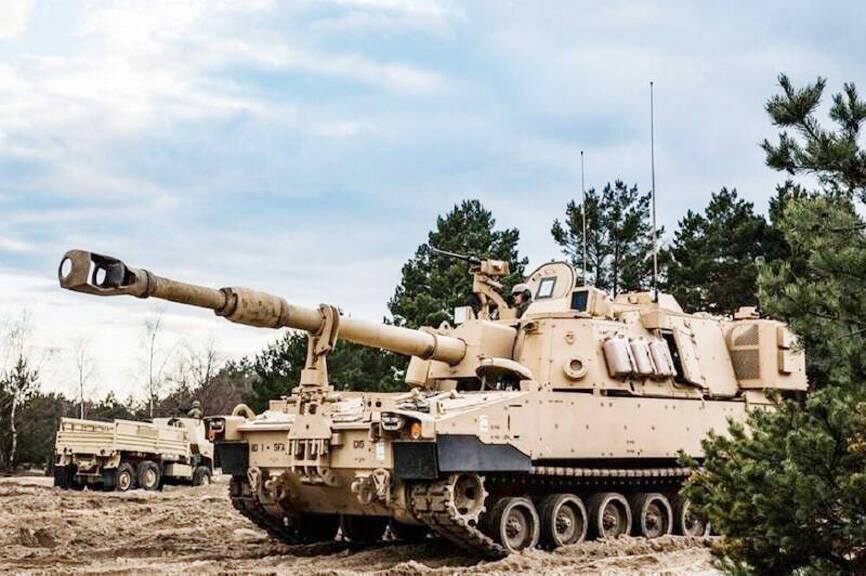
Photo taken from the US Department of War
The package contains 82 High Mobility Artillery Rocket Systems (HIMARS), 420 Army Tactical Missile Systems (ATACMS), 60 M109A7 howitzers, 60 tracked ammunition carrier vehicles, 1,050 FGM-148 Javelin anti-tank missiles and related equipment, 1,545 tube-launched, optically tracked, wire-guided (TOW) missiles and Anduril ALTIUS-700M kamikaze drones.
Five of the eight arms packages — the M109 howitzers, HIMARS, TOW guided anti-tank missiles, anti-armor drones and Javelin anti-tank missiles — are covered in an NT$1.25 trillion (US$39.7 billion) special defense budget put forth last month by the government, pending lawmakers’ review.
A senior military official on Saturday said the first batch of 60 howitzers, valued at about US$4 billion, would be purchased using the NT$1.25 trillion special defense budget, with delivery for the first batch scheduled within five to eight years.
The second batch as well as supplemental equipment would be paid by the annual defense budget of the Ministry of National Defense, the anonymous official said, spreading funding across several fiscal years.
Taiwan is reported to have reduced the number of M109A7 howitzers requested to 120 from 168 out of concern that the delivery of the weapons might not be completed within the execution timeline for the special budget. The howitzers would be delivered to Taiwan in two phases.
The accompanying support equipment includes 60 M992A3 field artillery ammunition resupply vehicles, 13 M88A2 armored recovery vehicles, 42 sets of the International Field Artillery Tactical Data System and 4,080 Precision Guidance Kits (PGK).
The M109A7 is equipped with a 155mm main gun, with a maximum firing range of up to 30km, which can be extended to 40km when firing M982 Excalibur precision-
guided artillery rounds. The howitzer fills the coverage gap between the HIMARS — whose rockets have ranges of 42km to 70km and whose ATACMS can reach up to 300km — and conventional artillery, which typically has a range of 20km to 30km. The M109A7 can significantly enhance Taiwan’s defensive operations and layered deterrence capabilities, the official said.
The M109A7 is the latest variant in the M109 family of self-propelled howitzers. Its most significant difference from the A6 version lies in its adoption of the chassis, engine, transmission and track system of the M2 Bradley infantry fighting vehicle, simplifying maintenance and parts interoperability.
The M109A7 has a digital fire-control system, GPS and digital navigation systems, a tactical data link and an onboard diagnostic computer with self-monitoring capabilities. While the currently deployed M109A5 requires a six-person crew, the M109A7 operates with a crew of only four.
The PGK is standard equipment currently in service with the US Army’s artillery batteries. The kit consists primarily of a fuze assembly, four stabilization fins and a GPS guidance antenna.
When integrated with artillery rounds such as M549A1 and M795 high-explosive rounds, the PGK enables the M109A7 to conduct precision strikes, allowing the projectile to correct its trajectory midflight in order to precisely
engage and destroy enemy targets.

NATIONAL SECURITY: Authorities are working to confirm the identities of the military personnel involved and investigating possible illegal conduct and regulatory violations Authorities are probing possible national security implications after Kinmen police and immigration officers on Sunday found a Chinese woman allegedly posing as a tourist while engaging in prostitution involving more than 10 military personnel. The woman, surnamed Chen (陳), has since been deported, authorities said, adding that investigators are still working to confirm the identities of those implicated, as the records only listed code names and aliases. The case stemmed from a report received by the Kinmen District Prosecutors’ Office on Friday last week from the Jinhu Precinct of the Kinmen County Police Bureau. On Sunday, police, along with the National Immigration

GLOBALGIVING: ‘ Caving to external pressure is not acceptable for an organization that has cultivated justice reform and human rights for 30 years,’ one NGO said A slew of non-government organizations (NGOs) have withdrawn from the GlobalGiving fundraising platform after it announced it would use “Chinese Taipei” instead of “Taiwan” from next month. The Taiwan Good Rice Association wrote on Facebook on Friday that it was informed on April 28 via a teleconference call of the change, which was made because the platform wanted to operate in China. Taiwan Good Rice is to terminate all cooperative relationships with GlobalGiving in response to the platform’s “unilateral and non-negotiable” decision to remove references to Taiwan, the NGO said. “Taiwan is in the official name of Taiwan Good Rice Association and the

HEAVY WEATHER: Typhoon Jangmi is due to crash straight into the Ryukyus as airlines look to shift flights to larger aircraft or cancel flights to Okinawa entirely Taiwan’s international air carriers announced flight adjustments over the weekend as Typhoon Jangmi is forecast to hit the Ryukyu Islands today and tomorrow. The Central Weather Administration (CWA) upgraded Jangmi from a tropical storm to a typhoon at 8am yesterday, with the eye located 580km south of Naha city. It was moving north at 19kph. Today, China Airlines’ CI-120, CI-121, CI-122 and CI-123 flights between Taoyuan and Naha, Okinawa, have been canceled as well as CI-132 and CI-133 between Kaohsiung and Naha. EVA Air’s BR-112, BR-113, BR-186 and BR-185 flights between Taoyuan and Naha are also canceled. Low-cost carrier Tigerair Taiwan canceled IT-230,

MULTIPRONGED APPROACH: China has sought to pressure Palau across a number of fronts, but the island nation has staunchly resisted overtures to ditch Taiwan Palau has been firm in backing Taiwan despite Chinese pressure that uses tourism economics, cyberattacks and criminal infiltration as tools to threaten the Pacific ally into renouncing its recognition of Taiwan as a sovereign state. The Presidential Office yesterday announced that Vice President Hsiao Bi-khim (蕭美琴) would visit Palau from Saturday to Wednesday next week at the invitation of Palauan President Surangel Whipps Jr. Whipps in April said in an interview that China had outspokenly asked Palau to “denounce Taiwan.” “And we have said: ‘We have no enemies, but nobody tells us who our friends are,’” he said. Whipps has told reporters multiple times


 RSS
RSS